Thursday, March 12, 2015

March 18--St. Cyril of Jerusalem, Bishop and Doctor of the Church


"Is Jesus God or man?  Is he more God than man or more man than God?  Is he something else, and if so, what?"  These may seem to be odd questions for us today, but they were matters of extreme importance in the fourth and fifth centuries when our saint was alive.  St. Cyril of Jerusalem was the bishop of Jerusalem during the time of the Arian heresy.  A heresy is a false teaching that goes against the orthodox teaching of the Church.  The problem was that this heresy was supported by some bishops!  It taught that since there is only one God (true) then Jesus can't be God (false) since that would mean that there would be two gods (also false).  It was an enticing belief but it went against the Scriptures, Tradition, and the consistent teaching of the Magisterium.

So what was St. Cyril's role?  Since one of the bishops who consecrated him was Arian, it may have been "supposed" that he would support the Arians.  But it was not true!  He had a conflict with that same bishop and was exiled from Jerusalem.  He persevered and was later cleared.  He went to a council in 381and supported the use of the word "consubstantial" as applying to the Father and the Son reaffirming that there is only ONE God.

Sometimes we have difficulty with the Church, her teachings, and/or her leaders, priests, bishops, sisters, religion teachers, etc.  The Church is a divine institution, but it is also a human one as well.  Her members do sin and bring scandal to her.  The Holy Spirit has guaranteed us that the Church will never err in matters of faith and doctrine, but not necessarily about "policy" or the proper implementation of that policy or on the holiness or politeness or manners of her leaders.  We need to recognize our fallen human nature even as we strive to do God's will.  As St. Cyril persevered, we need to persevere in prayer for our leaders that they may do God's will in the best way possible.

March 9--St. Dominic Savio, Holy Man


To call St. Dominic Savio a holy man is a bit of a stretch.  He was only 14, or about the age of a freshman in high school, when he died from a lung problem in 1857.  Fourteen and yet he was a saint of God, living a holy life among boys his own age.  He started following St. John Bosco at the age of twelve.  He was known as a peacemaker and he impressed St. John Bosco with his desire to become a priest.  He even founded a group called the Company of the Immaculate Conception which was dedicated to prayer and work.  He did not accomplish great feats, but he knew how to pray and love.

Can a junior high or high school student be a saint?  Why not?  We are all called to holiness at every age of our lives.  Children and youths have a natural turn to idealism.  They are looking for something and someone to which they can dedicate themselves.  That something is love and that someone is Jesus!  Adults need to foster the innate desires of holiness and restrain the concupiscence of pre-teens and teens.  They need role models of goodness, holiness, kindness, self-discipline, firmness of purpose, loyalty, friendship, generosity, forgiveness, and love to help them to grow to become the saints that God has called them to be.  We also need to let them be role models to adults, as St. Dominic Savio is.

March 2--St. Agnes of Bohemia, Religious


What is it like to be desired by many people?  Movie stars, models, and celebrities get a lot of fan mail and even some marriage offers!  Our saint was greatly desired as a marriage partner by kings and an emperor in Europe.  She was the daughter of the King and Queen of Bohemia, which made her desirable for political alliances.  She was betrothed to the Duke of Silesia at the age of three, but he died soon after.  Then King Henry VII of Germany, King Henry III of England, and Emperor Frederick II of the Holy Roman Empire all wanted to marry her.  Such choices!  She only wanted to serve God in the religious life and the pope sided with her.  She eventually became a Poor Clare nun and devoted 45 years of her life in seclusion in the monastery where she lived in prayer and obedience until  her death in 1282.  

Where is God calling us to serve him?  Marriage?  We need happy and holy husbands/fathers and wives/mothers to be signs of God's love for the Church and to bring new life into the Church.  The single life? We need people to dedicate themselves to service of others.  The religious life? We need men and women to take vows of poverty, chastity, and obedience living out their special charism, or gift.  It may be like St. Agnes in joining the Poor Clares who pray constantly, or to the Notre Dame Sisters who serve through education and social justice, or to the Jesuits who teach and do missionary work.  God desires us to be in every nook and cranny of society.  Pray to know your vocation as did St. Agnes of Bohemia.

February 17--Seven Founders of the Servite Order


"News Flash:  Warren Buffett and Bill Gates have just converted to Catholicism, left all their money to charity, and have moved to Montana to live a life of prayer and service to God.  Film at eleven."  That would be quite a story!  It was quite a story when seven wealthy nobleman of the city of Florence, Italy did just that in 1240.  They were already Catholic, but there was a major heresy in Florence that led people away from the faith.  These seven men wanted to live in penance and prayer.

The Servite Order is a combination of monastic life, which is one of prayer and work and silence, and the active ministry, which is one of going out into the community to serve and teach and minister to the needs of the people.  We need both prayer and silence in our lives along with service and ministry.  There is a balance we can achieve by focusing on God and what he calls us to do.  We need to take time to build our relationship with God through prayer.  That may be five minutes or an hour a day depending on our schedule, but also depending on the need to be closer to God.  We need to serve others, whether it be in our church or community or workplace.  This service needs to be an "extra", more than what we are used to.

The seven founders of the Servite Order made a radical choice to pray and serve.  We are called to make a radical choice to pray and serve.  We need to move further out of our comfort zone to follow God.

Wednesday, February 4, 2015

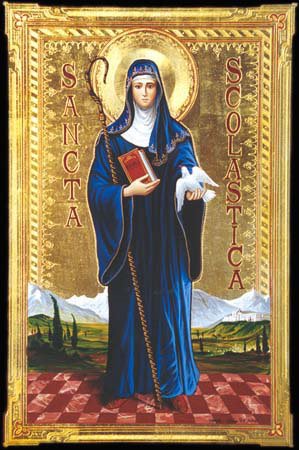
February 10--St. Scholastica, Virgin


Saints have families; fathers, mothers, sisters, brothers.  Many times saints come from holy families.  The same is true for today's saint, Saint Scholastica.  Her twin brother was St. Benedict of Nursia, the founder of the Benedictine religious order.  To have such a famous brother might be a burden for some, but St. Scholastica was famous in her own right as a founder of a religious order of women and thus she is the patron saint of nuns.

St. Scholastica's community was five milesa away from Monte Cassino, the famous first monastery of the Benedictines that St. Benedict founded.  They would meet once a year to pray and talk with one another about spiritual matters.  The last time that they met, St. Scholastica requested her brother to stay longer, but he wanted to get back to his monastery.  She then prayed for a miracle to allow her to be with her brother and a thunderstorm broke out, keeping him there.  He was troubled and said to her, "'God forgive you, what have you done?'  She answered him, 'I desired you to stay, and you would not hear me; I have desired it of our good Lord, and he has granted my petition.'"  Three days later she died and St. Benedict saw her soul ascend to heaven in the form of a dove.

Our families are where we first learn of God and his love for us.  We help each other to grow closer to God by being loving fathers, mothers, sisters, brothers, and so forth.  May all that we do for our families be done according to God's will with God's love, as St. Scholastica did and would have us do.

February 2--The Presentation of the Lord


February 2 is the feast of the sacred groundhog, whose sacred home is in Punxsutawney, Pennsylvania.  Every year on this day we celebrate the possibility of the coming of glorious spring or the continuation of the gloomy winter for six more weeks.  NOT LIKELY!  Catholics do not celebrate the winter musings of a large rodent.  We celebrate the Presentation of the Lord in the Temple.  Mary and Joseph came to Jerusalem for the ritual purification of Mary and for the presentation of Jesus, both in accordance with the Jewish Law.

But more than that, it is at this event that we have two testimonies to Jesus' future sacrifice.  Simeon and Anna were witnesses to the promise of God's salvation and rejoiced:  Simeon, who was promised that he would not see death until he saw the Lord, through his song, "Now, Master, you may let your servant go in peace, according to your word, for my eyes have seen your salvation, which you have prepared in sight of all the peoples, a light for revelation to the Gentiles, and glory for your people Israel" (Lk. 2:29-32); and the prophetess Anna, who "gave thanks to God and spoke about the child to all who were awaiting the redemption of Jerusalem" (Lk. 2:38).

The "glorious spring" that we await is the celebration of Easter; the "gloomy winter" we joyfully endure is the season of Lent, which prepares us for Easter.  There is no downside to either event.  It is not about the vision of the groundhog which guides us, but the vision of Simeon and Anna, who, in their joy, prepares us for the joy of the redemption of all humanity.  Groundhog--no, Jesus--Yes.

January 26--Sts. Timothy and Titus, Bishops


We know of Sts. Timothy and Titus from Paul's letters of the same name.  We know that they were companions of Paul on his missionary journeys.  We call them bishops because Paul appointed them to be in charge of communities of believers in Ephesus and Crete respectively as overseers, to maintain and teach the faith, to worship and celebrate the sacraments, and to guide the people in the right way of living.  Because Paul appointed them, they were able to continue to spread the faith.  As bishops they were successors to the first apostles.

One reason we believe what we believe is because of apostolic succession, bishops succeeding each other all the way back to the first twelve apostles.  Our bishops maintain the same role in the Church as did those first twelve.  They are called to witness to the truth of the love of Jesus for us, to spread the Good News of salvation to all the world, to serve the people under their care.

Paul writes in his second letter to Timothy:  "I remind you to stir into flame the gift of God that you have...."  In his letter to Titus, Paul writes:  "I left you in Crete so that you might set right what remains to be done ...."  Timothy and Titus had the privilege of knowing Paul, who knew Jesus.  Our bishops knew the bishops who ordained them and so on.  We have the surety, through the apostolic succession, that our bishops are guiding us to God.