Monday, June 8, 2015

May 3--Sts. Philip and James, Apostles


So you know the names of all the apostles.  Okay, who was St. Philip and what did he do?  How about St. James the Less?  We know about these two only because they are mentioned in the Gospels as two of the twelve apostles.  We know that Philip was from the same town as Peter and Andrew and that he brought Nathanael to Jesus, but other than that we have only a few stories about Philip; one when Jesus asked him where they should buy enough food to feed the 5000.  Philip responded, "Two hundred days' wages worth of food would not be enough for each of them to have a little [bit]" (Jn 6:7).  This would seem to indicate that Philip had some knowledge of logistics and supplies.  Beyond those few stories, we have from legend that he was stoned to death after preaching the Gospel.  

Of St. James, son of Alphaeus, also known as James the Less to distinguish him from James, the brother of John, we only know his name and the fact that he was an apostle.  That's it!  However as an apostle, he was chosen by Jesus to go forth and spread the Good News.  His anonymity did not prevent him from doing God's will once he was filled with the Holy Spirit.  According to legend, he also died a martyr's death.

What can we learn from these two apostles?  Don't worry about fame.  Don't worry about prestige.  Don't worry about worldly success.  Be faithful to the mission that we have been given.  Be faithful to our calling as disciples.  Be faithful to our faith.  Sts. Philip and James, pray for us.

Sunday, June 7, 2015

April 29--St. Catherine of Siena, Virgin and Doctor of the Church


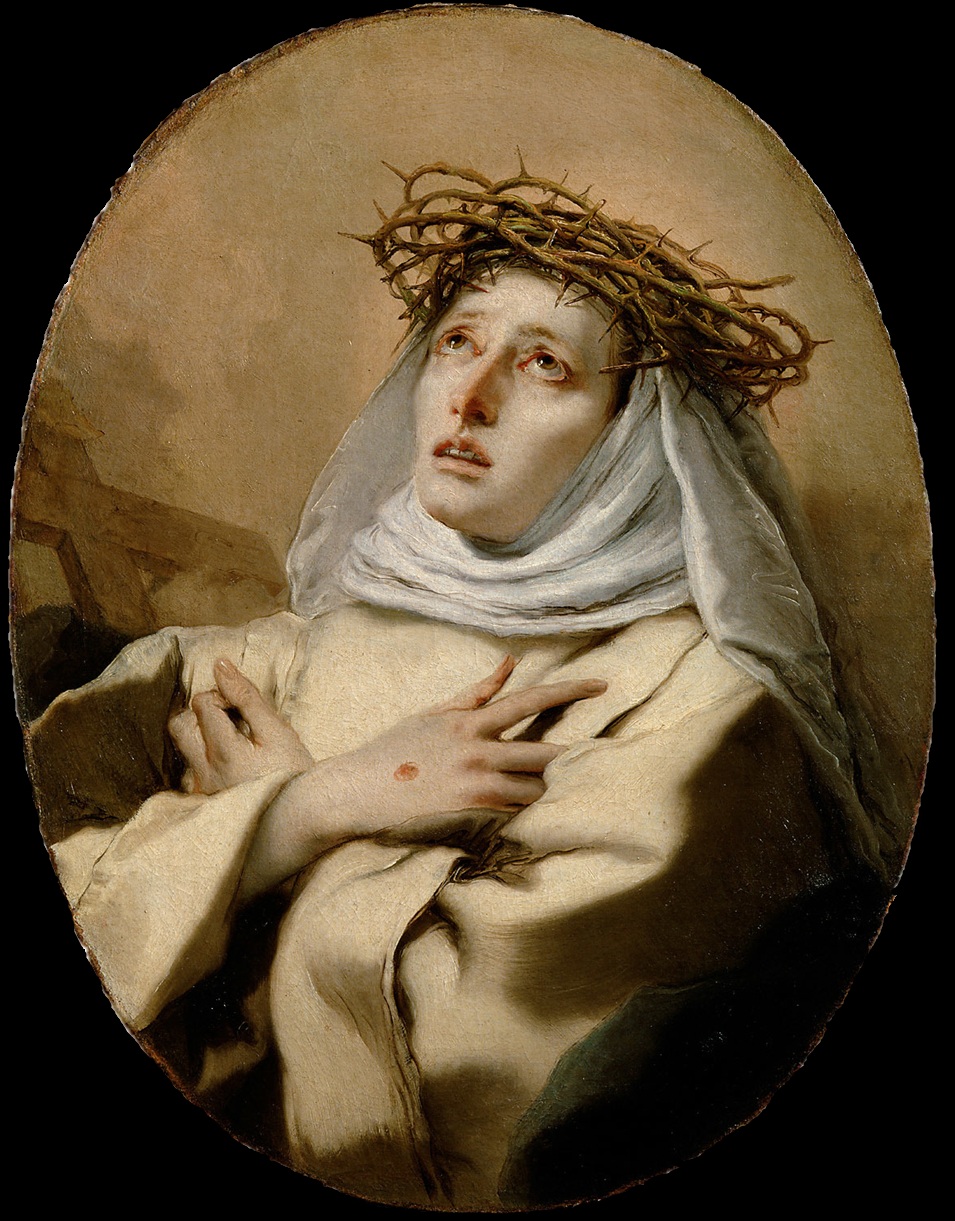
Mystic, mediator, counselor to popes, Doctor of the Church, third order Dominican, virgin, stigmatist, saint--St. Catherine of Siena had quite a resume!  She dedicated herself to God through the Dominican order as a lay member.  She was not a cloistered nun and could travel.  That was helpful, because as she became known as a holy woman, she gathered disciples and went around Italy to help resolve conflicts.  She was also sent to Avignon, France to convince the pope to return to Rome after the papacy was away for almost 70 years.  She received the stigmata, which are the wounds similar to Christ's wounds from the cross, but they were hidden from view.  

As a Doctor of the Church, St. Catherine is known for her book, The Dialogues, which came to her in a vision. In that vision God spoke to her about prayer and the importance of love and the necessity of charity and the joy of the Eucharist and how we can resist temptation.  She is one of 36 Doctors of the Church, four of whom are women.

St. Catherine's way of dealing with people was both blunt and sophisticated.  She would let popes know what she believed to be God's way and would challenge them to follow it.  But she also prayed extensively and advised people on how they could lead holy lives.  We need to adapt Jesus' message of love to those whom we are witnessing.  We may need to be forthright in some situations and subtle in others.  Prudential judgment needs to guide us to be the best fishers of men.  St. Catherine of Siena, pray for us.

April 25--St. Mark, Evangelist


Even though Mark's Gospel is second in Scripture, it was actually the first one written.  It is also the shortest Gospel and the one that is jam-packed with excitement and miracles.  Mark wrote for the Christians in Rome who were being persecuted about the time of Peter and Paul's martyrdom, so the emphasis in Mark's Gospel is one of Jesus suffering.

What we know about Mark comes to us mainly from Scripture.  He went on the first missionary journey with Paul and Barnabas, but had a falling out with Paul because Paul did not accept him on the second journey.  However, they did reconcile.  We also know that Mark's family was important in the early Church.  When Peter miraculously escaped from prison he went to the home of Mark's mother.  Some speculate that he was the young boy who escaped when Jesus was arrested.  According to legend he became the companion of Peter, from whom he received the Gospel.  He also became the bishop of Alexandria.  His relics were eventually taken to Venice and interred within the Basilica of St. Mark.

St. Mark shares with us the message of Jesus:  “This is the time of fulfillment. The kingdom of God is at hand. Repent, and believe in the gospel" (Mk. 1:15).  We are called to constant repentance, to turn our lives over every day to God and believe in the message of God's love for us.  Every day is a new opportunity to bring about the kingdom of God by being a true disciple of Jesus:  We hear the Word of God; we accept the Word of God; we spread the Word of God.  Go forth and share God's love with all you meet.  Mark did through his Gospel.

April 15, Blessed Cesar de Bus, Priest


How do we raise our children?  Do we teach them right from wrong?  Do we teach them the sacraments and the faith?  Do we help them to grow into productive citizens of our country as well as responsible members of the local community and faithful members of the Church?  Well of course we do!  That is what today’s saint, Bl. Cesar de Bus, dedicated his life to, the teaching of the faith in the family setting.  Bl. Cesar was a young man dedicated originally to the court and the army in France in the late 16th century.  After he saw the realities of battle he decided to become a priest.  As a priest he spent his life teaching the faith to families in rural areas.  He developed a program to help families share the faith with their children.  He gathered others to help him and founded the Fathers of Christian Doctrine.

Parents are the first teachers of their children.  It is one of their foremost responsibilities.  The Church helps parents with schools and parish religious education programs, but nothing can take away the special witness that parents provide.  We can teach our children in small ways and great.  We can pray before and after meals and at bedtime.  We can pray the rosary.  We can take our children to Mass.  We can address issues raised in the news by providing a faith note.  We can also live our faith.  We can love our spouses.  We can do our daily chores without grumbling.  We can live as Jesus did in the Holy Family with love, respect, and care for one another.  Bl. Cesar de Bus is guiding us in our efforts.

Monday, March 30, 2015

April 11--St. Stanislaus, Bishop and Martyr


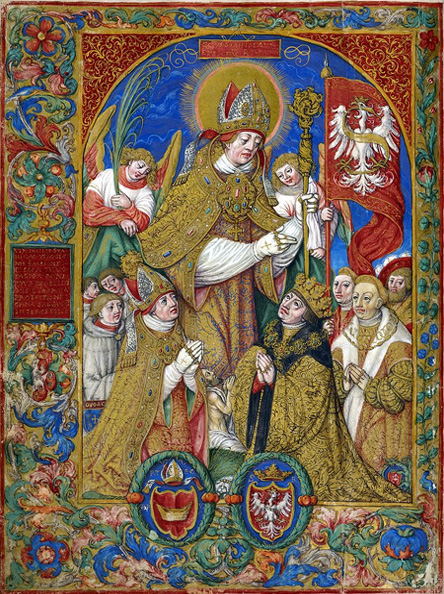
"Religious freedom is the first freedom."  The first amendment to the constitution affirms freedom of religion, not just freedom of "worship", by stating that "Congress shall make no law respecting an establishment of religion or prohibiting the free exercise thereof."  Our saint would surely understand that!  St. Stanislaus became bishop of Kraków in 1072, a time when the Church was reforming itself, especially against the interference of the state.  It is always the Church's duty to speak out against evil and immorality.  St. Stanislas spoke out against the unjust wars and immorality of the Polish king, Boleslaus II.  King Boleslaus repented, but reversed himself and eventually St. Stanislas excommunicated him.  Boleslaus was infuriated enough to kill St. Stanislaus with his bare hands!

We are not in danger of martyrdom for following Church teaching today in America.  But there have been efforts at curtailing our freedoms little by little.  The current administration tried to define who was a minister in a religious school, but was defeated in a unanimous decision by the Supreme Court.  The administration also tried to force companies to go against their religious beliefs by requiring them to provide certain contraceptives in their health plans.  This attempt was also defeated in a 5-4 Supreme Court decision in 2014.  There are other situations that threaten our freedom.  As Catholics, we need to stand up against immorality and injustice wherever we see it.  Freedom is not free.  We must remain vigilant.  Freedom of religion is more than the right to worship.  It means the right to practice our faith in the public arena.  St. Stanislaus would approve.

April 1--St. Hugh of Grenoble, Bishop


Our saint today was the worst man for the job, or so he thought.  He was overwhelmed by the problems that beset him and the Church at the time:  priests violating their vows of celibacy, the state telling the Church what to do, people buying influence and positions in the Church, people not caring about their faith or ignorant of what their faith mean, corruption all over!  Sound familiar?  St. Hugh was so upset at these difficulties that he left his position as bishop and tried to become a monk.  However, he was found and the pope exhorted him to return to the vocation that God had called him.  St. Hugh then came back and redoubled his efforts.  He was a good reformer and he stood up for the faith of the Church against civil authorities, supporting the pope and encouraging people through his preaching.  He died in 1132 and was canonized two years later.  Not bad for a man who thought he couldn't handle the job.

Sometimes we are overwhelmed by the difficulties of the world around us.  We see Christians not living their faith, the state interfering in the duties of the Church, sin in our priests, and complacency.  What do we do?  Do we try to hide in a monastery as St. Hugh did?  Do we hide in other ways:  in our jobs, in ourselves, in addictions?  God has not called us to be successful; he has called us to be faithful, as Mother Teresa reminds us.  We need to witness to our faith and have faith in divine providence.  As we prepare for the Easter Triduum we need to keep in mind that the war against evil has already been won by the cross of Christ.

March 24--St. Catherine of Genoa, Holy Woman

Confession is good for the soul!  This is absolutely true and today's saint demonstrates even more the benefits and power of the confessional.  St. Catherine of Genoa married at the age of 16 and spent ten years in a difficult marriage.  One day she went to confession and experience God's love for her.  This led her to receiving communion daily, which was extremely rare in those days, and service in a hospital.  Her husband, being changed from his ways, joined her in serving in the hospital.  Because his spending had left them without money, they lived and served together in the hospital for another 24 years until he died.  He had become a third order Franciscan.  She continued to serve there until her death in 1510.

It was confession that turned St. Catherine's life around.  During Lent it is good for us to remember that Jesus is calling us to repentance.  We may not need to turn 180 degrees to come back to Jesus, but we are always in need of metanoia, which means to change one's life.  Priests love to help penitents to amend their lives so that they may experience God's mercy.  Sometimes people are afraid of confession because it has been a long time.  Sometimes they are afraid because of what the "priest might think."  Confessors want us to be reconciled to God, others, and even ourselves.  We hear in the song "Hosea" that God is calling to us:  "Come back to me, with all your heart.  Don't let fear keep us apart.  Long have I waited for your coming home to me and living deeply our new life."  Have a soul-changing experience as St. Catherine did.