Monday, February 15, 2021

February 21--St. Peter Damian, Monk, Bishop, and Doctor of the Church

*

The Church is holy due to Jesus, not us. We are still sinners. We live in a time when some priests and bishops have committed grave public sins. In the eleventh century, there were also serious sins of sexual immorality and crimes of corruption committed by the clergy. One who championed the good and right against such deviations from chastity and holiness was our saint, St. Peter Damian.

Born about 1007 in Ravenna, Italy, Peter was the youngest of a noble, but poor family. Poorly treated by one brother, he was adopted by another brother who was archpriest of Ravenna, who provided him with an education. Peter Damian was gifted in academics and became a university teacher at the age of 25. He left teaching to become a monk. As a monk he was dedicated to austerity and penance, including the discipline of self-flagellation, which he later moderated due to the imprudent zeal of others. He then assisted the Church in opposing the sins of his time as bishop and cardinal.

He was also a great advocate of clerical reform, especially against the corruption of simony, or the buying and selling of Church offices, and clerical sexual license, including concubinage and sodomy. He wrote the book Liber Gomorrhianus, or the Book of Gomorrah, which railed against clerical sins against chastity. Pope Leo IX wrote in response to St. Peter’s work: “Therefore, lest the unrestrained license of filthy lust should spread abroad, it is necessary that it be repelled by a suitable reprimand of apostolic severity and that some attempt at more austere discipline should be made [with them].” St. Peter Damian is a model of how our priests, bishops, and laity should live the gift of chastity. He died about 1072 and was named a Doctor of the Church in 1828.

*https://www.catholic.org/files/images/saints/780.jpg

Monday, February 8, 2021

February 20--Sts. Francisco and Jacinta Marto, Holy Children


Our saints today are proof that age is no barrier to holiness. They were ten and nine when they died from the 1918 influenza pandemic. They are the youngest non-martyrs canonized. St. Jacinta and her brother St. Francisco along with their cousin Lúcia dos Santos were blessed with the apparitions of Our Lady of Fátima on the 13th of each month May through October 1917. Mary asked them to learn to read and write and to pray the rosary “to obtain peace for the world and the end of the war.” They were told to pray for sinners and the conversion of Russia. After the apparitions they practiced austere self-mortifications, such as prostrating themselves to pray for hours or kneeling with their heads on the ground.

Pope Pius XI denied their causes for sainthood because he decided that minors could not fully understand or practice heroic virtue. However, in 1979 the Bishop of Leiria-Fátima asked that the world’s bishops to petition the pope for their causes. The Congregation for the Causes of Saints decided that children could be blessed with the grace to be “spiritual prodigies.” Pope St. John Paul II declared them venerable in 1989 and blessed in 2000. Pope Francis canonized them on May 13, 2017, one hundred years after the first appearance of Mary to them.

Children are gifts from God to their parents. Parents are blessed to be able to share the faith with these new disciples in the haven of the domestic Church, the home. Children are God’s opportunities to bring parents closer to God so the children can also be closer to God. Holiness is both our calling and a grace from God. Sts. Francisco and Jacinta Marto show us that even children can know holiness. May they pray for us and our children.

*https://upload.wikimedia.org/wikipedia/commons/0/0f/ChildrensofFatima_%28croped%29.jpg   Attributed to Joshua Benoliel, Public domain, via Wikimedia Commons

Sunday, January 31, 2021

February 8--St. Josephine Bakhita, Virgin


*

Slavery has been outlawed in the United States since the 13th amendment was ratified in 1865.  It was abolished in 1888 in Brazil and in 1926 by the League of Nations.  In 1948 the United Nations General Assembly adopted the Universal Declaration of Human Rights, including the article:  "No one shall be held in slavery or servitude; slavery and the slave trade shall be prohibited in all their forms."


So what does this have to do with today's saint?  She was a slave.  Bakhita, which means "fortunate", was born about 1869 in southern Sudan, kidnapped at the age of seven, and sold several times as a slave.  In 1883 she was sold to the Italian consul in Sudan and two years later "given" to his friend from Italy.  She then became a babysitter to the friend's daughter, joining the Church in 1890, taking the name Josephine.  When the friend wanted to take his daughter and Josephine back to Africa, Josephine refused, and the case went to court.  The Patriarch of Venice and the Canossian sisters intervened and the judge concluded that since slavery was illegal in Italy, Josephine had been free since 1885!  She joined the Canossian Sisters in 1893 and remained with them as a gatekeeper for a compound that included a kindergarten, orphanage, recreational center, and school until her death in 1947.


St. Josephine Bakhita had many owners, but only one Master.  She wrote, "Seeing the sun, the moon, and the stars, I said to myself: who could be the Master of these beautiful things?  And I felt a real desire to see him, to know him and to pay him homage."  God is our master, but one who has set us completely free by saving us from sin through Jesus Christ.  We are blessed beyond all telling!

*https://nunspeak.files.wordpress.com/2010/10/bakhita-01.jpg

Monday, January 25, 2021

February 4—St. Joan of Valois, Holy Woman

*


Today's saint was, for a time, Queen of France.  However, as is the case with all saints, suffering beset her throughout her life.  Jeanne de Valois was born in 1464, the second daughter of King Louis XI of France.  She was afflicted with a physical handicap, possibly curvature of the spine, which allowed others to disparage her.  She was forced into marriage with her cousin Louis, who also treated her poorly.  Nonetheless,  when Louis was rebelling against her brother, King Charles VIII and was captured by him, Joan pleaded for his life and administered the duchy.  Eventually Duke Louis was released and became King Louis XII after the death of his brother-in-law.  One would think things would get better for Joan, but Louis wanted more territory and so appealed to the pope for an annulment from his marriage to her, citing lack of consent and her deformity as a cause for lack of consummation of the marriage.  St. Joan objected but the pope granted the annulment for political reasons.

St. Joan became the Duchess of Berry and formed a community dedicated to the Annunciation in 1500.  She and her spiritual director wrote the rule, and the community was established as a branch of the Poor Clares in 1504.  She renounced her title and possession and became a nun on Pentecost, 1504.  She died less than a year later.  The nuns still have monasteries in Europe and Costa Rica and religious sisters serve in Europe, Africa, and Guatemala.

St. Joan's treatment was unjust!  She did step aside and prayed for her husband.  St. Joan accepted her annulment ordeal in the spirit of the Annunciation, saying:  "Be it done to me and her own if so it is to be."  May we be as forgiving when mistreated!  St. Joan, pray for us.

*By Jean Perréal - http://www.anuncjatki.pl/assets/images/mniszki/jeanne.jpg, Public Domain, https://commons.wikimedia.org/w/index.php?curid=16021386


Monday, January 4, 2021

Sunday after Epiphany: The Baptism of the Lord

*

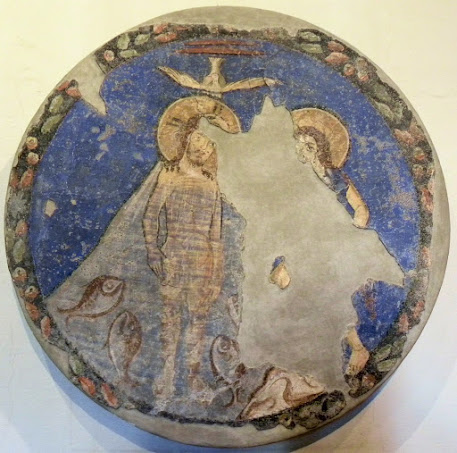
Merry Christmas!  This is the last day of the Christmas season, but it celebrates the first day of Jesus' public ministry.  Thus, the Church connects the birth of Jesus, the beginning, with the Paschal Mystery, the end!  Each Gospel has the Baptism of Jesus in it with variations.  Mark's version is the shortest with a statement of the baptism followed by a theophany, or the visible manifestation of God, with the Holy Spirit represented as a dove, and God the Father speaking from the heavens approving of God the Son.  Matthew adds John's objection to baptizing Jesus because John is not worthy.  Luke adds a historical element by naming the political leaders of the time as well as some of John's teachings.  The Gospel of John has John the Baptist giving testimony to Jesus' Baptism as though he were in a court of law.  He also calls Jesus the "Lamb of God, who takes away the sin of the world" (Jn. 1:29).

The Baptism of Jesus is also important for the post-Ascension Christian community when they chose a replacement for Judas:  "Therefore, it is necessary that one of the men who accompanied us the whole time the Lord Jesus came and went among us, beginning from the baptism of John until the day on which he was taken up from us, become with us a witness to his resurrection" (Acts 1:21-22).

We are baptizes so that we may fulfill the command of Jesus:  "Go, therefore, and make disciples of all nations, baptizing them in the name of the Father, and of the Son, and of the holy Spirit, teaching them to observe all that I have commanded you" (Mt. 28:19-20).  As we share in the life of Christ, we call others to share in Christ's life, his life of love. 

*https://www.flickr.com/photos/ian-w-scott/7420840650


Tuesday, December 22, 2020

January 1--Solemnity of Mary, the Mother of God

*

Merry Christmas!  The feast of Mary, Mother of God is the eighth day of the Octave of Christmas.  January 1 was originally the Feast of the Circumcision, when Jesus was given his name in the Temple, as was the custom of the Jewish people going back to Abraham.  It shows that Jesus, the Son of God, is truly, man, the New Adam, son of a woman, the New Eve.  In 1960, January 1 was simply part of the Octave of the Nativity.  But in 1969, with the revision of the Roman calendar, January 1 became the Solemnity of Mary the Mother of God.

So why all the changes and why is the feast about Mary and not Jesus?  Well, the feast IS about Jesus.  It is still the Octave of Christmas.  We celebrate Mary because she is the Mother of God!  In the fifth century a heresy was proposed that Mary was the mother of Jesus, and was the mother of the Messiah,  but NOT that she was the mother of God.  The reasoning of the heresy, Nestorianism, was that Mary could not be the mother of the God who created her.  In other words, the logic of human procreation was applied to the Incarnation of Jesus, which was NOT human procreation!  That is NOT the faith of the Church!

The Church taught that since Jesus IS truly God, the Son of God and IS truly man, the son of Mary; then Mary, his mother, IS truly the Mother of God!  The word used in Greek is Theotokos, or "God-bearer".  So, we celebrate January 1, the eighth day of the Octave of Christmas, the day on which Jesus was circumcised into the Jewish covenant, as the day of the maternity of Mary, who was the Ark of the New Covenant, the MOTHER OF GOD, JESUS!
* https://pxhere.com/en/photo/1174875  


Thursday, December 10, 2020

December 25--The Nativity of Our Lord

*
Critics of Christianity sometimes like to point out that Jesus wasn’t born on December 25, or Christmas was instituted by the Emperor Constantine, or the Christians were just using a pagan holiday called Saturnalia to lure pagans into worshiping Christ. Given that the Jewish concept of birthdays was not we have, there are reasons to think it is reasonable to use December 25. The feast of the Annunciation is March 25, which is nine months before Christmas and also held by the ancient Church as the date of Jesus’ Crucifixion and Resurrection. The first recorded Christmas celebration was in AD 336, during the reign of Constantine. And even though Saturnalia was not the basis of Christmas, Christians did take pagan holidays and Christianize them to help convert the people through their culture.

But all that, interesting as it may be, is not the point. The point is that God became man. The incarnation began at the Annunciation, but the birth of Jesus is the birth of the new era of reconciliation between God and humanity. To quote John: “In the beginning was the Word, and the Word was with God, and the Word was God. And the Word became flesh and made his dwelling among us, and we saw his glory, the glory as of the Father’s only Son, full of grace and truth” (Jn 1:1, 14). We are the recipients of the greatest gift ever given, Jesus Christ, who, through his Paschal Mystery brought about our salvation. What can we do to respond to such a great gift? We can say thank you. We can give others the gift of our love. We can praise God with joy and offer mercy and grace to our neighbors. We can say “Merry Christmas”!

*https://pixy.org/529082/