Showing posts with label St. Benedict. Show all posts

Sunday, January 4, 2026

January 11–St. Theodosius the Great, Abbot


St. Theodosius the Cenobiarch at Church of St. Thomas-Goudi, licensed under CC by-SA 4.0.

In many respects monks saved Western Christianity. St. Benedict of Nursia was the pivotal figure in the West, whereas St. Basil the Great was the pivotal figure in the East. But they were not alone in helping to spread the monastic lifestyle, Today’s saint, St. Theodosius the Great, lived from about A.D. 423-529, and developed the communal monastic way of life in the Judaean desert near Bethlehem.

There are many different kinds of monasticism, including hermits, who lived by themselves, anchorites, who lived by themselves, but physically connected to a church, and cenobites, what we think of today as being monks in community. This style was not as common in Theodosius’s day. He originally started out as a hermit, living in a cave on a mountain. But he eventually founded the Monastery of St. Theodosius near Bethlehem, which stressed the common life rather than the solitary life. It “grew rapidly, with monks of several cultures and languages, and became very well known for its work with the sick, elderly, and mentally impaired.”

What is notable about St. Theodosius was his desire to do God’s will wherever it led him. As a developer of the communal monastic movement he was able to help others find their way to God as well. We are all called by God to live according to our calling to holiness. For many it is the married life, living in the world, evangelizing and sharing faith with family, friends, and colleagues. For others it may be the priestly life, and for still others it may be the cloistered life in a monastery or the missionary life as a sister or brother of a religious order. We are all called to discern our place in God’s plan of salvation for the world. St. Theodosius, pray for us!

Wednesday, February 4, 2015

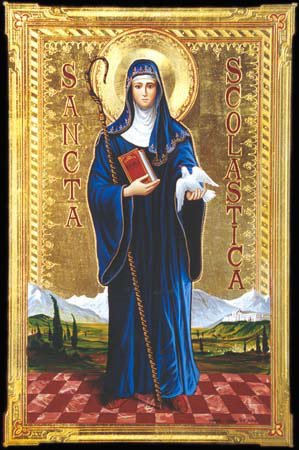
February 10--St. Scholastica, Virgin


Saints have families; fathers, mothers, sisters, brothers.  Many times saints come from holy families.  The same is true for today's saint, Saint Scholastica.  Her twin brother was St. Benedict of Nursia, the founder of the Benedictine religious order.  To have such a famous brother might be a burden for some, but St. Scholastica was famous in her own right as a founder of a religious order of women and thus she is the patron saint of nuns.

St. Scholastica's community was five milesa away from Monte Cassino, the famous first monastery of the Benedictines that St. Benedict founded.  They would meet once a year to pray and talk with one another about spiritual matters.  The last time that they met, St. Scholastica requested her brother to stay longer, but he wanted to get back to his monastery.  She then prayed for a miracle to allow her to be with her brother and a thunderstorm broke out, keeping him there.  He was troubled and said to her, "'God forgive you, what have you done?'  She answered him, 'I desired you to stay, and you would not hear me; I have desired it of our good Lord, and he has granted my petition.'"  Three days later she died and St. Benedict saw her soul ascend to heaven in the form of a dove.

Our families are where we first learn of God and his love for us.  We help each other to grow closer to God by being loving fathers, mothers, sisters, brothers, and so forth.  May all that we do for our families be done according to God's will with God's love, as St. Scholastica did and would have us do.

Sunday, August 18, 2013

July 11--St. Benedict, Abbot


Pope Benedict XVI named himself for St. Benedict, the man who wrote a Rule for monks to live together in community.  That Rule is the basis for the Order of St. Benedict, the religious group of monks who Christianized Europe.  St. Benedict was a young man of sixth century Italy who left his studies in Rome to become a hermit.  Some other hermits were drawn to his holiness and asked him to lead them.  He did, but they came to despise him and tried to poison him.  He left that group and later founded a monastery at Monte Cassino, where he died not long after his twin sister, St. Scholastica.

The Rule of St. Benedict is the most common Rule used by monasteries and monks for over 1,400 years.  Its first word is obsculta, a Latin word meaning both “listen” and “obey”.  The Benedictine monk is to listen to and obey the words of the Rule so that he may grow in holiness.  The Rule is also exemplary for its tone of moderation.  Nothing too hard was exacted from the monk.  Everything was to be done in moderation, both work and prayer, which are hallmarks of the Benedictine order.

Benedictine monasticism became the norm in Europe following the fall of the Roman Empire in the West in 476 A.D.  Charlemagne mandated that Benedictine monasteries be founded wherever his empire extended.  By the 14th century there were 37,000 Benedictine monasteries in Europe.  There had been 24 Benedictine popes and over 1,500 canonized Benedictine saints.  So one can understand why Pope Benedict XVI said that “with his life and work St Benedict exercised a fundamental influence on the development of European civilization and culture.” 
We owe much to St. Benedict and to the Benedictines.