Showing posts with label July. Show all posts

Monday, July 21, 2025

July 29--Sts. Martha, Mary, and Lazarus, Holy Family


Raising of Lazarus by Giotto Public domain


Although not common, it is not completely unusual for whole families to be saints. Before canonizations were under the direction of the papacy in the eleventh century, saints were often chosen by local churches and the people. Thus, whole families were known as saints, including Elizabeth, Zechariah, and John the Baptist; Basil the Elder, Emilia, Macrina the Elder, Macrina the Younger, Basil the Great, Gregory of Nyssa, and Peter of Sebaste; Augustine and Monica; Benedict and Scholastica; Louis, Zelie, Thérèse of Lisieux, and Leonie Martin; Clare and Agnes of Assisi; and today’s saints, Martha, Mary, and Lazarus of Bethany.

“Saints Martha, Mary, and Lazarus were added to the General Roman Calendar as a combined memorial on July 29th by Pope Francis on January 26, 2021. This replaced the previous celebration of Saint Martha alone on that date.” This is because the identity of Mary of Bethany was not definitively established until recently by scholarship.

“Martha, Mary, and Lazarus of Bethany were beloved by Jesus. We don’t know the full background, but it appears all three siblings were loved by the Lord and were close friends and disciples of his. Each had a different charism. We know that Martha had a servant’s heart and that Mary preferred to sit at the feet of her Lord and learn from him. We don’t know as much about Lazarus other than he is one for whom Jesus wept and who he rose from the grave. John’s Gospel also tells us that because Jesus rose Lazarus from the grave, the chief priests and elders also plotted to put Lazarus to death, but we don’t know if they succeeded. May we be more like Martha, Mary, and Lazarus and draw near to Christ to love and serve him.”

Sts. Martha, Mary, and Lazarus, pray for us.

Monday, July 14, 2025

July 25--St. Christopher, Martyr


Whatever happened to St. Christopher? We know that he was a martyr under the persecution of the Emperor Decius in the third century in Lycea in present-dayTurkey, but we do not know anything else about him. Because of that, the Church removed him from the liturgical calendar. However, that does not mean that the Church demoted him or denied his existence. He is still on the Roman Martyrology, the approved list of saints in the Catholic Church.

In the Middle Ages a story spread about St. Christopher. The legend states that he was a giant who wished to serve the strongest, most powerful king. He started out serving a Christian king who crossed himself whenever he heard the devil’s name. Thus St. Christopher went to serve the devil who shuddered at the sight of the cross of Christ. Thus St. Christopher went to serve Christ. He was told by a hermit he would find Christ by carrying people across a river. “After Christopher had performed this service for some time, a little child asked him to take him across the river. During the crossing, the river became swollen and the child seemed as heavy as lead, so much that Christopher could scarcely carry him and found himself in great difficulty. When he finally reached the other side, he said to the child: ‘You have put me in the greatest danger. I do not think the whole world could have been as heavy on my shoulders as you were.’ The child replied: ‘You had on your shoulders not only the whole world but Him who made it. I am Christ your king, whom you are serving by this work.’ The child then vanished.” Thus, he is the patron of travelers.

St. Christopher is still a saint! St. Christopher, pray for us.

Monday, July 7, 2025

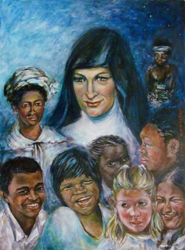
July 15--Bl. Anne-Marie Javouhey, Religious and Foundress


“If at first you don’t succeed, try, try again.” We have all heard this aphorism many times in our lives. It speaks to the virtue of perseverance, which “signifies the steadfast pursuit of a goal despite facing obstacles, delays, or difficulties” and is a strength in the virtue category of courage. This is perhaps the single most important characteristic of today’s saint, Bl. Anne-Marie Javouhey.

Born in France in 1779 just before the French Revolution, she dedicated her life to care for children of all races. In 1801 she and her three natural sisters ran a school for poor children and “during the next decade she ran two day schools and an orphanage.” For many, that would be enough, but not for her. In 1812 she founded the Sisters of St. Joseph of Cluny. From these beginnings she expanded her ministry to missionary work in the French Caribbean and African colonies, including Senegal, Gambia, Sierra Leone, and French Guiana. At the request of the French government she prepared six hundred slaves for emancipation in French Guiana. “As each family was ready to be freed, Mother Javouhey arranged for them to have money, some land, and a cottage." She also faced and overcame episcopal opposition, including prohibition of reception of the sacraments for two years.

The motto she gave her sisters illustrated her entire mission: The Holy Will of God. She said, “I am in God’s hands, ready to do God’s Will as soon as it is revealed to me.” Thus she can guide us according to Jesus’ own words for us as we pray to the Father: “Thy will be done.” To do God’s will is our bread, our life, and our calling to holiness. She died in 1851 and was beatified in 1950. Bl. Anne-Marie Javouhey, pray for us!


Monday, June 30, 2025

July 8--Sts. Priscilla and Aquila, Holy Married Couple


Pope Benedict XVI gave a General Audience on Saints Priscilla and Aquila, spouses, in February of 2007:

“Based on the information in our possession, this married couple played a very active role in the post-Paschal origins of the Church.

“When Paul wrote the First Letter to the Corinthians from Ephesus, together with his own greeting he explicitly sent those of ‘Aquila and Prisca, together with the church in their house’ (16: 19).

“Hence, we come to know the most important role that this couple played in the environment of the primitive Church: that of welcoming in their own house the group of local Christians when they gathered to listen to the Word of God and to celebrate the Eucharist.

“In the house of Aquila and Priscilla, therefore, the Church gathered, the convocation of Christ, which celebrates here the Sacred Mysteries.

“This couple in particular demonstrates how important the action of Christian spouses is. When they are supported by the faith and by a strong spirituality, their courageous commitment for the Church and in the Church becomes natural. The daily sharing of their life prolongs and in some way is sublimated in the assuming of a common responsibility in favour of the Mystical Body of Christ, even if just a little part of it. Thus it was in the first generation and thus it will often be.

“A further lesson we cannot neglect to draw from their example: every home can transform itself into a little church. Not only in the sense that in them must reign the typical Christian love made of altruism and of reciprocal care, but still more in the sense that the whole of family life, based on faith, is called to revolve around the singular lordship of Jesus Christ.”

Sts. Priscilla and Aquila, pray for us!

Monday, June 23, 2025

July 4--Bl. Pier Giorgio Frasatti, Third Order Dominican


An ordinary man is going to be canonized! He wasn’t a cleric. He did no miracles in his lifetime. He wasn’t a visionary or a mystic. He went to school to become an engineer. He helped the poor. He was a mountain climber. He protested against injustice. He opposed Italian fascism. He is Bl. Pier Giorgio Frassati. St. John Paul II said he was a “man of the Beatitudes,” “a young man filled with a joy that swept everything along with it, a joy that also overcame many difficulties in his life”. Pope Francis said: “Pier Giorgio said that he wanted to return the love of Jesus that he received in Holy Communion by visiting and helping the poor.”

Frassati (1901-1925) was the son of an agnostic newspaper publisher and an artist. He became a member of the Catholic Federation of University Students and Catholic Action in Italy as a college student and also a member of the Third Order Dominicans. “He often said: ‘Charity is not enough; we need social reform’. He helped establish a newspaper entitled Momento whose principles were based on Pope Leo XIII's Rerum novarum.” He died of polio in 1925. “His parents expected Turin's elite and political figures to come to offer their condolences and attend the funeral and expected to find many of his friends there as well. All were surprised to find the streets lined with thousands of mourners as the cortege passed out of the reverence felt for him among the people he had helped.”

Bl. Pier Giorgio Frassati was an ordinary man with an extraordinary dedication to God, love, and holiness. This is the purpose of canonization, to show that God’s love can be exemplified in our normal, everyday lives by loving others extraordinarily. Bl. Pier Giorgio Frassati, pray for us!

Monday, July 1, 2024

July 24--St. Kinga (Cunegunda), Holy Woman


Can a woman both be married and a virgin and be dedicated to loving both husband and God? Yes! We have two excellent examples of that unique calling: Our Blessed Mother Mary and St. Kinga. St. Kinga’s story is one of devotion to God through her role as Queen of Poland. Born in Hungary in 1224 to the King of Hungary, St. Kinga had many saintly relatives. St. John Paul II, in his canonization homily said, when “she was to marry Prince Boleslaus, she convinced him to live a life of virginity for the glory of God, and after a waiting-period of two years the spouses made a vow of perpetual chastity….

“This way of life, perhaps difficult to understand nowadays, yet deeply rooted in the tradition of the early Church, gave Saint Kinga that inner freedom which enabled her to be concerned first of all with the things of the Lord and to lead a profound religious life. Today let us reconsider this great testimony. Saint Kinga teaches us that both marriage and virginity lived in union with Christ can become a path to holiness. Today Saint Kinga rises to safeguard these values. She reminds us that the value of marriage, this indissoluble union of love between two persons, cannot be brought into question under any circumstances. Whatever difficulties may arise, one may not abandon the defence of this primordial love which has united two persons and which is constantly blessed by God. Marriage is the way of holiness, even when it becomes the way of the Cross. …

“[S]he esteemed chastity and virginity, rightly seeing in this state an extraordinary gift whereby man experiences in a special way his own freedom.” We need both holy marriages to raise godly families and consecrated virgins dedicated completely to serving God.

July 16--St. Bartholomew of Braga, O.P., Bishop


Today's saint was canonized by Pope Francis in 2019, 429 years after his death. This is much longer than the average 181 years. It was also an equipollent canonization, which means that the normal requirement for two miracles can be dispensed if the pope declares that the saint has been venerated continuously since ancient times.

So what makes St. Bartholomew of Braga worthy of such an unusual declaration? He was born in Portugal in 1514, entered the Order of Preachers (Dominicans) in 1527, and was ordained a priest, teaching theology for his order. He was ordained bishop of Braga in 1559 and attended sessions in the Council of Trent from 1561-1563. He contributed 268 suggestions, collaborated with St. Charles of Borromeo regarding the duties and virtues of priests, and “exercised great influence in the discussions, particularly those with regard to the decrees on the reform of ecclesiastical life.” After the Council he returned to Braga to implement the decrees. He resigned in 1582 and retired to a convent until his death in 1590. All in all, he was a good, holy bishop. He is patron saint of catechists, teachers of the faith.

For example, he wrote about prayer: “We ought continually to raise our hearts to God, … and expose them to the rays of His light, so that our prayer should kindle a fire in our souls, from whence a heat may come forth which will spread over all our actions. We must strive to procure this peace by every possible effort, and ask it of God with many sighs, so that amidst this crowd of affairs and continual distractions, our minds may remain always quiet and calm, and preserve their liberty and vigour.” Words of a true teacher and shepherd of his people! St. Bartholomew, pray for us!


Monday, June 3, 2024

July 7--The Blessed Ulma Family, Martyrs


The Church has beatified and canonized married couples, as well as members of the same family, but only one family has been beatified together as martyrs, the Blessed Ulma Family. Pope Francis spoke of them on the day of their beatification:

“Today in Markowa, Poland, the martyrs Józef and Wiktoria Ulma, and their seven children, were beatified: an entire family exterminated by the Nazis on 24 March 1944 for having given shelter to a number of persecuted Jews. They opposed the hatred and violence that characterized that time with evangelical love. May this Polish family, which represented a ray of light in the darkness of the Second World War, be for all of us a model to imitate in the zeal for goodness and service to those in need.…”

Jesus said: “No one has greater love than this, to lay down one’s life for one’s friends” (Jn. 15:13). The Ulmas gave the ultimate sacrifice of love, their lives, in order to protect and save eight Jews. However, they were all denounced so that the lands of the Jewish family could be taken away. All were killed by immediate and summary execution as a sign to the Polish people to not hide Jews. The Jews were executed first, then, in front of their children, Józef and Wiktoria, who was pregnant, and finally the other six children aged eight, seven, six, four, three, and two. They were buried in front of their house, but later, relatives exhumed and reburied the bodies, including the unnamed infant boy, who was born during the execution.

This is a terrible and tragic story, except that it is not! True, the execution of both Jews and Catholics is horrific. But the love and sacrifice shown by such martyrdoms is heroic. Blessed Ulmas, pray for us!


Monday, July 10, 2023

July 27–St. Titus Brandsma, Priest, Religious, and Martyr


We need martyrs! “The blood of the martyrs is the seed of Christians” according to Tertullian and also to St. John Paul II. The twentieth century was filled with martyrs in Mexico, Spain, Nazi-occupied Europe, Communist-controlled countries, and anti-Catholic dictatorships and governments. This has spilled into the twenty-first century as well. “Martyrs are revered with particular devotion by the People of God who see in them a living portrayal of Christ's Passion.”

Today’s saint was a “witness” (the meaning of the word martyr) to Jesus’ Passion in Nazi-occupied Netherlands. Born in 1881, St. Titus Brandsma grew up on a dairy farm and entered the Carmelite order in 1898. He was ordained a priest in 1905, received his doctorate, helped found the Catholic University of Nijmegen, and taught philosophy and history of mysticism there. He also became a journalist, which led to his arrest by the Nazis in 1942. He was hand-delivering a letter from the Dutch bishops to editors of Catholic newspaper editors to prohibit publishing official Nazi documents and was arrested and sent to Dachau where he was killed by an injection of carbolic acid. “In 1985, Pope St. John Paul II declared Titus Blessed, saying that he “‘answered hate with love.’"

We need martyrs to show that Jesus’ sacrifice of love is lived out in the lives and deaths of his faithful ones! We need martyrs to bolster the faith of our brothers and sisters in Christ! We need martyrs to convert the hearts of those who oppose, harass, torture, persecute, arrest, unjustly convict, and unjustly imprison and kill! We need martyrs to proclaim the truths of faith, hope, and love in Christ Jesus! We need martyrs to be “a life-giving sap of unity for the Church, the Mystical Body of Christ.” St. Titus Brandsma, pray for us.

July 16--Bl. Guadalupe Ortiz, Holy Woman and Member of Opus Dei

 
https://catholicreadings.org/catholic-quotes/blessed-guadalupe-ortiz-de-landazuri-fernandez-de-heredia-saint-of-the-day-july-16/

Is there a conflict between science and religion? Many who believe science can answer every question (scientism) say yes and “that science alone can give us complete and reliable knowledge of reality.” Those who believe religion can give us truths say no because, as Pope St. John Paul II says: “Truth cannot contradict truth.” Truth can be found in both science and religion! Today’s saint is a witness to that truth!

Bl. Guadalupe Ortiz was both a scientist and a member of Opus Dei, a personal prelature composed of priests and laity who “spread the Christian message that every person is called to holiness and that every honest work can be sanctified.” She was born in Spain in 1916 and became a teacher in 1939. She met St. Josemaría Escrivá, the founder of Opus Dei, who admitted her to the movement. She then moved to Mexico to share the message of Opus Dei and began her doctorate. She also helped found a school for girls and a mobile medical clinic for the poor. She then moved to Rome to help St. Josemaría and at the same time worked on a research project, for which she received an award, and completed her doctorate. She died in 1975 after years of heart problems and was declared Blessed in 2019.

Pope Francis wrote for her beatification: “With the joy that came from knowing she was a daughter of God, as she had learned from Saint Josemaría himself, Guadalupe Ortiz placed her many human and spiritual qualities at the service of others, helping in a particular way other women and families in need of education and development. She did all this not with a proselytizing attitude but simply through her prayer and witness.” Science and religion are both true as Bl. Guadalupe Ortiz demonstrated!

Tuesday, June 20, 2023

July 10--Bl. Faustino Villanueva y Villanueva, Priest and Martyr

http://newsaints.faithweb.com/martyrs/Guatemala.htm

What does it mean to be a martyr? Pope Francis has beatified many martyrs, including those killed during the civil war in Guatemala from 1954-1996. Why were they martyred? The Vatican biography for their beatification states: “From 1980, a systematic persecution against the Church began, overwhelming priests, religious and lay people under the pretext that they were ‘enemies of the state’. … The ten martyrs [of Quiché] … were killed in Guatemala between 1980 and 1991 … for being committed to and protecting the dignity of the poor.”

The following is from a Spanish newspaper article: “Faustino Villanueva was born on February 15, 1931 in Yesa, where his parents were also from. He entered the apostolic school of the Missionaries of the Sacred Heart, in Valladolid, as a child. He professed in 1949 and was ordained a priest in 1956. He went as a volunteer to the mission of Quiché (Guatemala) in 1959, where he remained until his martyrdom, which occurred in the parish office on July 10, 1980, after twenty-one years of fruitful missionary service to the poorest. A month before he died, he wrote to his mother, reiterating his desire to remain in the mission despite the prevailing violence: ‘We cannot leave the people abandoned.’ He died machine-gunned by two young hitmen in the parish office of Joyabaj (El Quiché) on July 10, 1980.

“Those who knew him affirm that ‘he was simply good, evangelical in his non-existent flirtations with power and prestige; so charmingly familiar and unfussy; so clearly biased in favor of the marginalized indigenous, of the favorite downtrodden peasants of the Gospel; of the voiceless.... However, this evangelical Faustino Villanueva was shot mercilessly. And not by mistake. He had long been on a sinister death row list. Guilty of siding with the poor and marginalized.’”

Monday, June 19, 2023

July 4--Bl. Pier Giorgio Frassati, Holy Man and Third Order Dominican

https://www.usccb.org/topics/youth-and-young-adult-ministries/blessed-pier-giorgio-frassati

Jesus taught the Beatitudes at the Sermon on the Mount (Mt. 5:3-12). Pope St. John Paul II (the Great) called Bl. Pier Giorgio Frassati “Man of the Eight Beatitudes.” Frassati lived from 1901-1925 in Turin, Italy. He dedicated himself to helping those in need and would say: "Charity is not enough; we need social reform.”

In his Beatification homily, Pope John Paul stated: “Today’s celebration invites all of us to receive the message which Pier Giorgio Frassati is sending to the men and women of our day, but especially to you young people, who want to make a concrete contribution to the spiritual renewal of our world, which sometimes seems to be falling apart and wasting away because of a lack of ideals. By his example he proclaims that a life lived in Christ’s Spirit, the Spirit of the Beatitudes, is ‘blessed’, and that only the person who becomes a ‘man or woman of the Beatitudes’ can succeed in communicating love and peace to others. He repeats that it is really worth giving up everything to serve the Lord. He testifies that holiness is possible for everyone, and that only the revolution of charity can enkindle the hope of a better future in the hearts of people.”

He inspires us to pray the Prayer for the Courage to be Great:

"Heavenly Father,
Give me the courage to strive for the highest goals,
to flee every temptation to be mediocre.
Enable me to aspire to greatness, as Pier Giorgio did,
and to open my heart with joy to Your call to holiness.
Free me from the fear of failure.
I want to be, Lord, firmly and forever united to You.
Grant me the graces I ask You through Pier Giorgio's intercession,
by the merits of Our Lord Jesus Christ.
Amen."

Sunday, July 11, 2021

July 28—Bl. Stanley Rother, Priest and Martyr


*

There are fourteen saints, eight blesseds, 25 venerables, and 184 Servants of God with American connections. They founded religious orders, became martyrs, taught, healed, led, and served. They ministered in America and around the world. They were all holy! 

Today’s blessed is one such man, Blessed Stanley Rother, a priest and missionary from Oklahoma, martyred in Guatemala in 1981 during its civil war. He was born in 1935 near Oklahoma City and graduated from the seminary in 1963. In 1968 he was assigned, at his request, to a mission in Guatemala. He served in Santiago Atitlán until his death. Along with his regular duties, he translated the New Testament into the native language of the people and founded a small hospital. 

The civil war eventually came to his parish. “His catechists and parishioners would disappear and later be found dead, with their bodies showing signs of being beaten and tortured.” He wrote to the people of Oklahoma in December 1980 before returning to Guatemala: “This is one of the reasons I have for staying in the face of physical harm. The shepherd cannot run at the first sign of danger.” He was told his name was on a death list but received permission to return to Santiago Atitlán. On July 28, 1981, shooters broke into the rectory and shot him twice in the head. He was one of ten priests murdered in Guatemala that year. He is buried in Oklahoma, but his heart is buried under the altar in Santiago Atitlán. 

On December 1, 2016, Pope Francis decreed that he had been killed in odium fidei, in hatred of the faith. He was beatified on September 23, 2017, the first US-born priest and martyr. Martyrdom is still a part of being Catholic. Bl. Stanley Rother, pray for us.

*http://www.catharchdioceseokc.org/history/rotherindex.htm

July 24--St. Sharbel Maklūf, Priest


*

The Catholic Church has 24 particular churches and six major rites of worship.  The largest particular church is the Latin Church.  There are 23 Eastern Catholic Churches united under the authority and leadership of the Pope.


Today’s saint is from the Maronite Catholic Church, which belongs to the West Syriac Rite.  St. Sharbel Maklūf was a priest, monk, and hermit who lived in Lebanon from 1828-1898.  He is known as the “Miracle Monk of Lebanon” due to the many miraculous healings and wonders attributed to him during his life and after, as well for his ability to unite Christians and Muslims.  He became a monk in 1853 and was ordained a priest for the Monastery of St. Maron.  He served the monastery for 19 years and then was granted permission to live as a hermit near the monastery.  He lived as a hermit for another 23 years in deep prayer with God and a life devoted to deprivation of material pleasures.


His wisdom comes through his life of holiness and his words:  “A man who prays lives out the mystery of existence, and a man who does not pray scarcely exists.”  “Success in life consists of standing without shame before God.”  “Persevere in prayer without ceasing… to understand and live according to his will, not to change it.”  “One does not have to look far to see evidence of Satan’s plan in our world today, as the family is further fragmented and divided in modern culture.”  “The family is the basis of the Lord’s plan; and all forces of evil are focusing all their evil on destroying the family because they know that by destroying the family, the foundations of the plan of God will be shaken.”  How prophetic for us, as we seek to strengthen the family against new “definitions.”

*By FOSS-the-world - Own work, CC BY-SA 4.0, https://commons.wikimedia.org/w/index.php?curid=63027121


Tuesday, July 6, 2021

July 12—Sts. Louis Martin and Azélie-Marie “Zélie” Guérin, Holy Man and Holy Woman

*

They are the only married couple canonized together.  Both tried to enter religious life but were rejected.  They married three months after meeting each other.  Both entered marriage with the intention of living as St. Joseph and St. Mary did.  Nonetheless, they did want children and their confessor guided them.  So, they became parents to nine children with five daughters surviving and eventually entering religious life, one of whom is St. Thérèse of Lisieux.  They were successful in business; Louis being a watchmaker who quit his career to manage his wife’s more successful lace-making business.  St. Zelie died of breast cancer at the age of 45, while St. Louis died from a heart attack after a lengthy illness brought about by strokes when he was 70, surviving his wife by 17 years.  


However, there was more to their lives than just living, working, raising a family, and dying.  They were holy and devoted their lives to God through living, working, raising a family, and dying.  We know quite a bit about them from his 16 letters and her 216 letters.  She wrote to one daughter:  “As for me, I wished to have many children so that I could raise them for Heaven.”  She had great love and affection for her husband as well:  “I always get what I want without a fight; there's still a month before you go (on retreat); that's enough time for me to change your father's mind ten times.”  The years after her death were hard on him, especially after the strokes, when he suffered delirium.  When he could, he would repeat:  “Everything for the greater glory of God,” and “I have never been humiliated in my life, I need to be humiliated.”  Here are models for modern families!  Sts. Louis and Zélie Martin, pray for us.

*https://www.ncregister.com/blog/the-holy-lives-and-passions-of-sts-louis-and-zelie-martin

Sunday, July 19, 2020

July 28--Blessed Maria Teresa Kowalska, Religious and Martyr


*

What happens when someone sins? An injury has been committed. How does one repair the injury? By sorrow and reparation. Sorrow is the key to forgiveness; reparation is the key to reconciliation. Today’s saint offered herself and her life in reparation to God for the sins of her family. Bl. Maria Teresa Kowalska was born in Poland in 1902. After the Russian Revolution in 1917 “her father and other relatives had embraced atheistic Communism and enthusiastically supported the new Soviet Union.” She entered the Capuchin Poor Clares in Poland in 1923 making her Solemn Perpetual Profession in 1928. She became a model nun, respected by her community. In 1941 the Germans arrested the thirty-six nuns at the convent and sent them to a concentration camp. She had tuberculosis while in the monastery and her illness worsened in captivity. One day she said, “I will not leave here alive. I offer my life for the sisters so that they may return to the monastery.” She died on July 25, 1941. Her sisters were released by the Germans two weeks later on August 7. She was beatified by Pope John Paul II in June 1999 with a group of 107 martyrs of WWII.

Reparation of sins is a holy purpose of prayer. Jesus made reparation for our sins through his death, but we can also make reparation for the sins of others through our prayers and sufferings.

The Morning Offering prayer states:

O Jesus, through the Immaculate Heart of Mary,
I offer you my prayers, works, joys, and sufferings of this day
for all the intentions of your Sacred Heart,
in union with the Holy Sacrifice of the Mass throughout the world,
for the salvation of souls, the reparation of sins, the reunion of all Christians,
and in particular for the intentions of the Holy Father this month.
Amen.

Monday, July 13, 2020

July 20—St. Apollinaris, Bishop and Martyr


*

If at first, you don’t succeed… well you know the rest. But what about attempting the conversion of others? What about facing continued rejection, intimidation, and even threats of persecution and death? Are we required to share our faith with others who hate us and hate what we believe? Are we called to bring Christ to them, or should we leave them be? Afterall, Jesus did say, “Whoever will not receive you or listen to your words—go outside that house or town and shake the dust from your feet” (Mt. 10:14) and “When they persecute you in one town, flee to another” (Mt. 10:23).

This may have been in the mind of today’s saint, Apollinaris. According to legend, he was sent by St. Peter to the city of Ravenna, Italy. With the working of miracles, he attracted attention and converts, but also enemies, who beat him and drove him out. He was found and hidden by Christians, but then captured, compelled to walk on coals and again expelled. He stayed in the area and preached, but later returned a third time to Ravenna. “Again he was captured, hacked with knives, had scalding water poured over his wounds, was beaten in the mouth with stones, … was flung into a horrible dungeon to starve to death;” but then put on a ship to Greece. After four years he returned to Ravenna a fourth time, staying hidden, but was discovered and, again, savagely beaten, after which he died.

What compelled him to keep returning when he knew what would happen to him? It may be, that as bishop he wanted to be with his flock. Whatever his reasons, he faced death for the sake of the Gospel. We may not be called to die for the faith, but we are called to witness.


Monday, June 29, 2020

July 9--St. Augustine Zhao Rong and Companions, Martyrs


*

Is Catholicism a Western ideology or a universal religion? This is an important question if we are to spread the Good News of Jesus Christ. St. Augustine Zhao Rong was one of 87 native Chinese, along with 33 foreign-born missionaries who were martyred between 1648 and 1930. He was a soldier assigned to escort a French bishop in China. St. Augustine was so impressed by the priest and his patience he converted and soon became a priest. However, Catholicism was seen as a foreign religion and a threat to Chinese culture. Shortly after his ordination, St. Augustine Zhao Rong was “jailed, tortured, and left to die in prison” in 1815. Many were martyred during the Boxer Rebellion of 1900, one a nine-year-old. None of the martyrs were engaged in political activities, nor were they agents of Western colonial powers, although that was what the governments feared. They were living their faith in Jesus.

The word catholic means universal. We have been given a command by Jesus to “Go, therefore, and make disciples of all nations, baptizing them in the name of the Father, and of the Son, and of the holy Spirit, teaching them to observe all that I have commanded you. And behold, I am with you always, until the end of the age” (Mt. 28:19-20). To do so we must inculturate, or adapt to the local culture, the message of Jesus and the faith of the Church. That is what missionaries do and have done through the centuries! Some have been more successful than others, but the goal has never been to wipe out other cultures to supplant it with Western culture, although many in modern society have accused the Church of doing so. Thus, the destruction of statues of St. Junipero Serra! We are called to love, not destroy.

Sunday, June 28, 2020

July 17--The Sixteen Blessed Carmelite Martyrs of Compiègne, Religious and Martyrs

*

When does might make right? Is it when we force others to do something because we know it is right? Is it when we punish others for not doing what we know to be right? Is it when we rule as a mob and persecute those who don’t have a right belief? Oh, this isn’t about the current civil unrest. No, this is about the Committee of Public Safety in Revolutionary France. This was the ad hoc government which oversaw the Reign of Terror in France with Maximilien Robespierre as their leader. From 1793 to 1794 16,594 men, women, and children were executed. Of those were sixteen women who were evicted from their convent in 1792. They were arrested in 1794 for refusing to recognize Reason as France’s official religion.

When brought before a prosecutor to answer to the charge of “persistent fanaticism,” one of the nuns asked what that meant. The prosecutor responded, “By fanaticism, I mean your attachment to childish practices and your stupid beliefs.” He then sentenced the sixteen women to death on the guillotine. They were executed that night, starting with a nineteen-year-old novice, who started chanting Psalm 117: “Praise the Lord, all you nations! Extol him, all you peoples! His mercy for us is strong; the faithfulness of the Lord is forever. Hallelujah!” The sisters took up the chant. The last to be executed was a seventy-nine-year-old nun who shouted, “I forgive you as heartily as I wish God to forgive me.” They offered their lives in martyrdom and love on July 17, 1794.

Might does not make right. It didn’t during the Reign of Terror. It doesn’t today. It won’t tomorrow. God’s love makes right because Jesus is the Way, the Truth, and the Life (Jn. 14:6). May we follow in their footsteps!
* https://commons.wikimedia.org/wiki/File:Carm%C3%A9litesComp02.jpg

Monday, June 22, 2020

July 5--St. Elizabeth of Portugal, Holy Woman

*


**


Do you have a peacemaker in your family; someone who can patch things up when one relative insults another, or when family members get into a dispute? Well, the Iberian peninsula and all its royalty had a saint to help them out, Elizabeth of Portugal. She was born to the future King of Aragon in 1271, betrothed to the King of Portugal in 1282, and married in 1288. Her brothers were kings of Aragon and Sicily; her son-in-law, King of Castile. So her whole family tended to want their way, being kings! She, on the other hand, was devout, even as a child. She is quoted as far as understanding her role in life: “God made me queen so that I may serve others.” And she served in many ways, but most notably as a peacemaker by stopping a civil war between her husband and son and as well as stopping a war between her son and son-in-law. Legend has it that in the civil war she rode on a mule between the two sides to prevent combat. She even negotiated a peace treaty with the Queen of Castile. After her husband died in 1325, she became a Third Order Franciscan, retired to a convent, and died in 1336.

Kings often have huge egos. We also tend to have huge egos, inflated by pride and self-righteousness. When we perceive a comment as an insult or even a disagreement with a cherished belief, we tend to lash out, causing pain and suffering. Jesus said, “Blessed are the peacemakers, for they will be called children of God” (Mt. 5:9). Many times he gives us those peacemakers to calm the waters and, even sometimes, to deflate our egos. If we have egos the size of royalty, may God send us peacemakers, such as St. Elizabeth!
*https://commons.wikimedia.org/wiki/File:Saint_Elizabeth_of_Portugal_(1271%E2%80%931336),_by_Spanish_(Madrilenian)_School.png
**https://commons.wikimedia.org/wiki/File:A_Rainha_Santa_em_Alvalade_(Roque_Gameiro,_Quadros_da_Hist%C3%B3ria_de_Portugal,_1917).png