Showing posts with label Saint. Show all posts

Tuesday, November 17, 2026

November 29--St. Saturninus of Toulouse, Missionary Bishop and Martyr


Stained glass window of the martyrdom of St. Saturnin of Toulouse. Photo by Reinhardhauke.

The Catholic Church is a missionary Church. She has expanded throughout the world to bring the message of the Gospel to all peoples as Jesus commanded in Mt. 28:19-20: "Go, therefore, and make disciples of all nations, baptizing them in the name of the Father, and of the Son, and of the holy Spirit, teaching them to observe all that I have commanded you. And behold, I am with you always, until the end of the age." This was the commission also given to today’s saint, St. Saturninus of Toulouse in A.D. 250 when Pope Fabian sent him and six other missionaries to Gaul in present-day France.

He was successful in starting a community and even silenced the demons used in oracles by the local pagan priests: “According to the Acts, the pagan priests ascribed the silence of their oracles to the frequent presence of Saturninus. One day they seized him and on his unshakeable refusal to sacrifice to the images they condemned him to be tied by the feet to a bull which dragged him about the town until the rope broke.” He was then buried by two pious women in a “deep ditch” to protect his remains from being profaned.

Thus his holy presence, as well as his preaching, brought God to the people! We are also called to bring God to the people we meet. Does our presence, our demeanor, our actions, our speech, our prayers, and our love, bring God to the people we meet? We may not become martyrs, but we are called to “make disciples of all nations . . . teaching them to observe all that” Jesus has commanded us. St. Saturninus gave the ultimate sacrifice, his life, for the salvation of the people to whom he was sent. St. Saturninus, pray for us!


Saturday, October 24, 2026

November 9--St. Elizabeth of the Trinity, Religious and Mystic


O my God, Trinity whom I adore,
help me forget myself entirely so to establish myself in you,
unmovable and peaceful as if my soul were already in eternity.
May nothing be able to trouble my peace or make me leave you,
O my unchanging God,
but may each minute bring me more deeply into your mystery!
Grant my soul peace.
Make it your heaven, your beloved dwelling and the place of your rest.
May I never abandon you there, but may I be there, whole and entire,
completely vigilant in my faith, entirely adoring,
and wholly given over to your creative action (CCC 260).

This prayer was composed by today’s saint, Elizabeth Catez, St. Elizabeth of the Trinity, a Carmelite nun who lived a short, but holy life (1880-1906) in France. Her life sounds much like St. Thérèse of Lisieux: Temper as a child; one parent died when young; wrote great spiritual and mystical works; and died young after intense suffering. Where they differed was that St. Thérèse wrote about living the “Little Way,” doing small things with love, and St. Elizabeth wrote about the “Indwelling of the Trinity” in the soul, the profound awareness that the Holy Trinity lives within the soul of every baptized person!

St. Elizabeth called herself Laudem Gloriae, which means “Praise of Glory.” She wanted that to be her heavenly name: "I think that in Heaven my mission will be to draw souls by helping them to go out of themselves in order to cling to God by a wholly simple and loving movement, and to keep them in this great silence which will allow God to communicate Himself to them and to transform them into Himself." Thus, she was dedicated to the salvation of souls. St. Elizabeth of the Trinity, pray for us.

October 25--St. Tabitha, Holy Woman


There are many saints mentioned in Scriptures who may get only a verse or two, or a mention by name. One of those is today’s saint, St. Tabitha. We only know the little bit about her from Acts of the Apostles:

“Now in Joppa there was a disciple named Tabitha (which translated means Dorcas). She was completely occupied with good deeds and almsgiving. Now during those days she fell sick and died, so after washing her, they laid [her] out in a room upstairs. Since Lydda was near Joppa, the disciples, hearing that Peter was there, sent two men to him with the request, ‘Please come to us without delay.’ So Peter got up and went with them. When he arrived, they took him to the room upstairs where all the widows came to him weeping and showing him the tunics and cloaks that Dorcas had made while she was with them. Peter sent them all out and knelt down and prayed. Then he turned to her body and said, ‘Tabitha, rise up.’ She opened her eyes, saw Peter, and sat up. He gave her his hand and raised her up, and when he had called the holy ones and the widows, he presented her alive. This became known all over Joppa, and many came to believe in the Lord” (Acts 9:36-42).

What an impact she made! The community in Joppa loved her so much that they wanted Peter to raise her up! And Peter did! This is a source of joy and faith to everyone, so much that we read about her today! We also know of people like St. Tabitha, “completely occupied with good deeds and almsgiving.” We should be thankful and praise God for all the good people he sends into our lives. St. Tabitha, pray for us.

Saturday, February 21, 2026

March 1--St. David of Wales, Abbot and Bishop


"Gwnewch y pethau bychain mewn bywyd." For those of you who don’t know Welsh, that means: “Do ye the little things in life,” the last words of today’s saint, St. David of Wales, who died around 589 A.D. Born in about 500 A.D., the grandson of a king in Wales, David became “renowned as a teacher and preacher, founding monastic settlements in Wales” and elsewhere. He attended a synod in Wales denouncing the Pelagian heresy, which stated that humans were not affected by Original Sin and we could earn our way to heaven, thus getting rid of our corporate sin and also the need of Jesus as Our Savior to die for us! Due to his speech he was elected primate of the monks in his region. He was later acclaimed archbishop. His last words were: “Lords, brothers and sisters, Be joyful, and keep your faith and your creed, and do the little things that you have seen me do and heard about. And as for me, I will walk the path that our fathers have trod before us." "Do ye the little things in life."


St. Thérèse of Lisieux also taught a “Little Way” whereby doing the ordinary things of everyday life with love bring us closer to God. Both St. David and St. Thérèse point out that holiness is everyone’s calling in life, no matter our state, our abilities, or our difficulties. Every moment is an opportunity for grace or, as Saint Padre Pio said, “The present moment is the only moment of grace.” We are chosen, called, and sent forth to bring God’s love to the world. We are the children of God who praise the love of Our Father, through his beloved Son, Our Lord and Savior, Jesus Christ! St. David, pray for us!

Sunday, January 4, 2026

January 11–St. Theodosius the Great, Abbot


St. Theodosius the Cenobiarch at Church of St. Thomas-Goudi, licensed under CC by-SA 4.0.

In many respects monks saved Western Christianity. St. Benedict of Nursia was the pivotal figure in the West, whereas St. Basil the Great was the pivotal figure in the East. But they were not alone in helping to spread the monastic lifestyle, Today’s saint, St. Theodosius the Great, lived from about A.D. 423-529, and developed the communal monastic way of life in the Judaean desert near Bethlehem.

There are many different kinds of monasticism, including hermits, who lived by themselves, anchorites, who lived by themselves, but physically connected to a church, and cenobites, what we think of today as being monks in community. This style was not as common in Theodosius’s day. He originally started out as a hermit, living in a cave on a mountain. But he eventually founded the Monastery of St. Theodosius near Bethlehem, which stressed the common life rather than the solitary life. It “grew rapidly, with monks of several cultures and languages, and became very well known for its work with the sick, elderly, and mentally impaired.”

What is notable about St. Theodosius was his desire to do God’s will wherever it led him. As a developer of the communal monastic movement he was able to help others find their way to God as well. We are all called by God to live according to our calling to holiness. For many it is the married life, living in the world, evangelizing and sharing faith with family, friends, and colleagues. For others it may be the priestly life, and for still others it may be the cloistered life in a monastery or the missionary life as a sister or brother of a religious order. We are all called to discern our place in God’s plan of salvation for the world. St. Theodosius, pray for us!

Monday, September 29, 2025

October 6--St. Bruno, Priest and Religious


The end of the first millennium saw numerous reforms in the Church and religious life. The reforms of Pope St. Gregory VII allowed for the Church to be independent from control of the state. New religious orders, based upon the Rule of St. Benedict, were developing, especially in France. One of those orders was the Carthusian order of monks founded by today’s saint, St. Bruno. “They lived primarily as hermits and came together for the liturgy and for occasional common activities.” St. Bruno was born in Cologne, now in Germany around A.D. 1030 to a principal family of the city. He studied in Reims, France where he eventually became in charge of the school of the bishop for eighteen years. He became chancellor of the Archdiocese of Reims in 1075. He was offered the position of bishop, but instead decided to withdraw from the active ministry of diocesan work for the role of a hermit. In 1084 he and six companions went into the French Alps near Grenoble at Chartreuse and started a small community of hermits, which became the Carthusian order. St. Bruno’s student, Pope Urban II, called him to Rome to reengage in the daily activities of helping to run the universal Church as Pope Urban’s counsellor. St. Bruno died in 1101.

St. Bruno is a model for both the active and the contemplative life as symbolized by Martha and Mary, who were friends of Jesus. We need public servants of the Church to do the daily practical work of teaching, administrating, preaching, worshipping, healing, and more for the benefit of the People of God. But we also need the hidden servants who pray, meditate, sacrifice, and intercede on behalf of the People of God. St. Bruno was a master of both! St. Bruno, pray for us.

Sunday, September 14, 2025

September 25--St. Cleopas, Holy Man


There are a few people mentioned by name once or infrequently under singular circumstances in the Gospels, Simon of Cyrene, Jairus, Joanna, Mary of Clopas and today’s saint, St. Cleopas. St. Cleopas is mentioned in Luke’s Gospel as one of the two persons Jesus encountered on the road to Emmaus after the Resurrection, which may be the same occurrence stated in Mark 16:12-13 about the appearance to two disciples on their way to the country. Some think that this is the same person as Clopas, who is mentioned as the husband of Mary, one of the women present at the crucifixion of Jesus. Some traditions claim that he was the brother of St. Joseph and thus the uncle of Jesus. Others say that he was also the same person as Alphaeus, who was the father of James the Less, an Apostle of Jesus. It is difficult to know for sure, but we do know that he was a witness to the resurrected Jesus.

As a named witness to the Resurrection, St. Cleopas and his companion, perhaps his wife, were favored with a noteworthy appearance. They were on the road to Emmaus on the day of Jesus’ Resurrection when a stranger, Jesus, came up to them and walked with them. They shared their experience of the suffering, death, and resurrection of Jesus and their lack of understanding of the whole situation. Jesus explained to them the meaning of the Old Testament regarding his passion and death and then moved as to leave them. They invited him to stay and he “broke bread” with them. At that they recognized him and he disappeared. Think about it; this is the structure of the Mass–reading of Scriptures and the homily along with the sharing of the Eucharist! WOW! St. Cleopas, pray for us.


Saturday, September 6, 2025

September 16--St. Cyprian of Carthange, Bishop and Martyr


Galerius Maximus: "Are you Thascius Cyprianus?"
Cyprian: "I am."
Galerius: "The most sacred Emperors have commanded you to conform to the Roman rites."
Cyprian: "I refuse."
Galerius: "Take heed for yourself."
Cyprian: "Do as you are bid; in so clear a case I may not take heed."
Galerius: "You have long lived an irreligious life, and have drawn together a number of men bound by an unlawful association, and professed yourself an open enemy to the gods and the religion of Rome; and the pious, most sacred and august Emperors ... have endeavoured in vain to bring you back to conformity with their religious observances; whereas therefore you have been apprehended as principal and ringleader in these infamous crimes, you shall be made an example to those whom you have wickedly associated with you; the authority of law shall be ratified in your blood. It is the sentence of this court that Thascius Cyprianus be executed with the sword." 
Cyprian: "Thanks be to God."

Thus, the trial and sentencing of St. Cyprian of Carthage in A.D. 258 under Emperor Valerian. He had survived the Decian persecution eight years earlier by going into hiding. However, many had criticized him for that. He explained that he needed to be pastor for his flock, whereas in the latter persecution he explained that he needed to be an example. In between, when the persecution had been relaxed, many who had lapsed from the faith in fear of martyrdom desired to return to the fold. St. Cyprian approved, but only after an appropriate public penance. He was opposed by those who wanted no penance and those who wanted no readmission! Pope St. Cornelius, whose feast day Cyprian shares, agreed with him. Reconciliation is a necessary sacrament for us as well! St. Cyprian, pray for us.

Sunday, August 17, 2025

August 30--St. Fiacre, Priest and Abbot


The Catholic Church recognizes patron saints from Academics–St. Thomas Aquinas and St. Albert the Great to Zoology–St. Albert the Great again! Today’s saint is the patron saint of Gardeners. St. Fiacre was born in Ireland about A.D. 600 and died in A.D. 670 in France. He grew up in a monastery, was ordained a priest, and eventually became an abbot. As people came to him because of his reputation for holiness and healing he went to France to become a hermit. He built a hermitage for himself and a hospice for travelers about 50 miles northeast of Paris. There he planted a vegetable and herb garden and an oratory in honor of the Blessed Virgin Mary. He lived a life of self-denial, prayer, fasting, vigils and healing by laying on of hands. Veneration towards him seems to be based on his healing abilities as well as his holiness. His patronage of gardeners is based on his gardening abilities.

Every good act we do can be an act of love for God and others. Gardening may bring joy through the beauty of flowers and health through the nourishment of fruits, and vegetables. Tilling the soil may allow us to focus our minds and hearts on prayer to God in praise and on behalf of others. Tending the yard may bring peace. Scripture envisioned earthly paradise as a garden: “The LORD God then took the man and settled him in the garden of Eden, to cultivate and care for it” (Gn. 2:15). Furthermore: “You make the grass grow for the cattle and plants for people’s work to bring forth food from the earth, wine to gladden their hearts, oil to make their faces shine, and bread to sustain the human heart” (Ps. 104:14-15). St. Fiacre, pray for us.

Monday, July 21, 2025

July 29--Sts. Martha, Mary, and Lazarus, Holy Family


Raising of Lazarus by Giotto Public domain


Although not common, it is not completely unusual for whole families to be saints. Before canonizations were under the direction of the papacy in the eleventh century, saints were often chosen by local churches and the people. Thus, whole families were known as saints, including Elizabeth, Zechariah, and John the Baptist; Basil the Elder, Emilia, Macrina the Elder, Macrina the Younger, Basil the Great, Gregory of Nyssa, and Peter of Sebaste; Augustine and Monica; Benedict and Scholastica; Louis, Zelie, Thérèse of Lisieux, and Leonie Martin; Clare and Agnes of Assisi; and today’s saints, Martha, Mary, and Lazarus of Bethany.

“Saints Martha, Mary, and Lazarus were added to the General Roman Calendar as a combined memorial on July 29th by Pope Francis on January 26, 2021. This replaced the previous celebration of Saint Martha alone on that date.” This is because the identity of Mary of Bethany was not definitively established until recently by scholarship.

“Martha, Mary, and Lazarus of Bethany were beloved by Jesus. We don’t know the full background, but it appears all three siblings were loved by the Lord and were close friends and disciples of his. Each had a different charism. We know that Martha had a servant’s heart and that Mary preferred to sit at the feet of her Lord and learn from him. We don’t know as much about Lazarus other than he is one for whom Jesus wept and who he rose from the grave. John’s Gospel also tells us that because Jesus rose Lazarus from the grave, the chief priests and elders also plotted to put Lazarus to death, but we don’t know if they succeeded. May we be more like Martha, Mary, and Lazarus and draw near to Christ to love and serve him.”

Sts. Martha, Mary, and Lazarus, pray for us.

Monday, July 14, 2025

July 25--St. Christopher, Martyr


Whatever happened to St. Christopher? We know that he was a martyr under the persecution of the Emperor Decius in the third century in Lycea in present-dayTurkey, but we do not know anything else about him. Because of that, the Church removed him from the liturgical calendar. However, that does not mean that the Church demoted him or denied his existence. He is still on the Roman Martyrology, the approved list of saints in the Catholic Church.

In the Middle Ages a story spread about St. Christopher. The legend states that he was a giant who wished to serve the strongest, most powerful king. He started out serving a Christian king who crossed himself whenever he heard the devil’s name. Thus St. Christopher went to serve the devil who shuddered at the sight of the cross of Christ. Thus St. Christopher went to serve Christ. He was told by a hermit he would find Christ by carrying people across a river. “After Christopher had performed this service for some time, a little child asked him to take him across the river. During the crossing, the river became swollen and the child seemed as heavy as lead, so much that Christopher could scarcely carry him and found himself in great difficulty. When he finally reached the other side, he said to the child: ‘You have put me in the greatest danger. I do not think the whole world could have been as heavy on my shoulders as you were.’ The child replied: ‘You had on your shoulders not only the whole world but Him who made it. I am Christ your king, whom you are serving by this work.’ The child then vanished.” Thus, he is the patron of travelers.

St. Christopher is still a saint! St. Christopher, pray for us.

Monday, June 23, 2025

July 4--Bl. Pier Giorgio Frasatti, Third Order Dominican


An ordinary man is going to be canonized! He wasn’t a cleric. He did no miracles in his lifetime. He wasn’t a visionary or a mystic. He went to school to become an engineer. He helped the poor. He was a mountain climber. He protested against injustice. He opposed Italian fascism. He is Bl. Pier Giorgio Frassati. St. John Paul II said he was a “man of the Beatitudes,” “a young man filled with a joy that swept everything along with it, a joy that also overcame many difficulties in his life”. Pope Francis said: “Pier Giorgio said that he wanted to return the love of Jesus that he received in Holy Communion by visiting and helping the poor.”

Frassati (1901-1925) was the son of an agnostic newspaper publisher and an artist. He became a member of the Catholic Federation of University Students and Catholic Action in Italy as a college student and also a member of the Third Order Dominicans. “He often said: ‘Charity is not enough; we need social reform’. He helped establish a newspaper entitled Momento whose principles were based on Pope Leo XIII's Rerum novarum.” He died of polio in 1925. “His parents expected Turin's elite and political figures to come to offer their condolences and attend the funeral and expected to find many of his friends there as well. All were surprised to find the streets lined with thousands of mourners as the cortege passed out of the reverence felt for him among the people he had helped.”

Bl. Pier Giorgio Frassati was an ordinary man with an extraordinary dedication to God, love, and holiness. This is the purpose of canonization, to show that God’s love can be exemplified in our normal, everyday lives by loving others extraordinarily. Bl. Pier Giorgio Frassati, pray for us!

Sunday, June 8, 2025

June 16--St. Lutgardis, Religious


“Catholic Christians traditionally recognize June as the month of the Sacred Heart of Jesus. During this time, we call to mind Christ’s love for us, which is visible in a special way in the image of His pierced heart, and we pray that our own hearts might be conformed to His, calling us to love and respect all His people” (USCCB). St. Lutgardis is considered one of the saints who had a devotion to the Sacred Heart long before it was recognized in the Church as hers was the first recorded mystical revelation about the Sacred Heart.

St. Lutgardis was born in Tongeren, Belgium, in 1182 and died in 1246. She was sent to the convent at the age of twelve because her father lost her dowry in a bad business deal and thus could not afford to have her married according to the customs of the time. It was only later, when she had a vision of Jesus with his wounds, that she actually became a Benedictine nun. Still later, she joined the Cistercians, which followed a stricter observance of the Rule of St. Benedict. One vision was specifically about the Sacred Heart of Jesus. Jesus asked her what gift she would like to receive instead of the one she previously asked for. “‘Lord,’ said Lutgarde, ‘I would exchange it for your Heart.’ Christ then reached into Lutgarde and, removing her heart, replaced it with his own, at the same time hiding her heart within his breast.”

The Sacred Heart of Jesus is a profound reminder of God’s love for us through Jesus’ sacrifice: “For God so loved the world that he gave his only Son, so that everyone who believes in him might not perish but might have eternal life” (Jn. 3:16). St. Lutgardis, pray for us!

Sunday, June 1, 2025

June 8--St. Melania the Elder, Holy Woman


Many people ask what role women had in the early Church since they couldn’t be ordained. Luke tells us that Jesus was supported financially by women: “Afterward he journeyed from one town and village to another, preaching and proclaiming the good news of the kingdom of God. Accompanying him were the Twelve and some women who had been cured of evil spirits and infirmities, Mary, called Magdalene, from whom seven demons had gone out, Joanna, the wife of Herod’s steward Chuza, Susanna, and many others who provided for them out of their resources” (Lk. 8:1-3).

This is also true of today’s saint, St. Melania the Elder (born about 325, died about 410-417). She was from a high Roman family and became “one of the wealthiest citizens of the empire.” She was a convert and became known for her generosity and holiness. “She was one of the first Roman women to visit the Holy Land.” After her husband died she visited North Africa and presented a desert monastery with chests of silver. From there she went to Jerusalem and founded a convent and a monastery. She spent thirty-five years in the Holy Land. Her kinsman, St. Paulinus of Nola, wrote of her: “What a woman she is, if it is permissible to call such a manly Christian a woman! . . . she loftily cast herself down to a humble way of life, so that as a strong member of the weak sex she might censure indolent men.”

This may sound sexist. However, it is not a matter of sexism to insist that holiness can be attained by everyone, including women! The holiest person, after Jesus himself, is Mary, our beloved Mother. St. Melania expressed her holiness through humility and generosity, gifts God gave to her.

St. Melania the Elder, pray for us!

Monday, May 26, 2025

June 2–St. Marcellinus and Peter, Priest and Exorcist, Martyrs


“To us, also, your servants, who, though sinners, hope in your abundant mercies, graciously grant some share and fellowship with your holy apostles and martyrs: with John the Baptist, Stephen, Matthias, Barnabas, (Ignatius, Alexander, Marcellinus, Peter, Felicity, Perpetua, Agatha, Lucy, Agnes, Cecilia, Anastasia) and all your saints; admit us, we beseech you, into their company, not weighing our merits, but granting us your pardon, through Christ our Lord.”

This is part of the First Eucharistic Prayer, the oldest eucharistic prayer in the Latin Rite. It contains the names of many saints, especially of martyrs, including Marcellinus and Peter. A catacomb outside Rome is named for them.

“The catacomb of Saints Marcellinus and Peter derives its name from the two martyrs buried within it. The story behind the life of these two martyrs goes back to the time of the Emperor Diocletian. St. Marcellinus and St. Peter were slain during the persecution of 304 AD - beheaded, in Rome. Before being killed, however, they were forced to dig their tomb with their own hands. The site of the terrible martyrdom of the two saints was known as ‘Selva Nera’ (meaning ‘Black Forest’), but after their death it was renamed ‘Selva Candida’, that is ‘White Forest’, along Via Cornelia.

“It was thanks to a Roman matron, who went with the name of Lucilla, that the bodies of the two martyrs were brought to Via Casilina, at the site called ad Duas Lauros. With the translocation of the saints’ bodies, the Christian cemetery, already in use, was dedicated in their memory.” (http://www.catacombeditalia.va)

Martyrs are the heroes of the faith, the men and women who gave their lives for their love of Christ. We honor them in our prayers and we ask for their prayers. Sts. Marcellinus and Peter, pray for us.

Tuesday, May 13, 2025

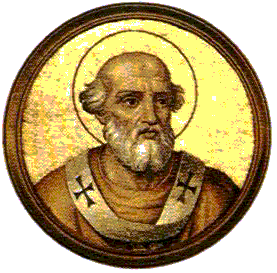
May 18--St. John I, Pope and Martyr


“Habemus Papam!”  At the time of this writing, May of 2025, the conclave of cardinals in Rome elected Robert Prevost, of Chicago, Illinois, U.S.A., Pope Leo XIV.  We pray for him and his successful tenure as 267th pope and shepherd of the Catholic Church.  Well and good!


We also honor St. John I, pope and martyr, who was elected in AD 523 and was martyred in AD 526 at the hands of a heretic king.  St. Martin I was the last pope to be martyred in AD 653.  Nonetheless, every pope is the successor to Peter, the Rock, who was told by Jesus:  “‘Amen, amen, I say to you, when you were younger, you used to dress yourself and go where you wanted; but when you grow old, you will stretch out your hands, and someone else will dress you and lead you where you do not want to go.’  He said this signifying by what kind of death he would glorify God. And when he had said this, he said to him, ‘Follow me.’”


Pope St. John I was martyred because he succeeded in accomplishing what Theodoric, the Arian King of Italy, requested of him:  accommodations with the Byzantine emperor to avoid persecution of the Arians in the East.  Such was St. John’s success that Theodoric suspected him of conspiracy with the emperor and thus imprisoned him upon his return to Italy with the favorable news!  St. John died in prison.  


Every pope is called to witness the faith.  Pope Leo XIV stated: “I also want to … walk together with you, as a united Church always seeking peace, justice, always trying to work as men and women faithful to Jesus Christ, without fear, to proclaim the Gospel, to be missionaries.”  St. John I, pray for us!

Sunday, May 4, 2025

May 11--St. Ignatius of Laconi, Religious


Which is it: “Blessed are the poor in spirit, for theirs is the kingdom of heaven” (Mt. 5:3) or “Blessed are you who are poor, for the kingdom of God is yours” (Lk. 6:20)? For our saint today, it is both! St. Ignatius of Laconi was born December 10, 1701 in Laconi on the island of Sardinia as the second of seven children to poor peasants. Thus, he truly was poor in the manner of Luke’s offering. He lived the peasant life until he joined the Franciscan Capuchin religious order in 1722. As a professed religious he dedicated himself to physical poverty, but also to poverty of spirit, whereby God calls us to depend wholly upon him. He died in 1781 on Sardinia.

He was the official beggar for his community. The people of his town appreciated his quiet and modest manner. They knew he gave to them more than he received! “He seldom spoke; when required he spoke with exceptional kindness and great affection. He would also instruct the children and the uneducated that he came across, and went out to comfort the sick and urge sinners to be converted and to perform penance.”

How about us? Are we called to voluntary poverty or are we called to total dependence on God? How about some of the first and all of the second! Almsgiving does not have to be done only during Lent. We can give of ourselves to others who need what we can give to them, whether it be our time, our treasure, or our talents. Nonetheless, we are all called to be poor in spirit, to absolute and total dependence on God, ALWAYS! One of St. Ignatius’s quotations is “Trust God.” How apt! And yet, how difficult! St. Ignatius of Laconi, pray for us!

Thursday, April 3, 2025

April 13–St. Martin I, Pope and Martyr


What happens when one does the right thing for the right reason in the right way but then is arrested, convicted, and exiled? He, St. Martin I, becomes the last pope to be martyred. Pope St. Martin I became pope in AD 649. What he did that got him arrested and martyred in 653 by the emperor was to condemn the heresy of Monothelitism, which the emperor supported.


Monothelitism stated that Jesus had only one will, a divine will, but not a human will. This was over 200 years after the Council of Chalcedon adopted the Tome of Pope St. Leo the Great, which had declared that Jesus Christ was one divine person with two natures, one divine and one human. To say that Jesus had one divine will is to deny him a human will and thus any human freedom in what he did or said. To say that he had only a divine will means that he was not really human because humans have a human will. Another problem with Monothelitism is that if Jesus only had a divine will then our human will is not saved. “What is not assumed is not saved,” according to St. Athanasius. God not only became incarnate by assuming human nature, but also by assuming all that it means to be human, and that means having a human will!


St. Martin I taught the truth and suffered: “Then Jesus said to his disciples, ‘Whoever wishes to come after me must deny himself, take up his cross, and follow me’” (Mt. 16:24). We are all called to love, to take up our crosses, and follow Jesus. This will lead to suffering, but we offer it up in turn to Jesus, who loves and strengthens us. Pope St. Martin I, pray for us.

Monday, March 31, 2025

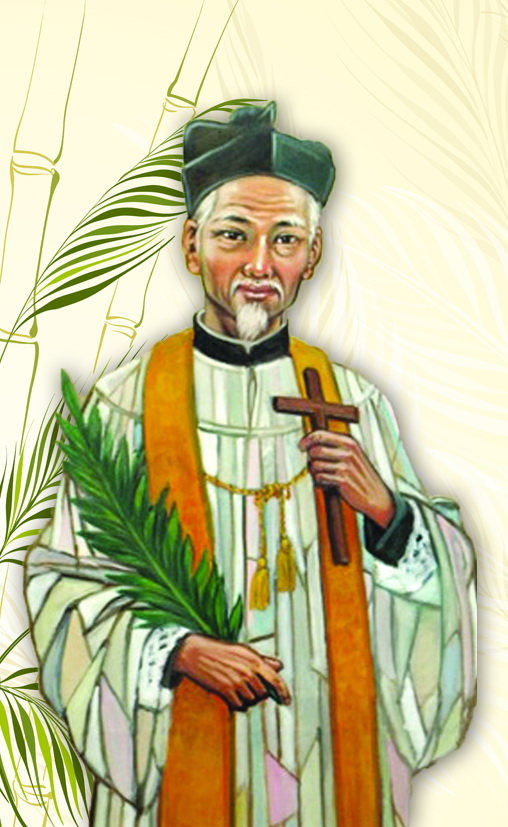
April 6--St. Paul Le-Bao Tinh, Priest and Martyr


Vietnam was evangelized by Catholic missionaries from Portugal, Spain, and then later from France. St. Paul Le-Bao Tinh was born in Vietnam in 1793. He was sent to a Catholic seminary at the age of twelve, after which he lived as a hermit until the local bishop asked him to bring missionary priests to Laos. In 1841 persecution began. He was arrested and spent seven years in prison in Hanoi. His sentence of death was commuted in 1848. He returned to the seminary and was ordained a priest. In 1855 he was again arrested and sentenced to death. In 1857 he was decapitated, as was the original St. Paul of Tarsus. St. John Paul II canonized him in 1988.

In both persecutions we have his words describing his suffering and his readiness for death: “I, Paul, bound in chains for the sake of Christ, send to you from prison salutations which are many and final… The prison is truly a living example of hell: to chains, shackles and manacles, are added anger, vengeance, lies, obscene conversations, brawls, evil acts, swearing, slander, plus boredom, sadness, mosquitoes and flies… I write these things so that your hearts might burst with desire to be martyrs, and that your prayers might strengthen me, who lives in the arena of combat.”

"My body is in your hands, please torture it as you wish, I am very happy, without any complaint. It dies but will rise again in glory tomorrow. As for my soul, it belongs to God, nothing can make me sacrifice it, no one can shake my faith. Christianity is the right religion, the true religion. I have loved and kept that religion since I was a child, and even if I die, I cannot abandon it." St. Paul Le-Bao Tinh, pray for us.

Monday, March 24, 2025

March 31--St. Benjamin, Deacon and Martyr


Vatican II reestablished the order of the diaconate as a “proper and permanent rank of the hierarchy:” “It is the duty of the deacon... to administer baptism solemnly, to be custodian and dispenser of the Eucharist, to assist at and bless marriages in the name of the Church, to bring Viaticum to the dying, to read the Sacred Scripture to the faithful, to instruct and exhort the people, to preside over the worship and prayer of the faithful, to administer sacramentals, to officiate at funeral and burial services” (Lumen gentium, 29).

Today’s saint was a deacon in this same manner in Persia in the 4th and 5th centuries. St. Benjamin was martyred in AD 424 during a persecution through two kings of Persia and for about forty years. The Eastern Roman Emperor Theodosius II was able to obtain his release after being imprisoned but with the condition that he not preach. St. Benjamin “declared it was his duty to preach about Christ and that he could not be silent.” He was then subjected to brutal torture, which killed him.

Today’s deacons may not be called to martyrdom, but they are called to preach the Gospel, to witness, and to serve the People of God in the ways directed by Vatican II. According to a study commissioned by the USCCB in 2021-2022, there were over 20,000 permanent deacons, with more than half of them in active ministry. We have been blessed by this ministry. Thus, we need to continue to promote vocations to the diaconate as well as to the priestly and religious vocations. The People of God need men and women to dedicate themselves to serving others so we may come closer to God. Be open to God’s call. St. Benjamin, pray for us.