Showing posts with label Pelagianism. Show all posts

Saturday, February 21, 2026

March 1--St. David of Wales, Abbot and Bishop


"Gwnewch y pethau bychain mewn bywyd." For those of you who don’t know Welsh, that means: “Do ye the little things in life,” the last words of today’s saint, St. David of Wales, who died around 589 A.D. Born in about 500 A.D., the grandson of a king in Wales, David became “renowned as a teacher and preacher, founding monastic settlements in Wales” and elsewhere. He attended a synod in Wales denouncing the Pelagian heresy, which stated that humans were not affected by Original Sin and we could earn our way to heaven, thus getting rid of our corporate sin and also the need of Jesus as Our Savior to die for us! Due to his speech he was elected primate of the monks in his region. He was later acclaimed archbishop. His last words were: “Lords, brothers and sisters, Be joyful, and keep your faith and your creed, and do the little things that you have seen me do and heard about. And as for me, I will walk the path that our fathers have trod before us." "Do ye the little things in life."


St. Thérèse of Lisieux also taught a “Little Way” whereby doing the ordinary things of everyday life with love bring us closer to God. Both St. David and St. Thérèse point out that holiness is everyone’s calling in life, no matter our state, our abilities, or our difficulties. Every moment is an opportunity for grace or, as Saint Padre Pio said, “The present moment is the only moment of grace.” We are chosen, called, and sent forth to bring God’s love to the world. We are the children of God who praise the love of Our Father, through his beloved Son, Our Lord and Savior, Jesus Christ! St. David, pray for us!

Monday, December 22, 2014

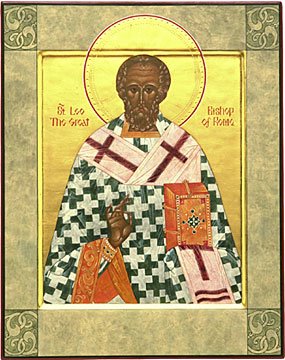
November 10--St. Leo the Great, Pope

                                  http://photos1.blogger.com/blogger/7995/1265/1600/StLeothegreat.3.jpg 
What does it take to be "Great"?  All the saints are great in holiness.  Some are greater than others with respect to their charisms, or gifts, from God.  But for a pope to be called "Great", what must he do?  Our saint of the day, Leo the Great, was called great because of his abilities to strengthen the papacy.  Leo was elected in 440, during the decline of the Roman Empire in the West.  The capital had been moved to Constantinople; the Western Roman Emperor was weak; the army couldn't defend the people from the invading barbarians; heresies were ravaging the Church.  Life was rough, to say the least.


In steps Leo, who was an amazing administrator.  He helped control the heresies of Pelagianism, which says that we don't need God's grace to choose good; Manicheism, which says that the body is evil; and Monophysitism, which says that Jesus was more God than man.  Each of these is dangerous to the faith and our understanding of the relationship we have with God.  He also stopped Attila the Hun from invading Rome and kept the barbarian Vandals from burning Rome when they invaded.

So what can we learn from this great pope?  We each have charisms that allow us to spread the Good News in our special way.  We each have our occupations, our avocations, and our relationships.  Each person develops the skills to become good at those jobs, hobbies, and relationships.  We can turn those skills into opportunities to share God's love, to serve God's people, to teach our faith in God.  Each of us is called to greatness in holiness.  We can also be "Great".