Showing posts with label November. Show all posts

Tuesday, November 12, 2024

Last Sunday in Ordinary Time--Christ the King


Why a feast for Christ the King? Because only in the Kingdom of God, with Christ as King, will we find the peace we are looking for. Pope Pius XI instituted this feast in 1925. The world had just gone through World War I. He wrote in the encyclical Quas primas: “Men must look for the peace of Christ in the Kingdom of Christ…” (1). “That these blessings may be abundant and lasting in Christian society, it is necessary that the kingship of our Savior should be as widely as possible recognized and understood, and to the end nothing would serve better than the institution of a special feast in honor of the Kingship of Christ” (21).

Jesus said: “For where your treasure is, there also will your heart be” (Mt 6:21). “If to Christ our Lord is given all power in heaven and on earth; if all men, purchased by his precious blood, are by a new right subjected to his dominion; if this power embraces all men, it must be clear that not one of our faculties is exempt from his empire. He must reign in our minds…. He must reign in our wills…. He must reign in our hearts…. He must reign in our bodies and in our members…. If all these truths are presented to the faithful for their consideration, they will prove a powerful incentive to perfection” (33).

Pope Pius XI fervently desired that we turn ourselves to Christ as King so that we may receive the blessings of love, holiness, and peace in our lives. We celebrate the Feast of Christ the King every year at the end of the liturgical calendar to look to the end of time when Christ will return in glory as King to judge all of humanity. “¡Viva Cristo Rey!”

Sunday, November 10, 2024

November 19–“Saint” Mechtild of Magdeburg, Beguine, Third Order Dominican, and Mystic

Photo: Andreas Praefcke, CC BY 3.0, via Wikimedia Commons

The language of love is one of complete self-gift of one to the other: “God is love, and he who abides in love abides in God, and God abides in him” (1 Jn 4:16). Pope Benedict XVI wrote the encyclical Deus caritas est, wherein he wrote about love as eros in a way that transcends sexuality: “True, eros tends to rise ‘in ecstasy’ towards the Divine, to lead us beyond ourselves; yet for this very reason it calls for a path of ascent, renunciation, purification and healing” (5). It is this sense of ecstasy and transcendence that the mystics touch in their writings, as well as in their prayer lives with God.

Today’s “saint”, Mechtild of Magdeburg (born about 1210, died about 1282/1297), has not been officially canonized by the Catholic Church, although some have called her saint and blessed. Yet she experienced mystical revelations from the Holy Spirit from the age of twelve and continued to write about these throughout her life, published as The Flowing Light of the Godhead. There, she describes the union of her soul with God: “O Lord, love me excessively and love often and long; the oftener you love me, so much the purer do I become; the more excessively you love me, the more beautiful I become; the longer you love me, the more holy will I become upon earth.” And elsewhere: “And he, with great desire, shows her his divine heart. It glows like red gold in a great fire. And God lays the soul in his glowing heart so that he, the great God, and she, the humble maid, embrace and are one as water with wine. … Then she says, ‘Lord! You art my beloved! My desire! My flowing stream! My sun! and I am your reflection!’” This is the language of love beyond love!


Sunday, October 29, 2023

November 7--St. Diego of Alcalá, Religious

San Diego de Alcalá by Francisco de Zurbarán licensed under PDM 1.0 DEED.

There are 21 Franciscan missions in California stretching from San Diego to Sonoma, 650 miles north. The first nine were founded by St. Junipero Serra, the first being San Diego de Alcalá, named for today’s saint. St. Diego, also known as St. Didacus, was born about 1400 in the Kingdom of Seville in Spain. He wanted to become a hermit as a child and later applied to the Observant branch of the Franciscans. He became a lay brother, that is, he was not ordained. As a friar he would do various trades as well as preach to the people in the surrounding villages. He was then sent to the Canary Islands as part of a missionary group. He became the head of the Franciscan community on one of the islands, which was unusual for a lay brother. He was filled with zeal and holiness and defended the indigenous people against the colonizers, which led to his return to Spain. He visited Rome in 1450 and served the sick during an epidemic. He returned to Alcalá, Spain, where he spent the rest of his life praying and remaining in solitude. He died on November 12, 1463 and was canonized by Pope Sixtus V in 1588, the first lay brother of the Franciscans to be so honored.

St. Diego sounds like your ordinary run-of-the-mill brother, preaching, praying, serving the poor and sick. He would probably approve of that description. But that is precisely the point of discipleship–prayer, worship, and service–the corporal and spiritual works of mercy! We are all called to be missionary disciples by our Baptism and Confirmation, sharing the love and joy of our relationship with God through Jesus Christ. We are called to holiness in our daily lives by being ambassadors of Christ. St. Diego, pray for us!  Amen!

Monday, October 24, 2022

November 1--All Saints' Day


"All Saints II" by Lawrence OP is licensed under CC BY-NC-ND 2.0.

"For all the saints who from their labors rest,
who thee by faith before the world confessed,
thy name, O Jesus, be forever blest.
Alleluia! Alleluia!"

Today we celebrate all the saints who do not have a feast day in the Church's calendar of over 10,000 saints.  That includes Grandma Mary, Uncle Joe, Cousin Susie, Neighbor Rosicky, Fr. Richard, Sr. Sarah and all the rest, who, by their lives of holiness have contributed to bringing about the Kingdom of God on earth in their own specific way.  

Because that is what it means to be a saint: one who lives by faith, hope, and love; one who strives to be holy and cares for others; one who prays for all and especially "enemies"; one who gives one's life in dedication to God and others; one who sacrifices and offers up the prayers, works, joys, and sufferings of each day in union with the holy sacrifice of the Mass throughout the world; one who shares the Good News of God's love and salvation with others; one who raises children, cares for the elderly, heals the sick, comforts the sorrowful, warns the sinner, instructs the ignorant, buries the dead, clothes the naked, shelters the homeless, feeds the hungry, bears wrongs patiently, visits the imprisoned, counsels the doubtful, forgives sins, prays, prays, and prays even more.

We are all called to be saints, to be holy.  We have so many who have gone before us who guide us, who pray for us, and who love us from heaven.  May all the saints praise God for his glory and pray that we may be forever with him and them.  Amen.

But, lo! there breaks a yet more glorious day;
the saints triumphant rise in bright array;
the King of glory passes on his way.
Alleluia! Alleluia!

Monday, November 15, 2021

November 28—St. Catherine Labouré, Religious

*


Many Catholics have a profound devotion to the Blessed Mother. We say rosaries, Memorares, and so forth, beseeching her intercession. One of those devotions is the Miraculous Medal, developed and promoted by today’s saint, St. Catherine Labouré. St. Catherine was born May 2, 1806 in the Burgundy region of France as the ninth of eleven children. She entered the novitiate of the Daughters of Charity, a religious order founded by St. Vincent de Paul in 1830.

Very soon after entering the convent, “she woke up after hearing the voice of a child calling her to the chapel, where she heard the Virgin Mary say to her, ‘God wishes to charge you with a mission. You will be contradicted, but do not fear; you will have the grace to do what is necessary. Tell your spiritual director all that passes within you. Times are evil in France and in the world.’” Later that year, she reported that Mary “displayed herself inside an oval frame, standing upon a globe; rays of light came out of her hands in the direction of a globe. Around the margin of the frame appeared the words ‘O Mary, conceived without sin, pray for us who have recourse to thee.’” She was told to take the images she saw to her confessor so they could be imprinted on medallions and given to the faithful. The medal became popular and is worn by millions of faithful Catholics. It became an important role in the declaration of the Immaculate Conception of Mary because of its declaration about Mary, “conceived without sin”. She died in 1876 and was canonized by Pope Pius XII in 1947. Let us wear this medal as a sign of our devotion to our Blessed Mother and her efforts to bring the world to her Son.
*https://upload.wikimedia.org/wikipedia/commons/c/c0/Catherine_Laboure.jpg  Unknown authorUnknown author, Public domain, via Wikimedia Commons

Wednesday, November 10, 2021

November 23—Bl. Miguel Augustín Pro, Priest and Martyr 

*

Martyrdom is the supreme sacrifice a person can offer to God, the sacrifice of one’s own life in witness to the love of God for humanity. Today’s saint was a witness to the love of God in Mexico. Bl. Miguel Pro was born in 1891 and joined the Jesuits, being ordained in 1925 in Belgium. He was in Europe for his training because the Mexican government had oppressed religious orders causing the Jesuits to flee Mexico. When he returned to Mexico in 1926, he had to go underground to serve faithful Catholics. He was arrested and released in October 1926 but kept under watch by the government. In November 1927, an assassination attempt on a Mexican government official gave the state an opportunity to arrest Bl. Miguel and his brothers. The President of Mexico gave orders that Bl. Miguel be executed without trial. 

On November 23, 1927 he was led to a courtyard and faced a firing squad. “He blessed the soldiers, knelt, and briefly prayed quietly. Declining a blindfold, he faced his executioners with a crucifix in one hand and a rosary in the other and held his arms out in imitation of the crucified Christ and shouted out, ‘May God have mercy on you! May God bless you! Lord, Thou knowest that I am innocent! With all my heart I forgive my enemies!’ Before the firing squad was ordered to shoot, Pro raised his arms in imitation of Christ and shouted, … ‘Viva Cristo Rey!’ – ‘Long live Christ the King!’. When the initial shots of the firing squad failed to kill him, a soldier shot him at point-blank range.” Bl. Miguel was beatified in 1988 by Pope John Paul II. Martyrdom may not be required of us yet, but we need to be ready to witness for Christ.
*https://upload.wikimedia.org/wikipedia/commons/b/b9/Miguel_Pro%27s_execution_%281927%29.jpg  Grentidez, Public domain, via Wikimedia Commons

Sunday, November 7, 2021

November 17—St. Elizabeth of Hungary, Holy Woman

*

For someone to be canonized within five years of death is amazing! That means the person not only lived a life of great holiness but was also an example of God’s love to a great multitude of faithful Catholics. St. Teresa of Calcutta was canonized nineteen years after her death; St. John Paul II, nine years after his. Today’s saint, St. Elizabeth of Hungary, was canonized in 1235, less than four years after her death in 1231. She is the patron of Catholic Charities and the Third Order of St. Francis. 


So who was she and why was she so beloved? St. Elizabeth was born in 1207, the daughter of the king of Hungary. She was married to the ruler of the Thuringia, in present-day Germany, at the age of fourteen, and had three children. In 1223, the Franciscans arrived, and she learned and lived by the ideals of St. Francis of Assisi, distributing alms to the poor. Her husband died on his way to the Sixth Crusade, when she was only 20. After this, her life became very difficult on account of her brother-in-law, who was regent for her five-year-old son. She took vows like those of a nun, which made her a political liability for her family, being unwilling to marry again. Her dowry was returned to her, and she built a hospital for the poor and the sick, where she and her companions cared for them. She died at the age of twenty-four. Soon after her death miracles were reported at her grave, which helped her cause for canonization in 1235. 

St. Elizabeth of Hungary is esteemed for her holiness and charity and dedication to serving others. Hers was the life of a saint in the world doing the will of God. St. Elizabeth, pray for us.

*https://upload.wikimedia.org/wikipedia/commons/b/be/Marianne_Stokes_St_Elizabeth_of_Hungary_Spinning_for_the_Poor.jpg

Monday, November 1, 2021

November 8—Bl. John Duns Scotus, Priest and Religious

*

It only took 685 years for today’s saint to be beatified after his death! John Duns was a Franciscan priest and friar born about 1265/66 and died in 1308. He is called Duns Scotus meaning Duns the Scot because he was from Scotland. He was a philosopher and theologian graduating from Oxford University. He is called “the Subtle Doctor” because of his complex and nuanced thought. He taught a metaphysical argument for the existence of God through the concepts of cause and effect. He also advocated for free will by stating that a person cannot stop what the person is doing if there is no free will; and yet people can stop what they are doing! 

He also defended the teaching of the Immaculate Conception of Mary, following St. Anselm of Canterbury’s principle: “God could do it, it was appropriate, therefore he did it!” In other words, according to Bl. Pope Pius IX, who infallibly defined the dogma of the Immaculate Conception in 1854: “At the moment of her conception, Mary was preserved free from the stain of original sin, in view of the merits of Jesus Christ.” 

Philosophy is the handmaiden of theology! What this means is that the Church uses philosophy to help us understand what God supernaturally reveals to us by using our natural reasoning ability, which God gave to us! We are not fideists, meaning, all we do is believe blindly and not think. Nor are we rationalists, meaning, all we do is use our own unaided reason as the ultimate basis of truth or falsehood and thus not believe. We believe and we think! One is a supernatural gift, faith, and the other is a natural gift, reason. By using both we can share what we believe in a rational manner. Bl. Duns Scotus, pray for us!

*https://upload.wikimedia.org/wikipedia/commons/c/ce/JohnDunsScotus_-_full.jpg 
Justus van Gent, Public domain, via Wikimedia Commons

Sunday, December 1, 2019

November 18--St. Rose Philippine Duchesne, Religious and Missionary

File:DuchesneRSCJ.jpg*
“Go West, middle-aged woman.” That is where today’s saint, St. Rose Philippine Duchesne, went to fulfill her calling in America, teaching among the pioneers and Native Americans of the American frontier of Missouri and Kansas.

Born in 1769, St. Rose started out as a nun in a French convent in the late 18th century. During the French Revolution, her convent closed, and she took it upon herself to care for the poor and sick, opened a school for street children, and helped priests. After that she joined the Society of the Sacred Heart, where she became a superior and a supervisor of the novitiate. But she still longed to go to America to work among the Native Americans. She finally got the chance when she was 49. She and four other sisters sailed to New Orleans and up the Mississippi to St. Louis, where she started the first free school for girls west of the Mississippi in St. Charles, Missouri. She also founded the first Catholic Native American school. At the age of 72, retired and in poor health, she went to a new mission in Sugar Creek, Kansas, about 50 miles south of Kansas City and worked among the Potawatomi. She could not teach, but prayed while others taught. She was named “Woman-Who-Prays-Always.” She died in 1852 at the age of 83 and canonized in 1988.

What does it take to be a pioneer? It doesn’t mean “Go West” in location, but rather “Go West” in love; go to those who need the most help, the poor, the outcast, the young, the hurting, the homeless. Expect hardship and suffering, but do so to offer it up in love for the grace of God to be showered on those whom we serve, as well as ourselves.

*https://commons.wikimedia.org/wiki/File:DuchesneRSCJ.jpg

Sunday, November 3, 2019

November 12--St. Josaphat, Bishop and Martyr


*


In 1995, Pope St. John Paul II declared: “The Church must breathe with her two lungs!” (Ut Unum Sint, 54) What he meant was that the Church was only breathing with one lung, namely the Western Church. He declared that we needed the Eastern Church as well. The Catholic Church has been separated from her Eastern Orthodox sister churches since 1054. However, since then, there have been efforts at union. One prominent event toward union was the Union of Brest in 1596. Seven Orthodox bishops in Lithuania/Poland/Ukraine came into full communion with the pope, while still retaining their Eastern Rites.

Why is this important for our saint? He became an archbishop in one of these dioceses after 1596. St. Josaphat was born in 1580 to Ruthenian Orthodox Catholic parents. After the Union of Brest he became a monk in 1604 in the Ruthenian Rite. His zeal for his faith led him to write catechisms and apologetics, defenses of the Church. He defended the rights of the Eastern Rite Churches, but some opposed him on the grounds that he was trying to “go Latin” and not be faithful to the Eastern traditions.

In 1623, an Orthodox priest insulted St. Josaphat and tried to force his way into the archbishop’s residence. St. Josaphat had him removed, but he had assembled a mob, which then attacked St. Josaphat, shooting him and hitting him in the head with a battle axe, killing him. He was canonized in 1867 as a martyr.

The Eastern Orthodox and Roman Catholic Churches have the same sacraments, the same faith, and the same love of God. However, the difference between the two is the role of the pope. Pope St. John Paul II wrote about the need for unification. May the prayers of St. Josaphat bring us into communion with each other.

*https://commons.wikimedia.org/wiki/File:St_Josaphat_Zbarazh.jpg


Sunday, October 27, 2019

November 3--St. Martin de Porres, Religious

*

Humility is the hallmark of holiness. Such is true for today’s saint. St. Martin de Porres was born of a Spanish conquistador and a freed slave woman in 1579. He became a lay brother in Lima, Peru. He was trained as a physician, but he also had the gift of healing. His monastery became a place of healing for the poor of Peru.

But where does humility come in? St. Martin did not want anyone to know of his gift of healing, so he would use an herb or some other device to hide his gift. However, he was found out by the Archbishop of Mexico, who was passing through Lima. The archbishop was in great pain and suffering from a fever. He knew of St. Martin’s healing ability and sent for him. The Dominican superior sent him immediately to the archbishop before St. Martin could gather his healing materials. When he arrived at the archbishop’s residence, the archbishop ordered him to reach out his hand. St. Martin did not want to, but the archbishop required obedience of St. Martin. He stretched out his hand and put it on the archbishop’s chest, taking away his pain. The archbishop required him to leave his hand on his chest and his fever and illness disappeared. St. Martin was embarrassed at this and retreated to the monastery.

As Pope St. John XXIII remarked of him at his canonization in 1962: "He tried with all his might to redeem the guilty; lovingly he comforted the sick; he provided food, clothing and medicine for the poor; he helped, as best he could, farm labourers and Negroes, as well as mulattoes, who were looked upon at that time as akin to slaves: thus he deserved to be called by the name the people gave him: 'Martin of Charity.'"

*https://www.google.com/url?sa=i&source=images&cd=&ved=2ahUKEwjJ0NmAhr7lAhUTJjQIHVcRAhEQjRx6BAgBEAQ&url=https%3A%2F%2Fwww.flickr.com%2Fphotos%2Fpaullew%2F7149072617&psig=AOvVaw3MKis4MmM1tshCNVM3t6ce&ust=1572320906588295

Sunday, November 4, 2018

November 16--St. Gertrude the Great, Virgin


There are few saints that are called “the Great”, four popes; Gregory I, Leo I, Nicholas I, and John Paul II; as well as a Dominican bishop, Albert. But today’s “the Great” was a woman, the only woman so designated in the Catholic Church. 

St. Gertrude the Great was a Benedictine nun who was a mystic and theologian. She was born in 1256 in Germany and went to the Cistercian monastery school at the age of five. She excelled in her education, especially “in literature, philosophy, song, and the refined art of miniature painting.” After time in the monastery school she entered religious life and became a nun. When she was 24 she had a crisis of faith and at the age of 25 she saw Jesus as an adolescent who said to her: “I have come to comfort you and bring you salvation.” It was after this that she dedicated her studies to Scripture, the Church Fathers, and theological writings. She died in 1301 and was elevated to sainthood through equivalent canonization in 1677.

She wrote many works, but her primary influence is as an early devotee of the Sacred Heart of Jesus. Her writings on the Sacred Heart are “notable within the history of Christian devotion because of their vivid descriptions of her visions, which show a considerable elaboration on the long-standing but ill-defined veneration of Christ’s heart.”

The devotion to the Sacred Heart has a long history in the Church, promoted in its earliest form by St. Gertrude and others. It is about the absolute and complete love Jesus has for each one of us, so much so that he gave his life in sacrifice for our sins and to attain for us salvation. It is love that kept Jesus on the cross, not the nails! Thank you St. Gertrude the Great, for this insight.

Sunday, November 12, 2017

November 21--The Presentation of the Blessed Virgin Mary


The Presentation of Mary is based not on Scripture, but on the Protoevangelium of James, a document that is not accepted as revealed, written about AD 145. Some may object to having a non-canonical source for a liturgical celebration, but its heritage is ancient, going all the way back to AD 543 with the dedication of the Basilica of St. Mary the New under Emperor Justinian I in Jerusalem. It was introduced into the Latin Church in the 14th century. Bl. Pope Paul VI reaffirmed in his Apostolic Exhortation, Maria cultus, “For the Right Ordering and Development of Devotion to the Blessed Virgin Mary,” that some feasts “apart from their apocryphal content, present lofty and exemplary values and carry on venerable traditions having their origin especially in the East” (para. 8).

This is true of the Presentation of Mary, which is about the tradition of how “Mary as a small child was presented to the Lord by her parents in the Temple.” This matters because it shows how Mary was dedicated to God from the very beginning of her life. This continues the chain of events in Mary’s life beginning with her Immaculate Conception, leading to the Annunciation and birth of Christ. Mary is the disciple above all others. She shows us how to live our lives by her selfless devotion to God.

We are called to be disciples. We are called to be holy. We are called to the Kingdom of God. We can best give ourselves over to Jesus by following Mary’s example. We were taught as children to love Jesus. We are the children of God and the children of Mary. Let us invoke Mary to pray for us “now, and at the hour of our death. Amen.”

Tuesday, November 7, 2017

November 15--St. Albert the Great, Bishop and Religious


It is rare when a pupil outshines the teacher, but that is the case with today’s saint. However, St. Albert the Great was the teacher and his pupil was St. Thomas Aquinas. St. Albert was a German Dominican. The Dominicans were great preachers and great scholars and St. Albert was among the greatest. He founded the University of Cologne in German, was made bishop of Regensburg, taught in universities, wrote prolifically (His collected works number thirty-eight volumes!), and had an encyclopedic knowledge on numerous topics, including the natural sciences. When he was canonized he was named the patron saint of natural scientists.

There is much fuss and commotion now-a-days about the supposed incompatibility of science and faith. Some say that science can explain everything. Some say that faith doesn’t need science. Both statements are wrong. The natural sciences are human efforts to discover the truths of the universe, which was made by God. Faith does not tell us the details of how the universe works, it tells us that God has a plan for us and that the created universe is a part of that plan. Science is a gift from God that helps us work out the amazing wonder of the universe. Physics, chemistry, biology, geology, botany, and more are awe-inspiring disciplines both in themselves and what they can tell us of the awe-inspiring creation of God!

St. Albert the Great knew the complementarity of science and faith. He wrote, “The aim of natural philosophy (science) is not simply to accept the statements of others, but to investigate the causes that are at work in nature.” He knew that the ultimate cause of nature was God. His great student, St. Thomas developed that in his understanding of God as the “uncaused cause” of all that is.

Sunday, October 29, 2017

November 13--St. Frances Xavier Cabrini, Religious


Today's saint was the first American citizen to be canonized. She was born in Italy in 1850 and died in Chicago in 1917. In 1880 she and six other women founded the Missionary Sisters of the Sacred Heart of Jesus. They came to America in 1889 at the urging of Pope Leo XIII, who wanted her to serve the Italian immigrants. During her 38 years in America she lived a life of dedication to those poor immigrants from Italy who had found their way to America only to lose their faith. She bolstered their faith and founded 67 institutions "dedicated to caring for the poor, the abandoned, the uneducated and the sick." She is the patron saint of immigrants.

We all came from somewhere. Our families originated in Europe, Africa, Asia, or the Americas. Our ancestors braved tragedies, wars, famine, drought, flood, economic hardships, and more so that they could raise their families in a new land with new opportunities for a better life. A better life also needs to be a holy life. But being immigrants means being aliens in a foreign land. Our ancestors needed help. Men and women like St. Frances Xavier Cabrini came to America as missionaries, serving all the poor they encountered, living the corporal and spiritual works of mercy. In turn, we who have benefited from their sacrifice need to feed the hungry, heal the ill, teach the ignorant, shelter the homeless, warn the sinner, protect the vulnerable for all those who are still looking to America as a beacon for hope and opportunity. America is still a land of immigrants. We still need to be like Mother Cabrini.

November 11--St. Martin of Tours, Bishop


The story goes like this: He was a Roman soldier on his horse when he met a nearly naked beggar. He cut his military cloak in half and gave it to the man. That night, he dreamed of Jesus wearing the cloak he cut off. He heard Jesus saying to the angels, “Martin, who is still but a catechumen, clothed me with this robe.” Thus, the saintliness of St. Martin of Tours was established.

The truth may not be far from the legend. St. Martin was a soldier in the Roman army in the 4th century when he declared his allegiance to Christ. He had become a monk and a hermit when he was going to Tours in France and was made bishop by popular acclamation. He founded a monastery near Tours as well as other monastic communities in his diocese. He is one of the first non-martyrs of the Church to have been called a saint.

Finding Jesus in the poor, and marginalized goes back to Jesus’ own words in the Parable of the Last Judgment (Mt. 25:31-46): “‘For I was hungry and you gave me food, I was thirsty and you gave me drink, a stranger and you welcomed me, naked and you clothed me, ill and you cared for me, in prison and you visited me.’ Then the righteous will answer him and say, ‘Lord, when did we see you hungry and feed you, or thirsty and give you drink? When did we see you a stranger and welcome you, or naked and clothe you? When did we see you ill or in prison, and visit you?’ And the king will say to them in reply, ‘Amen, I say to you, whatever you did for one of these least brothers of mine, you did for me.’” May we imitate St. Martin of Tours in giving to others and thus, giving to Christ.

Monday, December 22, 2014

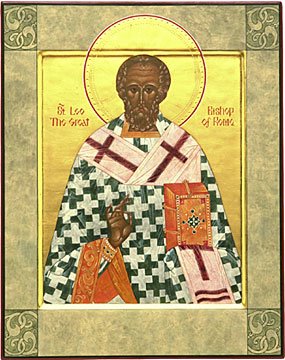
November 10--St. Leo the Great, Pope

                                  http://photos1.blogger.com/blogger/7995/1265/1600/StLeothegreat.3.jpg 
What does it take to be "Great"?  All the saints are great in holiness.  Some are greater than others with respect to their charisms, or gifts, from God.  But for a pope to be called "Great", what must he do?  Our saint of the day, Leo the Great, was called great because of his abilities to strengthen the papacy.  Leo was elected in 440, during the decline of the Roman Empire in the West.  The capital had been moved to Constantinople; the Western Roman Emperor was weak; the army couldn't defend the people from the invading barbarians; heresies were ravaging the Church.  Life was rough, to say the least.


In steps Leo, who was an amazing administrator.  He helped control the heresies of Pelagianism, which says that we don't need God's grace to choose good; Manicheism, which says that the body is evil; and Monophysitism, which says that Jesus was more God than man.  Each of these is dangerous to the faith and our understanding of the relationship we have with God.  He also stopped Attila the Hun from invading Rome and kept the barbarian Vandals from burning Rome when they invaded.

So what can we learn from this great pope?  We each have charisms that allow us to spread the Good News in our special way.  We each have our occupations, our avocations, and our relationships.  Each person develops the skills to become good at those jobs, hobbies, and relationships.  We can turn those skills into opportunities to share God's love, to serve God's people, to teach our faith in God.  Each of us is called to greatness in holiness.  We can also be "Great".

November 2--All Souls' Day


*

V. Eternal rest grant unto them, O Lord.
R. And let the perpetual light shine upon them.

And may the souls of the faithful departed, through the mercy of God, rest in peace.
Amen.

November 2 is All Souls' Day, when we offer our prayers for the souls in Purgatory.  These are the members of the Church Suffering, those who need to be purified of the temporal punishment due to sins already forgiven.  They are headed for heaven!  They are among the saved!  They are ancestors, friends, relatives, and acquaintances.  They have a relationship with Jesus and us.  We pray for their eventual entrance into heaven.

Why is there a Purgatory?  If we love God and we are sorry for our sins, isn't that enough?  Well, if I break someone's computer and I apologize, isn't that enough?  The answer to both questions is, "No!"  I need to make reparation or restitution.  Sacramentally, that means penance.  Thus when we go to Confession, we are given a penance to help heal the harm we have done to the Church and strengthen ourselves to resist future sin.  Confession is good for the soul and for the Church.  Purgatory is also good for the soul and the Church!

If we are not ready to see God, we need to be made ready.  If we are not purified of the punishment we deserve for our sins while we are on Earth, we need to be purified in Purgatory.  However, the Church also offers consolation for those in Purgatory, namely our efforts.  We, as members of the Church Militant, those battling against evil, can offer our prayers, works, joys, and sufferings on their behalf.  So let us pray for all the souls in Purgatory that they may be united forever with God in heaven.
*https://commons.wikimedia.org/wiki/File:Candles_placed_at_the_graves_during_the_All_Souls%27_Day_ceremony_of_Homage_and_Remembrance_at_Newark_Cemetery._Picture,_Laurence_Goff_http-www.panoramio.com-photo-113342510_-_panoramio.jpg

Sunday, January 12, 2014

November 30—St. Andrew, Apostle


St. Andrew was the first apostle called by Jesus. John the Baptist pointed out Jesus to him and the future apostle, John: "'Behold the Lamb of God.' The two disciples heard what he said and followed Jesus. Jesus turned and saw them following him and said to them, 'What are you looking for?' They said to him, 'Rabbi' (which translated means Teacher), 'where are you staying?' He said to them, 'Come, and you will see.' He found his own brother Simon and told him, 'We have found the Messiah'" (Jn. 36-39, 41).

What are we looking for? Success, a career, comfort, money, stability, respect, adventure, love? God has planted in our hearts a desire for him. St. Augustine wrote, "Our hearts are restless until they rest in you." God wants us to look for him. He wants us to find him. It is in our deepest desires that God calls us to him. When we hear the call we need to respond with love.

Andrew responded, in love, by bring his brother Simon Peter to Jesus. Who do we bring to Jesus? Who do we love? We are called to bring our spouses, our children, our colleagues, and everyone we meet to a closer relationship with Jesus. By our actions and prayers we can be more like St. Andrew.

Specifically, we can honor Jesus in the hearts of others. God rests in the deepest recesses of our hearts. He speaks to us from there. He calls us to respond with love to his presence in the hearts of every human being. Heart speaks to heart in love. And where there is love, there is God. Then God sends us out as disciples to bring his love to the world.  St. Andrew, pray for us.

November 22--St. Cecilia, Virgin and Martyr


Today is the feast day of patroness of the Archdiocese of Omaha, St. Cecilia.  According to legend, St. Cecilia was married, but decided to remain a virgin.  She warned her husband that an angel guarded her.  When he wanted to see the angel, she told him he needed to be baptized.  He was and he saw the angel.  His brother also converted and the two dedicated themselves to burying the martyrs.  Eventually Cecilia was arrested and condemned to death by suffocation in the baths, which were like our modern spas.  She survived and was condemned to die by beheading.  The executioner tried three times and then left her to die, but she survived for three days, whereupon she died.

St. Cecilia’s life and death are a matter of legend due to the lack of verifiable witnesses.  However, there were martyrs throughout the early Church.  St. Cecilia is also the patroness of music due to her hearing heavenly music in her heart when she was married.  Omaha is the only diocese that has her patronage.

Music raises our spirits, reflects our mood, changes our mood, and allows us to sing and worship God.  “The true purpose of sacred music, … ‘is [for] the glory of God and the sanctification of the faithful.’”  We sing in Mass so that we may glorify God, raising our hearts and souls and voices in praise together.  We are grateful for the musicians and song leaders and choir members who help us, in the words of St. Augustine, “pray twice” when we sing.