Showing posts with label Pope. Show all posts

Saturday, April 11, 2026

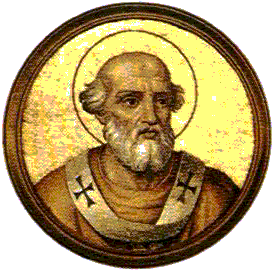
April 19--Leo IX, Pope


The Church has always reformed itself, meeting the needs of each age, but still remaining in continuity with Jesus and the Apostles. Today’s saint, Leo IX, was one of the great papal reformers of the Church. The son of a count and cousin of an emperor, he was a soldier and officer in his cousin’s army. Then he was chosen to be bishop of Toul, France in 1027, where he remained for twenty years. Although he was proposed as pope by Emperor Henry III in 1049, he waited until he received the approval of the clergy and the people of Rome. As bishop and soldier he was disciplined, bringing that discipline to the papacy to reform the Church. Thus, we have the start of the great reforming popes of the eleventh century.

He enforced clerical celibacy, condemned simony (the buying and selling of Church positions) and personally deposed those bishops who were guilty, encouraged liturgical reform, and prohibited clergy from being involved in violence. He also foreshadowed Pope St. John Paul’s efforts at showing the unity of the Church by traveling throughout Europe and personally encouraging and enforcing reforms through councils and synods in Italy, France, and Germany. He sent a delegate to Constantinople to support the Latin rite there, but that eventually resulted in the Great Schism in 1054 after his death. He reaffirmed the real presence of Jesus Christ in the Eucharist, foreshadowing the Church’s dogmatic declaration of that truth at the Council of Trent in 1551. Furthermore, to prevent imperial interference in the selection of the pope, he proposed the use of cardinals as electors of the pope. He also brought the future Pope St. Gregory VII with him to Rome who continued his reforms. The Church is always reforming! Pope St. Leo IX, pray for us!

Sunday, October 5, 2025

October 12--St. Wilfrid, Bishop


Can bishops be political? We often want our bishops to be above politics, arguing that their work is directed toward God and not toward the world. And yet, bishops are called to be ministers to all, teaching the faith and upholding the dignity of the human person as a child of God. To that end, they are necessarily political, helping form public policy to support the God-given, natural human rights of both the unborn (CCC 2270-2275) and the immigrant (CCC 2241)!

Today’s saint was deeply political! St. Wilfrid was born in 633 and raised in northern England becoming a monk, abbot, and eventually the Bishop of York. He worked with kings to bring about Christianity in various parts of England only a generation after the reintroduction of Christianity by St. Augustine of Canterbury in 597. He established new Catholic communities and monasteries and, at the time, built the largest church north of the Alps. He helped the English Church follow the Roman method of setting the date for Easter. He was also exiled three different times by different kings of the various Anglo-Saxon kingdoms of England, each time appealing to Rome, and each time being upheld by the pope. He died in 709 at a monastery he founded in Mercia, England.

Our bishops need to be political! Jesus sent his Apostles out to the world with the instruction: “Behold, I am sending you like sheep in the midst of wolves; so be shrewd as serpents and simple as doves” (Mt. 10:16).  When dealing with the leaders of the people our bishops can follow the example of St. Wilfrid. As our bishops are in union with Rome and the pope, they will strive to fulfill God’s will for God’s people. We are all called to do the same. St. Wilfrid, pray for us.

Tuesday, May 13, 2025

May 18--St. John I, Pope and Martyr


“Habemus Papam!”  At the time of this writing, May of 2025, the conclave of cardinals in Rome elected Robert Prevost, of Chicago, Illinois, U.S.A., Pope Leo XIV.  We pray for him and his successful tenure as 267th pope and shepherd of the Catholic Church.  Well and good!


We also honor St. John I, pope and martyr, who was elected in AD 523 and was martyred in AD 526 at the hands of a heretic king.  St. Martin I was the last pope to be martyred in AD 653.  Nonetheless, every pope is the successor to Peter, the Rock, who was told by Jesus:  “‘Amen, amen, I say to you, when you were younger, you used to dress yourself and go where you wanted; but when you grow old, you will stretch out your hands, and someone else will dress you and lead you where you do not want to go.’  He said this signifying by what kind of death he would glorify God. And when he had said this, he said to him, ‘Follow me.’”


Pope St. John I was martyred because he succeeded in accomplishing what Theodoric, the Arian King of Italy, requested of him:  accommodations with the Byzantine emperor to avoid persecution of the Arians in the East.  Such was St. John’s success that Theodoric suspected him of conspiracy with the emperor and thus imprisoned him upon his return to Italy with the favorable news!  St. John died in prison.  


Every pope is called to witness the faith.  Pope Leo XIV stated: “I also want to … walk together with you, as a united Church always seeking peace, justice, always trying to work as men and women faithful to Jesus Christ, without fear, to proclaim the Gospel, to be missionaries.”  St. John I, pray for us!

Thursday, April 3, 2025

April 13–St. Martin I, Pope and Martyr


What happens when one does the right thing for the right reason in the right way but then is arrested, convicted, and exiled? He, St. Martin I, becomes the last pope to be martyred. Pope St. Martin I became pope in AD 649. What he did that got him arrested and martyred in 653 by the emperor was to condemn the heresy of Monothelitism, which the emperor supported.


Monothelitism stated that Jesus had only one will, a divine will, but not a human will. This was over 200 years after the Council of Chalcedon adopted the Tome of Pope St. Leo the Great, which had declared that Jesus Christ was one divine person with two natures, one divine and one human. To say that Jesus had one divine will is to deny him a human will and thus any human freedom in what he did or said. To say that he had only a divine will means that he was not really human because humans have a human will. Another problem with Monothelitism is that if Jesus only had a divine will then our human will is not saved. “What is not assumed is not saved,” according to St. Athanasius. God not only became incarnate by assuming human nature, but also by assuming all that it means to be human, and that means having a human will!


St. Martin I taught the truth and suffered: “Then Jesus said to his disciples, ‘Whoever wishes to come after me must deny himself, take up his cross, and follow me’” (Mt. 16:24). We are all called to love, to take up our crosses, and follow Jesus. This will lead to suffering, but we offer it up in turn to Jesus, who loves and strengthens us. Pope St. Martin I, pray for us.

Tuesday, August 1, 2023

August 7--St. Sixtus II, Pope and Martyr, and Companions, Martyrs


From the time of St. Peter to the legalization of Christianity by Emperor Constantine I in A.D. 313, 27 of the 31 popes were martyred! That is a rate of 87%. Talk about “most dangerous jobs!” And these were not ordinary executions by today’s standards. The popes were crucified, beheaded, tied to an anchor and tossed into the sea, worked to death, and killed by the sword, to name a few of the methods. And yet these men were willing to be successors to Peter to maintain the leadership of the Church.

Today’s saints were no different! Pope St. Sixtus II was pope from 257-258, being martyred on August 6, less than a year after his election. His companions were deacons of the Church. The most famous deacon at this time, St. Lawrence, was martyred four days later and has his own feast day. Pope St. Sixtus was arrested while saying Mass in the cemetery of St. Callistus under the persecution of the Emperor Valerian and executed. The following epitaph was placed on his tomb by Pope St. Damasus I:

“At the time when the sword pierced the bowels of the Mother, I, buried here, taught as Pastor the Word of God; when suddenly the soldiers rushed in and dragged me from the chair. The faithful offered their necks to the sword, but as soon as the Pastor saw the ones who wished to rob him of the palm (of martyrdom) he was the first to offer himself and his own head, not tolerating that the (pagan) frenzy should harm the others. Christ, who gives recompense, made manifest the Pastor's merit, preserving unharmed the flock.” We owe much to our shepherds. They are willing to undergo suffering for the sake of their sheep. Let us pray for our popes!

Wednesday, December 14, 2022

December 31--St. Sylvester I, Pope


"The Lord gave and the Lord has taken away; blessed be the name of the Lord" (Job 1:21).  This famous saying seems to indicate that whoever gives has the ability to remove what was given.  If that is so, then how does the Catholic Church exist, except by the allowance of the state?  It's a fair question that had to be dealt with by today's saint, Pope St. Sylvester I (AD 314-335).  Emperor Constantine I granted the Church the right to freedom of religion in the 313 Edict of Milan.  This was a great gift to the Church because now it could exist without fear of off-and-on persecution; it could preach and influence the populace so as to win disciples to Christ; and it had the backing of the emperor, who remained in power for over 30 years.

So how did St. Sylvester I deal with this strong and benevolent ruler?  We don't know!  There is not a lot of knowledge of St. Sylvester's rule, except by inference.  We know he was pope at the same time as Constantine was emperor.  We know that he approved of the decisions of the Council of Nicaea in AD 325, called by that same emperor.  We know that the emperor donated buildings, land, and privileges to the Church.  Yet, we know that the Church did not become the tool and "yes-man" of the emperor.  That means that St. Sylvester must have been wise and skilled in diplomacy.  That doesn't mean that Constantine didn't try to use the Church to further his imperial ambitions.  He did.  But the Church remained the Church and not a department of state.  St. Sylvester I can guide us in the virtue of prudence so we can bring about God's will in the face of strong, and sometimes, oppositional, forces.


Monday, December 5, 2022

December 11-St. Damasus I, Pope

AlekjdsCC BY-SA 4.0, via Wikimedia Commons

He was pope, but he was opposed by a faction who elected another man pope, an anti-pope, which resulted in factional violence.  He was accused of murder and adultery, but eventually cleared himself in both civil court and a Church synod.  These are not particularly auspicious events in the life of a pope!

St. Damasus I, pope from A.D. 366-384, lived in the time of the Church when it was no longer officially persecuted.  Emperor Constantine I signed the Edict of Milan in A.D. 315, which allowed freedom of religion, thus finally legalizing Christianity.  The Catholic Church then enjoyed the privileges of peace!  During his papacy, the Catholic Church was named the state religion of the Roman Empire by Emperor Theodosius I in 380.  So, it fell to St. Damasus to make sure that the Catholic Church did not fall into error, condemning numerous heresies, especially Arianism, which taught that Jesus was not God!  He also commissioned St. Jerome, his personal secretary, to write an updated translation of the Bible into Latin, called the Vulgate.  He also called the Council of Rome in 382 to codify the official canon of Sacred Scripture, which was identical to that declared as dogma at the Council of Trent in the 16th century.

St. Damasus was quite a busy man, with controversies, successes, and setbacks.  How does his life reflect on today's situation?  One, popes are not universally liked.  Two, popes are not always appreciated for what they do and sometimes opposed.  Three, popes are given to us by God to do the hard work of shepherding Jesus' flock, which can be quite difficult.  Four, popes deserve our respect and prayers regardless of their popularity or ability to persuade us of God's ways for us.  May God give us holy men to shepherd us.

Monday, October 4, 2021

October 14—St. Callistus I, Pope and Martyr


*


“Blessed are the merciful, for they will be shown mercy” (Mt. 5:7). Today’s saint lived a life that needed mercy and he gave mercy to others. St. Callistus I was born a slave in the late 2nd century, and as a young man was put in charge of donated funds to care for Christian widows and orphans. However, he lost the funds and fled the city. He was captured and given the chance to recover the money. However, he was arrested for getting into a fight trying to collect debts. Then he was denounced as a Christian and sent to the mines. He was eventually released and taken under the wing of the pope, eventually ordained as a deacon, and put in charge of a Christian cemetery, called the Catacombs of St. Callistus, which were rediscovered in 1849. He was elected pope in AD 217. 

During his papacy he was attacked for being merciful to Christians who had violated Church or civil law: 1. He admitted to Communion those who had done public penance for murder, adultery, and fornication; 2. He held as valid marriages between free women and slaves; 3. He ruled that mortal sin was insufficient to depose a bishop; 4. He allowed apostates who denied their faith during persecution back into the Church. He was martyred in AD 222.

We live in a time when mercy is hard to come by. If we do not follow the “proper” political, social, or moral standards we are cancelled and reviled. Jesus says: “But rather, love your enemies and do good to them, … then your reward will be great and you will be children of the Most High, for he himself is kind to the ungrateful and the wicked. Be merciful, just as your Father is merciful” (Lk. 6:35-36).
*https://live.staticflickr.com/4129/5080579818_8a38769a52_b.jpg

Thursday, July 30, 2020

August 13--Sts. Pontian, Pope and Martyr, and Hippolytus, Priest and Martyr

aretino hashtag on Twitter*
File:Dieric Bouts & Hugo van der Goes - Triptiek van de Heilige Hippolytus.jpg**

Two men, both Christian but opposed to each other; one a pope for only five years, the other an anti-pope for 18 years; both arrested and sent to Sardinia to die a “living death” in the mines around 235/236. However, both are saints. St. Pontian was pope from 230-235 and, when arrested to be exiled, resigned his office as pope, the first to do so. St. Hippolytus entered into schism with St. Pontian’s predecessors on the grounds that the pope did not condemn a heresy strongly enough. He was then elected pope by his followers, the first anti-pope. However, in Sardinia he became reconciled with the Church. St. Hippolytus is also known for his theological and liturgical writings. 

So what brings two such different men together to be celebrated as saints on the same day? St. Hippolytus was a “holier than the Church” sort of man and St. Pontian was a pope who had to make difficult decisions, including a resignation that led to the end of the schism St. Hippolytus began. Perhaps reconciliation is the key to the mystery!  

Reconciliation is the key to our relationship with God. Without our conversion, our repentance, our turning back, our metanoia, we cannot be reconciled with the God who made us, loves us, and saved us through his own passion, death, and resurrection. Jesus started his ministry proclaiming his Gospel in Galilee: “This is the time of fulfillment. The kingdom of God is at hand. Repent, and believe in the gospel” (Mk 1:15). He ended his ministry on the cross in Jerusalem: “Jesus cried out in a loud voice, ‘Father, into your hands I commend my spirit’; and when he had said this he breathed his last” (Lk 23:46). He reconciled us to the Father and brought us into communion with our God.

*http://faith.nd.edu/s/1210/faith/interior.aspx?sitebuilder=1&pgid=15938&cid=32078&ecid=32078&ciid=104285&crid=0
**https://commons.wikimedia.org/wiki/File:Dieric_Bouts_%26_Hugo_van_der_Goes_-_Triptiek_van_de_Heilige_Hippolytus.jpg

Sunday, September 8, 2019

September 16--St. Cornelius, Pope and Martyr

*

What would happen today if someone threatened to kill or harm us if we were Christian? There are modern martyrs in the Church. But what if we denied our faith? In the third century, when St. Cornelius was pope, persecution was an off and on problem for the Church. It happened sporadically, but intensely. When the persecution subsided, those Christians who had denied their faith to avoid martyrdom wanted to be readmitted to the Church. The question facing St. Cornelius was whether, and how, to readmit lapsed Christians.

One option was to deny the lapsed Christians any forgiveness and readmission to the Church. This was supported at various times and by various Church leaders leading to schisms and heresies. The other option was to use the Sacrament of Penance as a means of readmitting the sinners back into the Church. Pope St. Cornelius advocated this approach. Pope St. Cornelius was opposed by Novatian, who became an anti-pope. Novatian was condemned, but his schism spread to other places in the empire. The Synod of Rome in 251 affirmed the pope’s decision and the lapsed Christians were welcomed back according to the “medicines of repentance.” Pope St. Cornelius died a martyr during exile by the emperor in A.D. 253.

The Church teaches us in the Catechism: “Without being strictly necessary, confession of everyday faults (venial sins) is nevertheless strongly recommended by the Church. Indeed the regular confession of our venial sins helps us form our conscience, fight against evil tendencies, let ourselves be healed by Christ and progress in the life of the Spirit. By receiving more frequently through this sacrament the gift of the Father's mercy, we are spurred to be merciful as he is merciful….” Let us use the “medicines of repentance” to bring us closer to God!


*https://wellcomecollection.org/works/fa53bzw9

Thursday, January 4, 2018

January 20--St. Fabian, Pope and Martyr


What would you do if a dove landed on you and the people around you then declared you pope? According to a Church historian of the fourth century, that is exactly what happened to St. Fabian. The previous pope had died and St. Fabian had come into the city of Rome. Many men were proposed as popes, but when a dove landed on St. Fabian, the people took it as a sign and he was elected pope then and there. Besides this story we know very little about him. He was martyred in 250 at the start of a major persecution under the emperor, Decius.

Signs are indicators of what is or what should be done. A “Stop” sign means we should stop at an intersection. A “Sale” sign indicates that there is something that can be bought for a lower price than usual. For the people of Rome, a dove landing on St. Fabian was a sign to choose him pope.

What other signs does God send to us? We have the “Sign of the Cross” which demonstrates our faith in the Trinity and the redemptive death of Jesus. We have the sign of the sacraments, symbols which bring about what they indicate: Baptism, new life in Christ; Eucharist, the Body and Blood of Jesus; Reconciliation, a return to a loving relationship with God. God places other signs in front of us every day: his presence in each one of us. We are signs of his love to others. We are signs of his efforts to bring about his Kingdom, as we pray, “Thy kingdom come.” When we look in the mirror do we see his love in our faces? Do we mirror his love? As St. Fabian was chosen by a sign, let us be a sign of choosing God’s love.

Sunday, September 17, 2017

May 29: St. Paul VI, Pope


St. Pope Paul VI is a much-misunderstood pope. He was elected after the death of Pope St. John XXIII in 1963 and continued Vatican II. He then implemented the reforms until his death in 1978. The reforms of Vatican II included reforming all the sacraments so that they were better understood and celebrated by the people; the understanding of who we are as Church; what the Church’s relationship with the world is; and relations with non-Catholic Christians and non-Christians.

St. Pope Paul VI also served the Church during the times of great social upheaval and changes in social and sexual mores throughout the world. He issued his last encyclical, Humanae Vitae to help the Church and the world deal with many issues concerning sexual behavior and family life. Many in Europe and America opposed it. It condemned artificial birth control as intrinsically evil on the grounds that it is opposed to the generation of life in the act of contracepting, which is contrary to Catholic Church teaching as well as natural law. Sacramental marriage is about being in union with God as well as one’s spouse: “Love is total—that very special form of personal friendship in which husband and wife generously share everything, allowing no unreasonable exceptions and not thinking solely of their own convenience. Whoever really loves his partner loves not only for what he receives, but loves that partner for the partner's own sake, content to be able to enrich the other with the gift of himself” (8,9).

St. Pope Paul VI also reaffirmed other doctrines of the Church, including a male priesthood, which was declared dogma by St. John Paul the Great in 1994. He may have been misunderstood, but that is the lot of prophets, and Saint Pope Paul VI is our modern-day prophet.

Friday, July 17, 2015

May 25--St. Gregory VII, Pope


What happens when a ruler wants to take over the Church?  Our saint today had that problem back in the  eleventh century.  Pope St. Gregory VII was pope at a time when the emperor was trying to control the Church through his investing of authority to bishops.  If Emperor Henry IV could "hire" the bishops, then he could control them and rule them, and the Church, the way he ruled the empire.  This corrupt use of power was called lay investiture, giving authority to leaders of  the Church by lay rulers.

Pope St. Gregory VII was a reforming pope.  Before he became pope he was an advisor to popes in their efforts to help the Church retain their religious rights and liberties against local rulers who wanted to make those bishops and abbots another part of the government.  Gregory excommunicated Henry at one point, but Henry repented and Gregory lifted the excommunication.  Whereupon, Henry consolidated his power, gathered his forces, arrested Gregory, and exiled him, where Gregory died.

The Church as the right to minister as she sees fit without restriction by the government.  She has the right to teach the faith.  She has the right to choose who may teach the faith and the right to require those teachers to be faithful to her teachings. She as the right to serve the poor without being required to follow the latest government dogmas on a new and unjust standard of equality.  She has the right to speak out against injustices perpetrated by the government.  Pope St. Gregory VII would recognize ours as a time of struggle between Church and State.  Pope St. Gregory VII, pray for us.

Monday, December 22, 2014

November 10--St. Leo the Great, Pope

                                  http://photos1.blogger.com/blogger/7995/1265/1600/StLeothegreat.3.jpg 
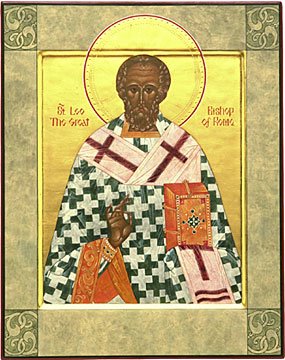
What does it take to be "Great"?  All the saints are great in holiness.  Some are greater than others with respect to their charisms, or gifts, from God.  But for a pope to be called "Great", what must he do?  Our saint of the day, Leo the Great, was called great because of his abilities to strengthen the papacy.  Leo was elected in 440, during the decline of the Roman Empire in the West.  The capital had been moved to Constantinople; the Western Roman Emperor was weak; the army couldn't defend the people from the invading barbarians; heresies were ravaging the Church.  Life was rough, to say the least.


In steps Leo, who was an amazing administrator.  He helped control the heresies of Pelagianism, which says that we don't need God's grace to choose good; Manicheism, which says that the body is evil; and Monophysitism, which says that Jesus was more God than man.  Each of these is dangerous to the faith and our understanding of the relationship we have with God.  He also stopped Attila the Hun from invading Rome and kept the barbarian Vandals from burning Rome when they invaded.

So what can we learn from this great pope?  We each have charisms that allow us to spread the Good News in our special way.  We each have our occupations, our avocations, and our relationships.  Each person develops the skills to become good at those jobs, hobbies, and relationships.  We can turn those skills into opportunities to share God's love, to serve God's people, to teach our faith in God.  Each of us is called to greatness in holiness.  We can also be "Great".

Saturday, October 18, 2014

October 11--St. John XXIII (Angelo Roncalli), Pope

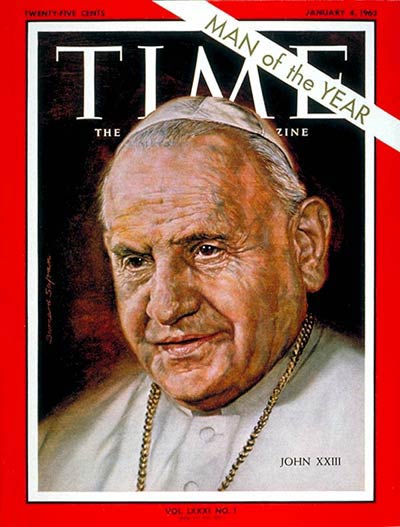
File:Pope John XXIII - Time Magazine Cover - January 4, 1963.jpg*


"Habemus papam."  "We have a pope!"  We also have a saint!  St. John XXIII was canonized saint along with St. John Paul II on April 27, 2014.  St. John XXIII was an unlikely candidate for pope.  He was almost 78 years old when elected.  Many believe that he was elected to be a care-taker pope, to serve and not make waves until the next pope could be elected.  But he surprised everyone when he called for an ecumenical council, which became Vatican II.  About his decision to call the council, he said, "I want to throw open the windows of the Church so that we can see out and the people can see in."

He was called "Good Pope John", a term of endearment for a loving man.  He visited the imprisoned in Regina Coeli prison and told the prisoners, "You could not come to me, so I came to you."  He had a warmth and wit that the Church had not seen before in such a high office.  When asked how many people worked in the Vatican, he said, "About half of them."  He also quipped, "Anyone can become a pope, look at me!"  Concerning his role as pope, he once remarked, "It often happens that I wake up at night and begin to think about the serious problems afflicting the world and I tell myself, I must talk to the pope about it.  Then the next day when I wake up I remember that I am the pope."

Humor is often an unappreciated virtue.  God gave us  the ability to laugh and to joke and to make fun of the foibles of life.  St. Teresa of Avila once said, "From silly devotions and sour-faced saints, Lord deliver us."  Yes, there is much sadness and travail in the world, but there is much to rejoice in.  God is good.  He gave us the portly and holy, happy man, Pope St. John XXIII.
*https://commons.wikimedia.org/wiki/File:Pope_John_XXIII_-_Time_Magazine_Cover_-_January_4,_1963.jpg

Monday, September 1, 2014

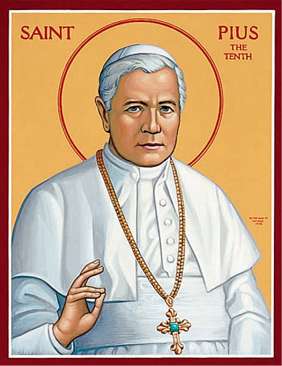
August 21--St. Pius X, Pope


The first pope to be declared a saint in the 20th century was also the first pope elected in the 20th century, Pope St. Pius X.  He came from peasant stock, which was unusual among papal candidates.  He accomplished many things as pope:  he lowered the age for first reception of Communion and Penance to the age of reason; began Catholic Action, an organization for the laity to be involved in service to the community; condemned the heresy of Modernism, which asserted that dogma could evolve over time; codified canon (Church) law; encouraged frequent reception of the sacraments; and led a holy life worthy of example.

What can we hope to follow from such a saint?  Undoubtedly, his humility.  He knew who he was and was respectful of his origins from poor peasant parents.  That did not limit his abilities or his responsibilities to respond to the opportunities that God set before him.  He led the People of God to live lives of greater holiness by the frequent reception of the sacraments.  He changed the practice of receiving Communion from about the age of 13 or 14 to about seven so we could receive Jesus earlier and more often.  Attendance at daily Mass became more common.  

Humility is knowing who we are.  We are children of God and the way we grow in our identity as children of God is by coming closer to God, especially in the sacraments of Reconciliation and Holy Communion.  So let us humbly follow the example of Pope St. Pius X by frequently going to Confession and receiving the Eucharist.

Sunday, February 9, 2014

February 22—The Chair of St. Peter the Apostle


How is it that a chair gets a feast?  As with many things in the Catholic Church, there is symbolism behind giving a feast to a chair.  Chairs can represent many things:  a role in a discussion as in, “pull up a chair”; the authority of a judge as in the judge’s bench; the responsibility of a monarch as in the king’s throne.  But for the Church, a chair represents the role of the bishop as priest, prophet, and servant.  Each bishop has his cathedral.  Cathedra is Latin for chair.  And in the cathedral is the bishop’s chair where he presides.


The Chair of St. Peter the Apostle then stands for the authority of the pope, a singular mark of the Roman Catholic Church.  “The Chair represents [the pope’s] mission as guide of the entire People of God.  Celebrating the ‘Chair’ of Peter means attributing a strong spiritual significance to it and recognizing it as a privileged sign of the love of God” (Pope Benedict XVI).  He has many titles which indicate his roles and duties:  Bishop of Rome, Vicar of Jesus Christ, Successor of the Prince of the Apostles, Supreme Pontiff of the Universal Church, Primate of Italy,  Archbishop and Metropolitan of the Roman Province, Sovereign of the Vatican City State, and Servant of the servants of God.  The pope has been given this authority for the sake of the Church, for the People of God.  His authority as pope is one that, ultimately, is meant for our salvation.  And so we pray for our pope, Pope Francis, that he may guide us by the Spirit of God to walk in the way of Jesus to become united with the Father in heaven.

Sunday, January 12, 2014

October 22—St. John Paul II (the Great), Pope


“Totally Yours”.  That was the motto of Bl. John Paul.  It described his personal consecration to the Virgin Mary.  It is from a prayer by St. Louis de Montfort who wrote extensively about Mary.  The whole prayer is translated:  “I belong entirely to you, and all that I have is yours. I take you for my all. O Mary, give me your heart.”


Now Bl. John Paul is totally ours as well.  He will be canonized April 27, 2014 along with his predecessor Bl. John XXIII.  For many growing up in the eighties, nineties, and all the way to 2005, John Paul was our pope.  He spoke to us from his heart.  He guided us through his encyclicals and teachings and the Catechism of the Catholic Church.  He showed us the way to holiness by the beatification of 1,340 people and the canonization of 483 saints.  He helped us to live in faith, hope, and live by establishing World Youth Day.  He brought about a new world by helping to free Europe from communism.  He taught us dignity by his suffering and death.  He left us a legacy of a true understanding of being authentically human by giving us Theology of the Body.


Bl. John Paul gave himself utterly and completely to God and now God has given him back to us.  When we read his great social justice encyclicals, On Human Work, On Social Concern, and On the Hundredth Anniversary, we learn of the message of human dignity, solidarity, concern for the poor, and the right to life.  He wrote The Gospel of Life to warn against the culture of death that permeates our society today.  He wrote The Splendor of Truth and Faith and Reason to guide us in right thinking and the right use of philosophy.  Perhaps the greatest philosopher the papacy has ever known, he will be for many the greatest pope we have ever loved.