Monday, January 25, 2021

February 4—St. Joan of Valois, Holy Woman

*


Today's saint was, for a time, Queen of France.  However, as is the case with all saints, suffering beset her throughout her life.  Jeanne de Valois was born in 1464, the second daughter of King Louis XI of France.  She was afflicted with a physical handicap, possibly curvature of the spine, which allowed others to disparage her.  She was forced into marriage with her cousin Louis, who also treated her poorly.  Nonetheless,  when Louis was rebelling against her brother, King Charles VIII and was captured by him, Joan pleaded for his life and administered the duchy.  Eventually Duke Louis was released and became King Louis XII after the death of his brother-in-law.  One would think things would get better for Joan, but Louis wanted more territory and so appealed to the pope for an annulment from his marriage to her, citing lack of consent and her deformity as a cause for lack of consummation of the marriage.  St. Joan objected but the pope granted the annulment for political reasons.

St. Joan became the Duchess of Berry and formed a community dedicated to the Annunciation in 1500.  She and her spiritual director wrote the rule, and the community was established as a branch of the Poor Clares in 1504.  She renounced her title and possession and became a nun on Pentecost, 1504.  She died less than a year later.  The nuns still have monasteries in Europe and Costa Rica and religious sisters serve in Europe, Africa, and Guatemala.

St. Joan's treatment was unjust!  She did step aside and prayed for her husband.  St. Joan accepted her annulment ordeal in the spirit of the Annunciation, saying:  "Be it done to me and her own if so it is to be."  May we be as forgiving when mistreated!  St. Joan, pray for us.

*By Jean Perréal - http://www.anuncjatki.pl/assets/images/mniszki/jeanne.jpg, Public Domain, https://commons.wikimedia.org/w/index.php?curid=16021386

Monday, January 4, 2021

Sunday after Epiphany: The Baptism of the Lord

*

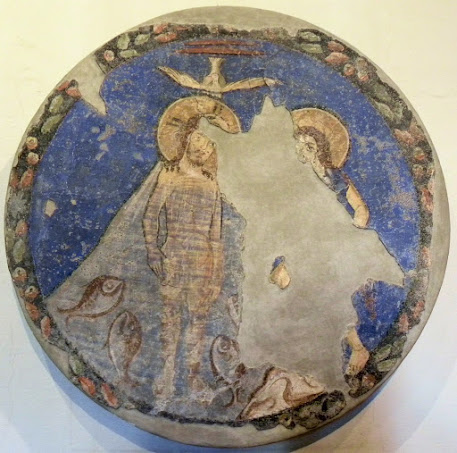
Merry Christmas!  This is the last day of the Christmas season, but it celebrates the first day of Jesus' public ministry.  Thus, the Church connects the birth of Jesus, the beginning, with the Paschal Mystery, the end!  Each Gospel has the Baptism of Jesus in it with variations.  Mark's version is the shortest with a statement of the baptism followed by a theophany, or the visible manifestation of God, with the Holy Spirit represented as a dove, and God the Father speaking from the heavens approving of God the Son.  Matthew adds John's objection to baptizing Jesus because John is not worthy.  Luke adds a historical element by naming the political leaders of the time as well as some of John's teachings.  The Gospel of John has John the Baptist giving testimony to Jesus' Baptism as though he were in a court of law.  He also calls Jesus the "Lamb of God, who takes away the sin of the world" (Jn. 1:29).

The Baptism of Jesus is also important for the post-Ascension Christian community when they chose a replacement for Judas:  "Therefore, it is necessary that one of the men who accompanied us the whole time the Lord Jesus came and went among us, beginning from the baptism of John until the day on which he was taken up from us, become with us a witness to his resurrection" (Acts 1:21-22).

We are baptizes so that we may fulfill the command of Jesus:  "Go, therefore, and make disciples of all nations, baptizing them in the name of the Father, and of the Son, and of the holy Spirit, teaching them to observe all that I have commanded you" (Mt. 28:19-20).  As we share in the life of Christ, we call others to share in Christ's life, his life of love. 

*https://www.flickr.com/photos/ian-w-scott/7420840650


Tuesday, December 22, 2020

January 1--Solemnity of Mary, the Mother of God

*

Merry Christmas!  The feast of Mary, Mother of God is the eighth day of the Octave of Christmas.  January 1 was originally the Feast of the Circumcision, when Jesus was given his name in the Temple, as was the custom of the Jewish people going back to Abraham.  It shows that Jesus, the Son of God, is truly, man, the New Adam, son of a woman, the New Eve.  In 1960, January 1 was simply part of the Octave of the Nativity.  But in 1969, with the revision of the Roman calendar, January 1 became the Solemnity of Mary the Mother of God.

So why all the changes and why is the feast about Mary and not Jesus?  Well, the feast IS about Jesus.  It is still the Octave of Christmas.  We celebrate Mary because she is the Mother of God!  In the fifth century a heresy was proposed that Mary was the mother of Jesus, and was the mother of the Messiah,  but NOT that she was the mother of God.  The reasoning of the heresy, Nestorianism, was that Mary could not be the mother of the God who created her.  In other words, the logic of human procreation was applied to the Incarnation of Jesus, which was NOT human procreation!  That is NOT the faith of the Church!

The Church taught that since Jesus IS truly God, the Son of God and IS truly man, the son of Mary; then Mary, his mother, IS truly the Mother of God!  The word used in Greek is Theotokos, or "God-bearer".  So, we celebrate January 1, the eighth day of the Octave of Christmas, the day on which Jesus was circumcised into the Jewish covenant, as the day of the maternity of Mary, who was the Ark of the New Covenant, the MOTHER OF GOD, JESUS!
* https://pxhere.com/en/photo/1174875  


Thursday, December 10, 2020

December 25--The Nativity of Our Lord

*
Critics of Christianity sometimes like to point out that Jesus wasn’t born on December 25, or Christmas was instituted by the Emperor Constantine, or the Christians were just using a pagan holiday called Saturnalia to lure pagans into worshiping Christ. Given that the Jewish concept of birthdays was not we have, there are reasons to think it is reasonable to use December 25. The feast of the Annunciation is March 25, which is nine months before Christmas and also held by the ancient Church as the date of Jesus’ Crucifixion and Resurrection. The first recorded Christmas celebration was in AD 336, during the reign of Constantine. And even though Saturnalia was not the basis of Christmas, Christians did take pagan holidays and Christianize them to help convert the people through their culture.

But all that, interesting as it may be, is not the point. The point is that God became man. The incarnation began at the Annunciation, but the birth of Jesus is the birth of the new era of reconciliation between God and humanity. To quote John: “In the beginning was the Word, and the Word was with God, and the Word was God. And the Word became flesh and made his dwelling among us, and we saw his glory, the glory as of the Father’s only Son, full of grace and truth” (Jn 1:1, 14). We are the recipients of the greatest gift ever given, Jesus Christ, who, through his Paschal Mystery brought about our salvation. What can we do to respond to such a great gift? We can say thank you. We can give others the gift of our love. We can praise God with joy and offer mercy and grace to our neighbors. We can say “Merry Christmas”!

*https://pixy.org/529082/

Friday, August 21, 2020

August 30--St. Jeanne Jugan, Virgin and Foundress

File:Jeanne Jugan par Nadar.JPG*

Two different societies were founded in the 19th century called Little Sisters. Today’s saint, Jeanne Jugan, also known as Mary of the Cross, founded the Little Sisters of the Poor in France. She was born in 1792 in Brittany, France and grew up during the terrors of the French Revolution. She dedicated much of her young life to helping others. In 1837 she and two other women lived together to pray, teach the catechism, and help the poor. In 1839 St. Jeanne met an elderly woman who was blind, paralyzed, and alone on a cold winter night. St. Jeanne took her home and gave the woman her own bed. She and the women who were serving others then became a religious community. In 1849 they adopted the name Little Sisters of the Poor. In 1852 St. Jeanne was forced into retirement and barred from leadership by the chaplain assigned to the order, who took upon himself the title of founder. She lived in obscurity and humility in her community for twenty-seven years, but was a heroine to the young novices. After her death in 1879, the chaplain was stripped of his titles and St. Jeanne was acknowledged as foundress.

St. Jeanne advised a novice: “When your patience and strength run out and you feel alone and helpless, Jesus is waiting for you in the chapel. Say to him, ‘Jesus you know exactly what is going on. You are all I have, and you know all things. Come to my help.’ And then go, and don’t worry about how you are going to manage. That you have told God about it is enough. He has a good memory.” Humility is a difficult virtue to cultivate, especially in the face of injustice. However, we are called to be children of God in humility.
*https://commons.wikimedia.org/wiki/File:Jeanne_Jugan_par_Nadar.JPG

Thursday, August 13, 2020

August 26--St. Teresa Jornet Y Ibars, Virgin, Religious, and Foundress

File:TereJornet.jpg*

"You have returned to the anguished faces of people venerable for their old age, the serenity and the joy of experiencing again the benefits of a home. You have been chosen by God to reinforce to the world the sacred dimension of life, … [that] man … is enthusiastically sacred because he is the Son of God and always deserves all the vigilance because he is predestined to an eternal destiny" (Paul VI, 1/27/1974).

These words from Pope St. Paul VI proclaim the holiness of today’s saint, St. Teresa of Jesus Jornet, as well as the mission she embarked upon. St. Teresa was born in 1843 in Spain and co-founded a religious order in 1873 that was completely dedicated to helping the elderly poor, the Little Sisters of the Abandoned Elderly. Her order spread throughout Spain to include more than one hundred houses by the time she died in 1897. She spent the rest of her life tending their needs. Today over 200 houses exist in Europe, Africa, and the Americas.

Although St. Teresa’s Little Sisters are not the same as the Little Sisters of the Poor being persecuted in the United States, there are similarities. Both were founded by women in Europe in the 19th century, one in France, the other in Spain, to serve the elderly poor. Both have spread out throughout the world with over 2,000 sisters. The Spanish government was anti-clerical and kept St. Teresa from becoming a religious in 1868. However, it did not succeed in stopping her. The American government had demanded that the Little Sisters of the Poor provide health insurance to their employees that included contraceptives and abortion coverage. As of this writing, the American government has not succeeded. We pray for those who give their lives to Jesus in our elderly poor.


*https://commons.wikimedia.org/wiki/File:TereJornet.jpg


Friday, August 7, 2020

August 16--St. Stephen of Hungary, Holy Man

Hungary-02209 - St. Stephen | PLEASE, NO invitations or self… | Flickr*


The conversion of a nation or people requires two things, the proclamation of the Good News of Jesus Christ and someone around whom Christianity focuses. In Ireland it was St. Patrick; in Germany, St. Boniface; in Bohemia, St. Wenceslas; and in Hungary, St. Stephen. St. Stephen was the first king of Hungary, crowned around AD 1000. Hungary was one of the last areas of Europe to be Christianized. Stephen was born pagan but was baptized as a child by St. Adalbert of Prague and was a devout Christian. His father imposed Christianity by force, but still worshipped pagan gods. After his father died, he was named leader of the Magyars, the people of Hungary, but then claimed kingship of Hungary. This led to consolidation of his rule. He did this by spreading Christianity throughout Hungary, establishing dioceses which were independent of the Holy Roman Empire. He forced his subjects to give up pagan rituals. He also fought pagan opponents. After consolidating power, he opened a new pilgrimage route to Jerusalem through Hungary, often meeting pilgrims. With peace and a land route to the Holy Land, his fame spread. He set up counties, with the county seats becoming a center of Church organization. He died in 1038 after a 43-year reign. He was canonized in 1083.

Missionaries are the first to bring Christianity to new peoples, but their work needs to be supported. In Europe, much of that support was given through rulers. St. Stephen of Hungary brought about the Christianization of Hungary, which also helped maintain Hungary’s culture. Christianization does not impose an outside colonialization but brings out the best of the native culture through the glory of God. Catholics are members of a universal Church embodied in a specific culture and people. Thus, we can say, “God bless America!”

*https://www.flickr.com/photos/archer10/32611649955