Showing posts with label August. Show all posts

Sunday, August 17, 2025

August 30--St. Fiacre, Priest and Abbot


The Catholic Church recognizes patron saints from Academics–St. Thomas Aquinas and St. Albert the Great to Zoology–St. Albert the Great again! Today’s saint is the patron saint of Gardeners. St. Fiacre was born in Ireland about A.D. 600 and died in A.D. 670 in France. He grew up in a monastery, was ordained a priest, and eventually became an abbot. As people came to him because of his reputation for holiness and healing he went to France to become a hermit. He built a hermitage for himself and a hospice for travelers about 50 miles northeast of Paris. There he planted a vegetable and herb garden and an oratory in honor of the Blessed Virgin Mary. He lived a life of self-denial, prayer, fasting, vigils and healing by laying on of hands. Veneration towards him seems to be based on his healing abilities as well as his holiness. His patronage of gardeners is based on his gardening abilities.

Every good act we do can be an act of love for God and others. Gardening may bring joy through the beauty of flowers and health through the nourishment of fruits, and vegetables. Tilling the soil may allow us to focus our minds and hearts on prayer to God in praise and on behalf of others. Tending the yard may bring peace. Scripture envisioned earthly paradise as a garden: “The LORD God then took the man and settled him in the garden of Eden, to cultivate and care for it” (Gn. 2:15). Furthermore: “You make the grass grow for the cattle and plants for people’s work to bring forth food from the earth, wine to gladden their hearts, oil to make their faces shine, and bread to sustain the human heart” (Ps. 104:14-15). St. Fiacre, pray for us.

Sunday, August 10, 2025

August 17--St. Joan of the Cross, Religious and Foundress

 
“Again I say to you, it is easier for a camel to pass through the eye of a needle than for one who is rich to enter the kingdom of God” (Mt. 19:24). The U.S. has the world’s largest economy by measurement of the nominal GDP. What does that say to us? Well, let’s see what possession of wealth said to today’s saint!

St. Jeanne Delanoue, aka St. Joan of the Cross, was born in France in 1666 (died 1736) as the youngest of twelve to parents who owned a business. After her parents died she took over the business and became successful, due in part to her shrewdness, but also due in part to greed, to the point of keeping the store open on Sundays, which was against the traditions of the time. However, a poor widowed pilgrim “converted” her during the days of Pentecost. In his canonization homily, St. John Paul II stated: “Known as a prudent and self-interested merchant, she suddenly became ‘very generous in charity,’ when the Holy Spirit, extinguishing ‘the fire of her avarice,’ made her understand that her ardent faith also required ‘the fire of charity,’ showing her the extent of poverty.” And so she changed her ways, founded a religious order, and started to serve “all those who on the Day of Judgment might say to her: I was hungry, thirsty, naked, sick, homeless.”

So what does her life say to us? Again St. John Paul II guides us: “Her example will certainly challenge our modern world.” Too true! We need to root out and address the causes of poverty. “But attention to the poor, and immediate and effective aid, remain essential to remedying the harshness of our world.” We can be benefactors! St. Joan of the Cross, pray for us.

Sunday, August 18, 2024

August 30--St. Euphrasia Eluvathingal, Virgin


The Church is not only Catholic, but catholic. The word catholic means universal. It was mentioned by St. Ignatius of Antioch in AD 110 to distinguish the Church from heretical groups. This is worthwhile for today’s saint because she is from India. The Catholic Church is all over the world! St. Euphrasia Eluvanthingal (1877-1952) was born in Karal State, which is on the Malabar Coast of India, where tradition has it that the apostle Thomas evangelized the people. She joined the Carmelite Order of the Syro-Malabar Church, which is an Eastern Catholic Church in union with Rome. She was a novice mistress at her convent and then Mother Superior. She became known as the “Praying Mother” due to her life of prayer and devotion to the Sacred Heart. She was canonized by Pope Francis in 2014. It is written of her: “Mother Euphrasia grew in humility, poverty and holiness as she completely obeyed the will of God every moment. The whole life of this virgin was full of continuous prayer, penance and reparation. Mother Euphrasia who found contentment in loving Jesus, her divine spouse, was always in the forefront in receiving censure and abuses. All those who approached her she helped with motherly love, prayer and good advice.”

The Church is one, holy, catholic, and apostolic. We are united as one through our faith and baptism. Sainthood is conferred on those who have demonstrated heroic virtue and holiness in their lives, giving us models to draw from. We are catholic in that we are all called to be with Jesus in community with the Catholic Church. We are apostolic because of the continuous succession of bishops and popes from Peter and the apostles. St. Euphrasia exemplified each of these marks through her life and holiness. St. Euphrasia, pray for us!

Sunday, August 11, 2024

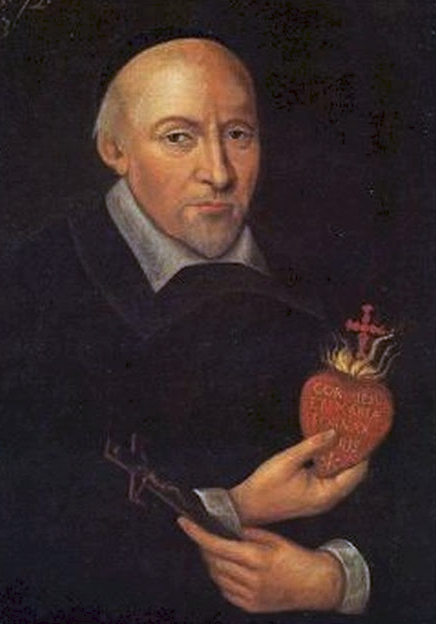
August 19–St. John Eudes, Priest and Founder

Anonymous, St. John Eudes, Public Domain, Wikimedia Commons.


Priests are the backbone of parish life. A good pastor can help his parish grow in love for God and each other, building parish life. But how does one become a good priest? That was the problem that today’s saint, St. John Eudes, faced when he decided to found the Congregation of Jesus and Mary. He founded and staffed three seminaries. St. John Eudes (1601-1680) was ordained in 1625 in France and eight years later became a parish missionary, going from parish to parish to preach renewal, giving 110 missions.

Pope Benedict XVI, in a general audience during the Year of the Priest in 2009, said, “Prompted by a lucid awareness of the grave need for spiritual assistance in which souls lay because of the inadequacy of the majority of the clergy, the Saint, who was a parish priest, founded a congregation specifically dedicated to the formation of priests. He founded his first seminary in the university town of Caen, a particularly appreciated experience which he very soon extended to other dioceses. The path of holiness, which he took himself and proposed to his followers, was founded on steadfast trust in the love that God had revealed to humanity in the priestly Heart of Christ and in the maternal Heart of Mary. In those times of cruelty, of the loss of interiority, he turned to the heart to speak to the heart, a saying of the Psalms very well interpreted by St Augustine. He wanted to recall people, men and women and especially future priests, to the heart by showing them the priestly Heart of Christ and the motherly Heart of Mary. Every priest must be a witness and an apostle of this love for Christ's Heart and Mary's Heart.” We need good priests! St. John Eudes, pray for us!

Sunday, August 4, 2024

August 13--St. Radegund, Religious


Daughter of a king, kidnapped at age twelve, married to the King of France as his fifth wife and subsequently mistreated by him due to her life of prayer and service, today’s saint, St. Radegund (520-587), withstood such abuse. However, her husband had her brother murdered, which prompted her to go to the bishop to allow her to become a nun. When he hesitated in fear of the king, she demanded, “If you refuse to consecrate me a deaconess, you fear man more than God, and he will require you to account for my soul.” The bishop acquiesced. After this, St. Radegund wrote, “I asked myself, with all the ardor of which I am capable, how I could best forward the cause of other women, and know, if our Lord willed, my own personal desires might be of advantage to my sisters.” She founded a double monastery–for men and women–Holy Cross in Poitiers, France. She was known for her asceticism and her learning.

Some say that the Church does not respect women because women are not ordained. Wherein does power lie? Not in ordination. Look to St. Radegund as a model of power. She founded a double monastery and served others. True power is about humility, love, and service. Jesus said, “You know that the rulers of the Gentiles lord it over them, and the great ones make their authority over them felt. But it shall not be so among you. Rather, whoever wishes to be great among you shall be your servant; whoever wishes to be first among you shall be your slave. Just so, the Son of Man did not come to be served but to serve and to give his life as a ransom for many” (Mt. 20:25-28). Love is power! St. Radegund, pray for us!

Sunday, July 28, 2024

August 8--St. Mary MacKillop, Virgin, Religious, and Foundress


She is the first saint of Australia and, at one time, was excommunicated by her bishop. Now that’s a headline! The daughter of Scottish immigrants, St. Mary MacKillop was born in Melbourne in 1842. As a teen she became a governess and eventually taught at a school and opened her own boarding school. In 1866 Fr. Julian Woods invited her and her sisters to open a Catholic school. That same year other women joined St. Mary and they became the Sisters of St. Joseph of the Sacred Heart, also known as the Josephites. The local bishop invited them to found a new school. The religious community developed a rule which “emphasized poverty, a dependence on divine providence, no ownership of personal belongings, faith that God would provide and willingness to go where needed.”

They expanded, but this sometimes caused issues about control of the schools. Bishops wanted episcopal control, while St. Mary MacKillop wanted control of the schools by the religious order. Two bishops told the sisters to leave their dioceses and another excommunicated her on grounds that she was insubordinate. Eventually, the excommunication was lifted. St. Mary persevered, her order was approved by Pope Leo XIII and their structure, living in the community and not in convents, along with the superior general being chosen by the congregation, was maintained. They primarily educated children, but also served the poor and those in need. St. Mary MacKillop died in 1909 and was canonized by Pope Benedict XVI in 2010. Today there are over 600 Josephites serving in six countries.

It takes a strong will as well as a loving, holy life to become a saint! Sometimes, our fallen brothers and sisters in the Church can be a source of suffering! Let us not be discouraged! St. Mary MacKillop, pray for us.

Monday, July 1, 2024

August 3--St. Lydia of Thyatira, Holy Woman


“We set sail from Troas, … and from there to Philippi.  On the sabbath we went outside the city gate along the river where we thought there would be a place of prayer.  We sat and spoke with the women who had gathered there.  One of them, a woman named Lydia, a dealer in purple cloth, from the city of Thyatira, a worshiper of God, listened, and the Lord opened her heart to pay attention to what Paul was saying.  After she and her household had been baptized, she offered us an invitation, ‘If you consider me a believer in the Lord, come and stay at my home,’ and she prevailed on us” (Acts 16:11a, 12a, 13-15).

This reading is from the Easter season, telling the story of the first convert of Europe–St. Lydia. This passage shows how Paul, like Jesus, received support from women. Lydia was a dealer in purple cloth, which meant that she was involved in an industry that involved great wealth. Only the rich or the royal could afford purple cloth. She was wealthy. Furthermore, she is the head of the household–her household is baptized. She offers the invitation. All these indicate that Lydia was a strong, independent, wealthy, businesswoman! Paul accepted her invitation and her house became a house church.

St. Lydia played a pivotal role in the evangelization of Europe. Women play pivotal roles in the evangelization of others: their families, their friends, their colleagues, their community. St. John Paul II wrote in his Letter to Women in 1995: “Thank you, every woman, for the simple fact of being a woman! Through the insight which is so much a part of your womanhood you enrich the world's understanding and help to make human relations more honest and authentic.” St. Lydia, pray for us!

Tuesday, August 1, 2023

August 7--St. Sixtus II, Pope and Martyr, and Companions, Martyrs


From the time of St. Peter to the legalization of Christianity by Emperor Constantine I in A.D. 313, 27 of the 31 popes were martyred! That is a rate of 87%. Talk about “most dangerous jobs!” And these were not ordinary executions by today’s standards. The popes were crucified, beheaded, tied to an anchor and tossed into the sea, worked to death, and killed by the sword, to name a few of the methods. And yet these men were willing to be successors to Peter to maintain the leadership of the Church.

Today’s saints were no different! Pope St. Sixtus II was pope from 257-258, being martyred on August 6, less than a year after his election. His companions were deacons of the Church. The most famous deacon at this time, St. Lawrence, was martyred four days later and has his own feast day. Pope St. Sixtus was arrested while saying Mass in the cemetery of St. Callistus under the persecution of the Emperor Valerian and executed. The following epitaph was placed on his tomb by Pope St. Damasus I:

“At the time when the sword pierced the bowels of the Mother, I, buried here, taught as Pastor the Word of God; when suddenly the soldiers rushed in and dragged me from the chair. The faithful offered their necks to the sword, but as soon as the Pastor saw the ones who wished to rob him of the palm (of martyrdom) he was the first to offer himself and his own head, not tolerating that the (pagan) frenzy should harm the others. Christ, who gives recompense, made manifest the Pastor's merit, preserving unharmed the flock.” We owe much to our shepherds. They are willing to undergo suffering for the sake of their sheep. Let us pray for our popes!

Monday, July 24, 2023

August 5--St. Mary Major, Basilica


The Catholic Church honors four church buildings in the liturgical calendar due to their roles as ancient churches in Rome: St. John Lateran, the mother church of the Catholic Church; St. Peter’s, which is above the burial site of St. Peter; St. Paul’s Outside the Walls, which is above the burial site of St. Paul; and St. Mary Major, to honor Mary as the Mother of God. These four churches were the original major basilicas of the Catholic Church. “Basilica” is a title given to a church by the pope to have special privileges due to its history or importance. The reason St. Mary Major has a feast is because it was built immediately after the Council of Ephesus in 431, which declared that Mary was not just the mother of Jesus, or the mother of the Messiah, but the Mother of God. It is the oldest church in the West dedicated to the honor of the Blessed Virgin Mary.

We can see that the understanding of Mary’s role in the Church goes back centuries, even to before the dedication of St. Mary Major. Mary’s role as Mother of God is foundational for God’s divine plan of salvation. We celebrate Mary, the Mother of God; the Annunciation, Mary’s fiat to being the Mother of God; the Immaculate Conception, God’s gift of freedom from Original Sin from the time of her existence; the Assumption of Mary body and soul into Heaven; the Most Holy Name of Mary; the Birth of Mary; the Queenship of Mary; Our Lady of Sorrows; Our Lady of the Rosary; Our Lady of Guadalupe; Our Lady of Lourdes; Our Lady of Fatima; and more! Why? Because she is the Mother of God! She is our Mother! She intercedes for us! She loves us! Thank God for Mary!

Sunday, August 22, 2021

August 31—St. Raymond Nonnatus, Priest and Religious


*


Jesus sacrificed his life for the redemption of all humanity. That is the heart of the Paschal Mystery of Jesus’ suffering, death, Resurrection, and Ascension. As Christian disciples we also suffer each day and offer up the difficulties and trials as part of our participation in the Paschal Mystery so we may help others to come to Jesus and ourselves to heaven. But imagine a person ransoming someone with his own life, releasing another from slavery and thus becoming a slave. That happened to today’s saint. 

St. Raymond Nonnatus was born in Spain around 1203. The nickname Nonnatus is from the Latin meaning “not born” because he was delivered by caesarian section. He joined the Mercedarians, the Order of the Blessed Virgin Mary of Mercy, and was ordained a priest in 1222. The purpose of the order was to ransom Christians from Muslims who were held captive because they were Christian. St. Raymond ransomed 140 Christians from slavery in Valencia and then 250 captives in Algiers, North Africa by buying their freedom. He then went to Tunis and offered himself as hostage to free 28 Christians when his money ran out as fulfillment of the orders fourth vow, which was taken from Matthew’s Gospel to free the prisoner. However, according to legend, he was prevented from preaching the Good News by having his lips pierced and then closed with a padlock, only to be opened when he ate. He suffered this torment for eight months until other Mercedarians brought the original ransom. He died in 1240 at the age of 37. 

St. Raymond lived the corporal work of mercy at that time, ransom the captive. Let us help free others from the torment that imprisons them, whether it be physical, psychological, emotional, social, or whatever. St. Raymond, pray for us.

*https://static.wixstatic.com/media/61f7a5_6b30669f682c4b0282413ca2a9f7b575~mv2.jpg/v1/fill/w_667,h_1004,al_c,q_85/Vicente_Carducho%2C__Martirio_de_san_Ram%C3%B3n.webp

Sunday, August 15, 2021

August 25--St. Joseph Calasanz, Priest and Religious


*

Jesus taught, “Blessed are you who are poor, for the kingdom of God is yours” (Lk. 6:20). He also taught, “For I was hungry and you gave me food, I was thirsty and you gave me drink, a stranger and you welcomed me, naked and you clothed me, ill and you cared for me, in prison and you visited me” (Mt. 25:34-36). So, what happens when someone tries to live Jesus’ teaching? Sometimes they are praised, sometimes persecuted, sometimes both.

Today’s saint is one who experienced both praise and persecution for serving the poor. St. Joseph Calasanz was born to a minor Spanish noble family in 1557. He received the benefits of wealth, but rather than enjoying those benefits for himself, he became a priest and in Rome started the “first popular and free school in Europe” for the poor and abandoned children. He founded a school system he called the “Pious Schools” in 1616. He founded an order to run the schools called the Piarists, Latin for pious, in 1617. His order took the three standard vows, plus a fourth vow “to dedicate their lives to the education of youth.” 

 However, his work caused opposition. “Many rich were threatened by the thought of underprivileged people learning new ideas.” He was a friend of Galileo and helped him when it was unpopular. His own order suffered internal strife due to the sins and power of some of its members to the point St. Joseph was pushed out as superior general. The order was suppressed in 1646. He died in 1648, “convinced that his Order and his dream would not die.” The Order was restored twenty years later, and he was canonized in 1767 and declared the “Heavenly Patron of all Christian popular schools” by Pope Pius XII in 1948.

* The Last Communion of St Joseph of Calasanz

by Francisco Goya
1819
Oil on canvas, 250 x 180 cm
Escuelas Pías de San Antón, Madrid

Monday, August 9, 2021

August 19--Servant of God Nicholas Black Elk, Holy Man


*

John G. Neihardt wrote Black Elk Speaks as an account of the destruction of the Native American culture with the Massacre of Wounded Knee as the final battle of the Indian Wars. But there is more to his life than the ending of a time and culture. Black Elk was a boy of nine when he had a vision where he was visited by spirits, shown the sacred tree, and called to save his people. His vision became the core of Neihardt’s book, as well as his life up to Wounded Knee.

He came from a long line of medicine men. He participated in the Battle of the Little Bighorn and traveled to England with Buffalo Bill’s Wild West show. He also fought at and survived Wounded Knee. That is where Black Elk Speaks ends with a later postscript showing Black Elk on top of Harney Peak, now named Black Elk Peak. There is no mention of how Black Elk became Nicholas Black Elk, a Catholic catechist.

Black Elk was baptized Nicholas in 1904 and was appointed a catechist on the Pine Ridge Reservation. As a catechist, he taught his people how Catholicism connects with the Lakota traditions and beliefs. He converted 400 people. At the end of his life, he wrote a book called The Sacred Pipe, whose purpose was stated: “It is my prayer that, through our sacred pipe, and through this book in which I shall explain what our pipe really is, peace may come to those peoples who can understand, and understanding which must be of the heart and not of the head alone. Then they will realize that we Indians know the One true God, and that we pray to Him continually.” His cause for canonization was opened in the Rapid City Diocese in 2017.

*https://commons.wikimedia.org/wiki/File:Black_Elk.jpg
Unknown authorUnknown author, Public domain, via Wikimedia Commons


Monday, July 26, 2021

August 13—Bl. Michael McGivney, Priest

*

“A priest walks into a bar and says to an Irishman, ‘Do you want to serve the Church and also buy some insurance to protect your family when you die?’”  Not necessarily a funny joke, but perhaps a quick and accurate assessment of what today’s saint did for the working Catholic immigrant in the late 19th century America.  Fr. Michael J. McGivney was the eldest of 13 children born to Irish immigrant parents in 1852.  His father worked in a brass mill and was joined by Michael when he was 13.  However, he entered the seminary at 16 in Quebec, leaving at one point to help his mother raise his siblings when his father died in 1873.  He eventually was ordained in 1877 and served in New Haven, Connecticut.  While there he realized how the impact of the deaths of immigrants in grueling working conditions devastated families.    

In response, he founded the Knights of Columbus, which is the world’s largest men’s charitable fraternal organization with 2 million members worldwide.  Its four degrees, or levels, of membership are based on four watchwords:  Charity, Unity, Fraternity, and Patriotism.  In 2019, the order donated $187 million and 77 million man-hours to charity.  It has over $100 billion of life insurance in force and $24 billion of assets under management.  The order has thousands of councils throughout the world and men who have been recognized for their holiness:  five Servants of God, including Fr. Flanagan of Boys Town; two Venerables, including Archbishop Sheen; six Blesseds, including Carlos Manuel Rodríguez of Puerto Rico; and seven Saints, including six Mexican priests martyred for their faith during persecutions in the early 20th century.  Bl. Michael McGivney was a man of vision, holiness, and concern for others.  He embodied the essence of priestly life through his ministry and service. 

*https://commons.wikimedia.org/wiki/File:Michael_J_McGivney.jpg

Richard Whitney, CC BY-SA 3.0 <http://creativecommons.org/licenses/by-sa/3.0/>, via Wikimedia Commons

August 7—St. Cajetan, Priest

*

What does it mean to be “most earnest in prayer”? St. Cajetan is described as such a man. He is also described “in love of neighbor”. That is impressive! It meets the requirements Jesus set forth, when he was asked in Matthew’s Gospel (22:36-40), “‘Teacher, which commandment in the law is the greatest?’ He said to him, ‘You shall love the Lord, your God, with all your heart, with all your soul, and with all your mind. This is the greatest and the first commandment. The second is like it: You shall love your neighbor as yourself. The whole law and the prophets depend on these two commandments.’” 


 Gaetano dei Conti di Thiene was born in 1480 near Venice to an Italian nobleman. He received degrees in both civil and canon law and worked as a diplomat for Pope Julius II. He was ordained a priest in 1516 after Pope Julius died and went back to his hometown of Vicenza, establishing a hospital in 1522. He established another hospital in Venice in 1523, but moved back to Rome to form a congregation dedicated to the spirit of monasticism and active ministry, where he and three others began Theatine order. In Naples he founded a bank to help the poor against those who charged extremely high interest rates. He died in 1547 in Naples. He is the patron saint of the unemployed and gamblers. 

 So, how was St. Cajetan most “most earnest in prayer” as well as “in love of neighbor”? For someone to be able to do the charitable acts he did, one needs to be grounded in Jesus. A strong prayer life is essential to developing that relationship of love. St. Cajetan’s life of prayer and charity was based on his love of Jesus and thus his service to others.
*https://commons.wikimedia.org/wiki/File:Francesco_Solimena_-_Estasi_di_San_Gaetano_da_Thiene.jpg
Francesco Solimena, Public domain, via Wikimedia Commons


Friday, August 21, 2020

August 30--St. Jeanne Jugan, Virgin and Foundress

File:Jeanne Jugan par Nadar.JPG*

Two different societies were founded in the 19th century called Little Sisters. Today’s saint, Jeanne Jugan, also known as Mary of the Cross, founded the Little Sisters of the Poor in France. She was born in 1792 in Brittany, France and grew up during the terrors of the French Revolution. She dedicated much of her young life to helping others. In 1837 she and two other women lived together to pray, teach the catechism, and help the poor. In 1839 St. Jeanne met an elderly woman who was blind, paralyzed, and alone on a cold winter night. St. Jeanne took her home and gave the woman her own bed. She and the women who were serving others then became a religious community. In 1849 they adopted the name Little Sisters of the Poor. In 1852 St. Jeanne was forced into retirement and barred from leadership by the chaplain assigned to the order, who took upon himself the title of founder. She lived in obscurity and humility in her community for twenty-seven years, but was a heroine to the young novices. After her death in 1879, the chaplain was stripped of his titles and St. Jeanne was acknowledged as foundress.

St. Jeanne advised a novice: “When your patience and strength run out and you feel alone and helpless, Jesus is waiting for you in the chapel. Say to him, ‘Jesus you know exactly what is going on. You are all I have, and you know all things. Come to my help.’ And then go, and don’t worry about how you are going to manage. That you have told God about it is enough. He has a good memory.” Humility is a difficult virtue to cultivate, especially in the face of injustice. However, we are called to be children of God in humility.
*https://commons.wikimedia.org/wiki/File:Jeanne_Jugan_par_Nadar.JPG

Thursday, August 13, 2020

August 26--St. Teresa Jornet Y Ibars, Virgin, Religious, and Foundress

File:TereJornet.jpg*

"You have returned to the anguished faces of people venerable for their old age, the serenity and the joy of experiencing again the benefits of a home. You have been chosen by God to reinforce to the world the sacred dimension of life, … [that] man … is enthusiastically sacred because he is the Son of God and always deserves all the vigilance because he is predestined to an eternal destiny" (Paul VI, 1/27/1974).

These words from Pope St. Paul VI proclaim the holiness of today’s saint, St. Teresa of Jesus Jornet, as well as the mission she embarked upon. St. Teresa was born in 1843 in Spain and co-founded a religious order in 1873 that was completely dedicated to helping the elderly poor, the Little Sisters of the Abandoned Elderly. Her order spread throughout Spain to include more than one hundred houses by the time she died in 1897. She spent the rest of her life tending their needs. Today over 200 houses exist in Europe, Africa, and the Americas.

Although St. Teresa’s Little Sisters are not the same as the Little Sisters of the Poor being persecuted in the United States, there are similarities. Both were founded by women in Europe in the 19th century, one in France, the other in Spain, to serve the elderly poor. Both have spread out throughout the world with over 2,000 sisters. The Spanish government was anti-clerical and kept St. Teresa from becoming a religious in 1868. However, it did not succeed in stopping her. The American government had demanded that the Little Sisters of the Poor provide health insurance to their employees that included contraceptives and abortion coverage. As of this writing, the American government has not succeeded. We pray for those who give their lives to Jesus in our elderly poor.


*https://commons.wikimedia.org/wiki/File:TereJornet.jpg


Friday, August 7, 2020

August 16--St. Stephen of Hungary, Holy Man

Hungary-02209 - St. Stephen | PLEASE, NO invitations or self… | Flickr*


The conversion of a nation or people requires two things, the proclamation of the Good News of Jesus Christ and someone around whom Christianity focuses. In Ireland it was St. Patrick; in Germany, St. Boniface; in Bohemia, St. Wenceslas; and in Hungary, St. Stephen. St. Stephen was the first king of Hungary, crowned around AD 1000. Hungary was one of the last areas of Europe to be Christianized. Stephen was born pagan but was baptized as a child by St. Adalbert of Prague and was a devout Christian. His father imposed Christianity by force, but still worshipped pagan gods. After his father died, he was named leader of the Magyars, the people of Hungary, but then claimed kingship of Hungary. This led to consolidation of his rule. He did this by spreading Christianity throughout Hungary, establishing dioceses which were independent of the Holy Roman Empire. He forced his subjects to give up pagan rituals. He also fought pagan opponents. After consolidating power, he opened a new pilgrimage route to Jerusalem through Hungary, often meeting pilgrims. With peace and a land route to the Holy Land, his fame spread. He set up counties, with the county seats becoming a center of Church organization. He died in 1038 after a 43-year reign. He was canonized in 1083.

Missionaries are the first to bring Christianity to new peoples, but their work needs to be supported. In Europe, much of that support was given through rulers. St. Stephen of Hungary brought about the Christianization of Hungary, which also helped maintain Hungary’s culture. Christianization does not impose an outside colonialization but brings out the best of the native culture through the glory of God. Catholics are members of a universal Church embodied in a specific culture and people. Thus, we can say, “God bless America!”

*https://www.flickr.com/photos/archer10/32611649955

Thursday, July 30, 2020

August 13--Sts. Pontian, Pope and Martyr, and Hippolytus, Priest and Martyr

aretino hashtag on Twitter*
File:Dieric Bouts & Hugo van der Goes - Triptiek van de Heilige Hippolytus.jpg**

Two men, both Christian but opposed to each other; one a pope for only five years, the other an anti-pope for 18 years; both arrested and sent to Sardinia to die a “living death” in the mines around 235/236. However, both are saints. St. Pontian was pope from 230-235 and, when arrested to be exiled, resigned his office as pope, the first to do so. St. Hippolytus entered into schism with St. Pontian’s predecessors on the grounds that the pope did not condemn a heresy strongly enough. He was then elected pope by his followers, the first anti-pope. However, in Sardinia he became reconciled with the Church. St. Hippolytus is also known for his theological and liturgical writings. 

So what brings two such different men together to be celebrated as saints on the same day? St. Hippolytus was a “holier than the Church” sort of man and St. Pontian was a pope who had to make difficult decisions, including a resignation that led to the end of the schism St. Hippolytus began. Perhaps reconciliation is the key to the mystery!  

Reconciliation is the key to our relationship with God. Without our conversion, our repentance, our turning back, our metanoia, we cannot be reconciled with the God who made us, loves us, and saved us through his own passion, death, and resurrection. Jesus started his ministry proclaiming his Gospel in Galilee: “This is the time of fulfillment. The kingdom of God is at hand. Repent, and believe in the gospel” (Mk 1:15). He ended his ministry on the cross in Jerusalem: “Jesus cried out in a loud voice, ‘Father, into your hands I commend my spirit’; and when he had said this he breathed his last” (Lk 23:46). He reconciled us to the Father and brought us into communion with our God.

*http://faith.nd.edu/s/1210/faith/interior.aspx?sitebuilder=1&pgid=15938&cid=32078&ecid=32078&ciid=104285&crid=0
**https://commons.wikimedia.org/wiki/File:Dieric_Bouts_%26_Hugo_van_der_Goes_-_Triptiek_van_de_Heilige_Hippolytus.jpg

Monday, July 27, 2020

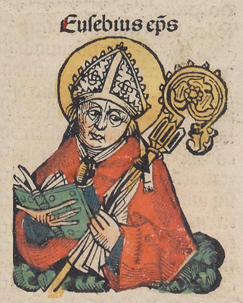
August 2--St. Eusebius of Vercelli, Bishop

File:Nuremberg chronicles f 128r 4..jpg*

Where is your home? Where do you really belong? Is our home in heaven or in the world? St. Eusebius of Vercelli answered that very question throughout his life. He was born in Sardinia at the beginning of the fourth century and became a priest in Rome. He went to Vercelli and was elected bishop by the people. In 354, the pope asked him to request the emperor call another council to settle the issue between Arians and Catholics. The Arians did not accept the Trinity as three Persons in one God even though the Council of Nicaea condemned Arianism in 325. The emperor favored Arianism as Pope Benedict XVI wrote: “For him it was not truth that counted but rather political opportunism: he wanted to exploit religion as the bond of unity for the Empire.” Thus, the emperor exiled Eusebius where he was subjected to persecution. Eusebius was eventually freed and returned to Vercelli where he died peacefully in 371. All the time he preached the truth of the Nicene Creed.

Benedict also wrote: “Just like the Apostles, for whom Jesus prayed at his Last Supper, the Pastors and faithful of the Church ‘are of the world’ (Jn 17: 11), but not ‘in the world’. Therefore, Pastors, Eusebius said, must urge the faithful not to consider the cities of the world as their permanent dwelling place but to seek the future city, the definitive heavenly Jerusalem. This ‘eschatological reserve’ enables Pastors and faithful to preserve the proper scale of values without ever submitting to the fashions of the moment and the unjust claims of the current political power.” Our home is heaven, but we must try to bring about the Kingdom of Heaven here: “Thy kingdom come, thy will be done on earth, as it is in heaven!”
*https://commons.wikimedia.org/wiki/File:Nuremberg_chronicles_f_128r_4..jpg

Sunday, August 18, 2019

August 25--St. Louis IX, Holy Man


To be a holy man or holy woman; isn’t that what we all should try to be? Holiness is the attribute that Isaiah hears the angels proclaim of God: “Holy, holy, holy is the Lord of hosts! All the earth is filled with his glory!” (Is. 6:3) The Psalmist declares: “Holy is the Lord our God”. (Ps. 99:9) And so when we hear of a king, a secular ruler, declared to be a holy man and a saint, it may take us aback. How can a king, who wages war and passes judgment on others, be considered holy?

St. Louis IX, King of France, was such a man. He dedicated his life to justice, which is especially desired in a king. As supreme judge of France he would hear appeals by anyone of his subjects. He abolished trial by ordeal and introduced the presumption of innocence in criminal proceedings. He created provosts and bailiffs to enforce application of his new legal system. Even in war he maintained the need for justice. When in war against his brother-in-law, Henry III of England, he negotiated a settlement for peace rather that fight for a total victory. He led the seventh and eighth crusades, both of which failed. His purpose in both was to bring aid to Christians suffering under the Muslim Saracens.

Justice was a hallmark of his reign, as was service to the poor. Every day he would invite thirteen guests from among the poor to eat with him. He would often serve the poor who came for a meal during Advent and Lent. He established three monasteries and sponsored the construction of great Gothic cathedrals. St. Louis died of typhoid fever at Tunis during the eighth crusade in 1270 and was canonized in 1297. We ask for his intercession on our behalf for justice and service in our day.