Showing posts with label Faith. Show all posts

Saturday, March 16, 2024

March 27--Bl. Francesco Faà di Bruno, Priest and Founder

Faà di Bruno’s Formula

“Science and faith do not mix.” Wrong! We have many giants of science and mathematics who were faithful members of the Catholic Church, including Galileo, Pasteur, Mendel, Copernicus, Pascal, Bacon, and ​​Lemaître, who developed the Big Bang Theory. We can also include today’s saint, Bl. Francesco Faà di Bruno, among them as a mathematician for whom Faà di Bruno’s Formula is named. Born in northern Italy in 1825 to parents of nobility, he had a wide-ranging career as an army officer, a professor of mathematics and recipient of a Doctor of Science degree from the Universities of Paris and Turin, a friend of St. John Bosco, social reformer, and overseer of the construction of a church in Turin, Italy. However, that was not enough for him! He discerned a vocation to the priesthood and was finally ordained at age 51. He founded the Minim Sisters of St. Zita in 1881 to provide aid to maids and domestic servants, later unmarried mothers, and then, prostitutes.

Pope St. John Paul II said of him in his beatification homily: “He used to say: ‘Giving oneself to God is equivalent to giving oneself to a superior activity, which drags us along like the swollen and tumultuous waters of a raging torrent. . .’. From the love for God came that love for ‘neighbor’, which pushed Francesco Faà di Bruno onto the path of the poor, the humble, the defenseless, making him a giant of faith and charity. Thus was born a whole series of works and welfare activities which are not easy to list. Even in the scientific field he was able to bear his coherent testimony as a believer, in a period in which dedication to science seemed incompatible with a serious commitment to faith.” Science and faith DO mix! Bl. Francesco, pray for us!


Sunday, August 18, 2013

July 15--St. Bonaventure, Bishop and Doctor of the Church


The Franciscans have given the Church many great saints, among these being St. Bonaventure.  St. Bonaventure lived in the 13th century, not long after the Franciscans were founded.  He became the Minister General, or leader, of the Franciscans and also was named a cardinal.  He was also influential in helping unite the Latin and Greek churches at the Council of Lyon in 1274.  He wrote many volumes on theology and philosophy.  A contemporary of St. Thomas Aquinas, he also worked on integrating faith and reason.   He died soon after the Council of Lyon.  He was named a Doctor of the Church and called the Seraphic Doctor.


Faith and reason do go together, as shown by St. Bonaventure’s, and others, works.  Many have accused Catholics and believers of having “blind faith”, that is, faith that does not have any connection to reason whatsoever.  This is not true.  Both faith and reason are gifts from God and need to be used in the correct context.  We use reason in acknowledging the existence of God.  We use reason as a natural gift from God.  We use faith as a supernatural gift from God.  Reason tells us there is a God; faith tells us that Jesus is God.  Reason tells us that the statement that Jesus is God is reasonable due to the evidence of the believers who first knew him, listened to him, and witnessed him as risen from the dead.  Faith builds on reason, just as grace builds on nature.  

Always be ready to give an explanation to anyone who asks you for a reason for your hope …” (1 Pet. 3:15).  We need to be ready to use our reason in defense of our hope and our faith, namely Jesus Christ.  We are not “blind fools”, but rather, “We are fools on Christ’s account …” (1 Cor. 4:10).

July 3--St. Thomas, Apostle


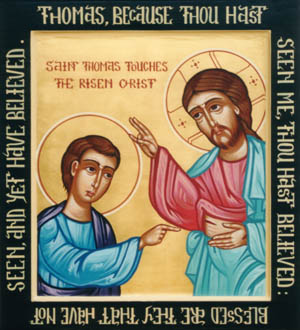
St. Thomas was one of the twelve Apostles, men who were sent out to evangelize and catechize.  We know about him primarily from the gospels, especially the Gospel of John where he is described as doubting the Resurrection.  And yet, when Jesus appears to the Eleven on the Sunday after the Resurrection, Thomas is awestruck, saying: “My Lord and my God,” which connects with the very first verse of John’s gospel:  “In the beginning was the Word, and the Word was with God, and the Word was God.”  Thomas’s declaration of faith leads to Jesus’ response:  “Have you come to believe because you have seen me?  Blessed are those who have not seen and have believed” (Jn 20:29).

“Doubting Thomas” is the consummate modern person.  He decided not to believe unless he could see.  That very well may describe many of us in our modern age.  We have been conditioned to not accept those things which cannot be proven to our satisfaction.  We have transferred our faith from belief in that which cannot be seen, touched, tasted, smelled, or heard—spiritual realities—to faith in that which can be experienced by our senses.

However, seeing is not believing; it is seeing.  Can we ‘see’ love? or hope? or courage? or perseverance?  No, we ‘see’ people expressing those realities in their words or actions.  Faith is the realization of what is hoped for and evidence of things not seen” (Heb 11:1).  “Believing Thomas” is our model; the man who professed belief in Jesus as Lord and God.  We are the ones “who have not seen and have believed.”  We need to maintain and share our faith by our words and actions so that others may ‘see’ Christ in us.