Showing posts with label Doctor of the Church. Show all posts

Monday, March 17, 2025

March 29–St. Berthold, Priest and Hermit


Mount Carmel was where Elijah defeated the prophets of Baal in 1 Kings 18. But it is also the location of the foundation of the Carmelite religious order. However, even before the Carmelites were founded other hermits and religious men lived together on Mt. Carmel. That seems to be the case with today’s saint. St. Berthold was a priest who went with the Crusaders on the Third Crusade. He “found himself in Antioch when it was being besieged by the Saracens. Through his urgings, the Christians in Antioch turned to prayer and penance, and the city was delivered.”

It is said that he built “a monastery and church on Mount Carmel and dedicated the church in honor of the prophet [Elijah]... and lived out his days on Mount Carmel, ruling the community he had founded for forty-five years until his death about 1195. His example and way of life stamped the beginnings of the Carmelite Order,” which was formally founded later. The Carmelites have given us numerous saints, especially mystics, such as St. John of the Cross, St. Teresa of Avila, and St. Thérèse of Lisieux, all Doctors of the Church.

There is much fruit that can grow from small seeds. This was true of St. Berthold and it can be true of us. Every moment is an opportunity to do the will of God. Whatever we are doing, we can offer it up in love to God. It can be a moment of suffering, and thus we can participate in Christ’s sufferings. It can be a moment of joy, and thus we can rejoice in the gifts God has given us. It can be a moment of silence, such as when Jesus prayed to his Father. We need to offer each moment to God! St. Berthold, pray for us.

Monday, February 17, 2025

February 27--St. Gregory of Narek, Monk, Priest, and Doctor of the Church


Lex orandi, lex credendi.” “The law of what is prayed is the law of what is believed.” This Latin phrase summarizes the impact and relationship of prayer and faith. As the Catechism states: “The law of prayer is the law of faith: the Church believes as she prays.” (1124).

Thus: Saint Gregory of Narek was a mystic, monk, priest, and, as declared by Pope Francis, Doctor of the Church. Living in the Kingdom of Armenia, modern Turkey (born about 951, died about 1003), Gregory and his brother were raised by their uncle in a monastery, which he eventually entered. He then taught there and wrote commentaries and prayers. His most famous work is The Book of Lamentations, a collection of ninety-five prayers, each beginning: “Speaking with God from the Depths of the Heart.” The prayers were expressions of love and dependency on God’s mercy. “He believed his book was written not only for himself, his monks, or the Armenian people, but for all people, for the entire world.” In other words, St. Gregory proclaimed the Gospel in the prayers he composed.

Here is the conclusion of his final prayer: Prepare the earth for the day of light and let the soil bloom and bring forth fruit, heavenly cup of life-giving blood, ever sacrificed, never running dry, all for the salvation and life of the souls in eternal rest. And though my body die in sin, with Your grace and compassion, may I be strengthened in You, cleansed of sin through You, and renewed by You with life everlasting, and at the resurrection of the righteous be deemed worthy of Your Father’s blessing. To Him together with You, all glory, and with the Holy Spirit, praise and resounding thanks, now, always and forever, Amen. St. Gregory of Narek, pray for us!

Sunday, September 10, 2023

September 17--Saint Hildegard of Bingen, Virgin, Abbess, and Doctor of the Church

File:St. Hildegard (Berlin) Sankt Hildegard.JPG

St. Hildegard, photograph by Bobo Kubrak, licensed under CC0 1.0.

What would a “Renaissance woman” be? Perhaps a woman who was a writer, composer, philosopher, scholar, scientist, healer, consultant to popes and emperors, mystic, visionary, and saint! Perhaps, St. Hildegard of Bingen! She lived from 1098-1179 in Germany. She was placed in the convent at the age of seven after it was discovered that she experienced visions, which were known only to a few. After the abbess died she was unanimously elected the new abbess at the age of 38. “Hildegard's works include three great volumes of visionary theology; a variety of musical compositions for use in the liturgy, as well as the musical morality play Ordo Virtutum; one of the largest bodies of letters (nearly 400) to survive from the Middle Ages, addressed to correspondents ranging from popes to emperors to abbots and abbesses, and including records of many of the sermons she preached in the 1160s and 1170s; two volumes of material on natural medicine and cures; an invented language called the Lingua ignota (‘unknown language’); and various minor works, including a gospel commentary and two works of hagiography.” Finally, Pope Benedict XVI proclaimed her a saint and Doctor of the Church in 2012, one of 37. “He called Hildegard ‘perennially relevant’ and ‘an authentic teacher of theology and a profound scholar of natural science and music.’”

St. Hildegard was a “Renaissance woman” and an amazing person in all regards! God raises special people to bring his message to the world. In the Church he sends saints, like St. Hildegard. She wrote, in the voice of God: “I am the breeze that nurtures all things green. I encourage blossoms to flourish with ripening fruits. I am the rain coming from the dew that causes the grasses to laugh with the joy of life.” St. Hildegard, pray for us!


Friday, November 25, 2022

December 7--St. Ambrose, Bishop and Doctor of the Church


He initially refused the position of bishop, faced down an emperor, comforted a mother in her sorrows, and baptized the greatest philosopher of the first millennium.  Who is he?  None other than St. Ambrose of Milan, who became one of the first Doctors of the Church.  When the position of bishop opened in Milan in A.D. 374 he was serving as governor of the province.  He was not a baptized Christian, but the people acclaimed him bishop anyway, whereupon he ran away to hide.  Once, the emperor heard about the election, he affirmed it and Ambrose accepted, being baptize and ordained within the week.

However, once he became bishop, he invested his whole life into serving the people, correcting the heresy of Arianism, teaching orthodox theology in great homilies, and guiding the liturgy of Milan, which is called the Ambrosian Rite and still used today.  He confronted Emperor Theodosius in 390 after the emperor allowed/ordered the massacre of citizens of Thessalonica.  St. Ambrose required the emperor to do penance before he could receive the Eucharist.  Theodosius did so.  According to legend, he also comforted St. Monica when she came to him in tears:  "The child of those tears shall never perish."  That child was St. Augustine, who came to Milan to listen to St. Ambrose's sermons.  They gave him the intellectual grounding he needed to convert to Christianity, with St. Ambrose baptizing him.

St. Ambrose responded to God's call by giving his life over to God.  We, too, are called to give our lives to God.  We are called live our lives as disciples of Jesus:  loving, witnessing, serving, praying, worshiping, and working to bring about the Kingdom of God here on earth in our families, jobs, and associations.  We are called to the greatness of holiness!

Monday, January 3, 2022

January 13—St. Hilary of Poitiers, Bishop and Doctor of the Church

*

Is Jesus God or not? That was key question of the fourth century and beyond that faced the Church. Some, with Arius, said that since Jesus was “begotten of the Father,” that meant he was a creature, albeit the first creature of God. Others, with St. Athanasius, said that Jesus is “begotten, not made” and thus consubstantial with the God the Father. Today’s saint helped hammer home the truth of who Jesus is by his opposition to the Arians and support of St. Athanasius, so much so he was called “Hammer of the Arians” and “Athanasius of the West.”

Born about A.D. 310 in Poitiers, France to pagan parents, St. Hilary received a good pagan education, later studying Scripture, thus resulting in his conversion to Christianity, along with his wife and daughter. He was elected bishop of Poitiers around A.D 350. Even though Arianism was condemned at the Council of Nicaea in A.D. 325 it was still in force throughout the empire, much due to the efforts of different emperors. So St. Hilary attempted to get Arian bishops turned back to the true faith. He also wrote Emperor Constantius II to stop Arians persecuting orthodox Christians, which resulted in his exile in 356. After his exile in 361, he returned in Poitiers and continued to fight for the true understanding of the Trinity against the Arians. He died in 367.

Falsehoods and lies take a long time to die. They are like a many-headed hydra, which keeps sprouting new variations on lies that are condemned and refuted. We need to endure and persevere in living the Truth. St. Paul wrote: “No, in all these things we conquer overwhelmingly through him who loved us” (Rom. 8:37). We must remain faithful to the Truth of Jesus Christ. St. Hilary, pray for us.

*https://commons.wikimedia.org/wiki/File:Hilaryofpoitiers.jpg
Richard de Montbaston et collaborateurs., Public domain, via Wikimedia Commons

Sunday, January 5, 2020

January 13--St. Hilary of Poitiers, Bishop and Doctor of the Church

File:Saint-Hilaire-de-Poitiers Reliquienschrein.jpg*


Arianism is the heresy that teaches that Jesus cannot be God because there is only one God and if Jesus is God, then there are two gods. Arius got it partially right and completely wrong. There is only one God AND Jesus is God: “I believe in one Lord Jesus Christ, the Only Begotten Son of God, born of the Father before all ages. God from God, Light from Light, true God from true God, begotten, not made, consubstantial with the Father” as it says in the Nicene Creed adopted at the Council of Nicaea in 325.

So, what does this have to do with our saint? St. Hilary of Poitiers was born in 315, was baptized in 350, and was acclaimed bishop in 353. As bishop he held the truth of the Catholic Church against Arianism and was banished by the emperors, who supported Arianism. St. Hilary wrote a major treatise against Arianism in order to teach why Jesus is God as well as the Son of God. St. Hilary died in 368. Arianism was condemned again in 381 and finally defeated in the sixth century in France.

Heresies start out as logical conclusions based on specific choices, but without taking into context the whole of the faith. For example, Arianism was based on the oneness of God, which is true. However, it did not take into account the faith that Jesus is God. And for that, hundreds of thousands, if not millions, were lured away from the true faith. People today are also lured away from the faith by denials of the truths of God. They rely on their own choices and make up their own faith and call it Catholic. We must stand true to the faith of Jesus in the Church, even if it means banishment from our society.


*https://commons.wikimedia.org/wiki/File:Saint-Hilaire-de-Poitiers_Reliquienschrein.jpg

Sunday, September 22, 2019

October 1--St. Thérèse of the Child Jesus, Virgin and Doctor of the Church

File:Teresa-de-Lisieux.jpg*


She died at the age of 24 of tuberculosis.  Her main work is The Story of a Soul, written at the behest of her superiors in order to share her life with others.  She became the patron saint of missionaries even though she lived her entire adult life in a cloistered convent in France.  Her “little way” of simplicity and practicality illuminates how each person can become a saint:  “I see that it is enough to recognize one's nothingness and to abandon oneself, like a child, into God's arms.”

St. Thérèse of Liseiux was born in 1873 to Zélie and Louis Martin, who have been since the only married couple canonized together by Pope Francis in 2015.  She was the sister of four surviving daughters, all of whom became nuns.  She asked Pope Leo XIII permission to enter the convent at 15.  He directed that she follow her superiors’ directions.  However, she was allowed to enter the Carmelite convent at Lisieux the following spring, when she was 15.  She spent nine years in the convent before she died.

Although her life in the convent was a hidden life, she desired nothing more than to be holy, to be a saint.  She served in the convent through prayer and obedience, offering herself and her suffering for others, especially priests.  She is called the Little Flower.  She wrote:  “I will scatter flowers, perfuming the Divine Throne, and I’ll sweetly sing my hymn of love.  These flowers are every little sacrifice, every glance and word, and the doing of the least of actions for love.”  St. Thérèse knew she could not do great or heroic acts, so she dedicated herself to doing little acts of love, everything for love.  So should we all!  St. Thérèse, pray for us.

*https://en.wikipedia.org/wiki/File:Teresa-de-Lisieux.jpg#file

Wednesday, July 10, 2019

July 21--St. Lawrence of Brindisi, Priest and Doctor of the Church


We are familiar with many Doctors of the Church, men and women who have outstanding holiness, depth of doctrinal insight, and an extensive body of writings that help us to know and understand our faith. We know Thomas Aquinas, Augustine, Thérèse of Lisieux, and Catherine of Siena. There are 36 altogether. But today’s saint is one of the lesser known doctors, St. Lawrence of Brindisi. He was born in Italy in 1559, joined the Capuchin Franciscans in 1575, and died in 1619. He was a linguist, diplomat, miracle-worker, healer, superior of the Capuchins, preacher, theologian, scholar, writer, crusader, and of course, saint.

Each of these functions is worth a book in itself. He was so good at Hebrew that he was tasked to preach to the Jews in Rome, who thought he was a convert from Judaism, he was so well-versed in Hebrew, the Old Testament, and in the Aramaic commentaries. As a diplomat he was asked to reconcile Christian princes with one another and their subjects. He healed people of illnesses and even levitated during Mass. He was chosen to be superior of the Capuchins when he was only 31. He preached in Lutheran Germany and won thousands back to Catholicism. He wrote that God would have become man even if there was no Original Sin, because God is love and he highest expression of God’s love is the incarnation of Jesus Christ. He held up a crucifix and led Christian soldiers against the Muslim armies who were attempting to invade Europe at the Battle of Shuhlweissenburg in Hungary in 1601. Through it all he maintained holiness and love of Jesus.

We are not called to do what St. Lawrence did, but we are called to live out our faith. We are all called to be holy by the grace of God.

Tuesday, May 15, 2018

May 25--St. Bede the Venerable, Monk and Doctor of the Church


“History is more or less bunk,” according to Henry Ford. On the other hand, “Those who cannot remember the past are condemned to repeat it,” said George Santayana. So, which is it? Do we need history, or can we skip it? St. Bede the Venerable would probably disagree with both statements. St. Bede was the author of the Ecclesiastical History of the English People, a book about how the Church was established in England. This work established his claim to the title, “The Father of English History”. 

St. Bede, who became known as the Venerable Bede for his holiness, was educated in a monastery in the north of England, in the 7th century. He became a monk and then a deacon and priest. He wrote volumes on theology, including commentaries on the Old and New Testaments, as well as educational works and poetry. He knew science, philosophy, astronomy, arithmetic, and more. He is patron of scholars. He died in 735 and was declared a Doctor of the Church in 1899 by Pope Leo XIII.

History is more than just a remembrance of things past. For Christians, history is about remembering where we came from and why. We came from men and women who followed Jesus. During the Mass, we respond to the Mystery of Faith: “We proclaim your Death, O Lord, and profess your Resurrection, until you come again.” Or, “When we eat this Bread and drink this Cup, we proclaim your Death, O Lord, until you come again.” Or finally, “Save us, Savior of the world, for by your Cross and Resurrection, you have set us free.” Each of these is an “anamnesis”, which means “remembering” of the mystery of our faith. History is a good thing. We remember that Jesus saved us and continues to save us each day because he loves us.

Sunday, December 10, 2017

December 21--St. Peter Canisius, S.J., Priest and Doctor of the Church


“Holy Mary, Mother of God, pray for us sinners now, and at the hour of our death. Amen.” This phrase from the Hail Mary is not from Scripture. Instead, tradition has it that St. Peter Canisius added these words, which were then included in the Catechism of the Council of Trent.

St. Peter Canisius was from the Netherlands and became a Jesuit soon after the order was founded. He then spent his time in Germany doing what he could to bring the truth of Catholicism to a Lutheran population. He published a Catechism, imitating Martin Luther, which was highly successful in bringing people back to Catholicism. He founded schools and universities, visited the sick and imprisoned, attended the Council of Trent, wrote books, and more. He is considered the patron of the Catholic press because of his Catechism, which was printed in twelve languages during his lifetime and eventually in 26 languages.

He was known for his charity toward Protestants and his general opposition to debating them. He wanted to win them over with loving actions, rather than by contentious wrangling. He wrote: “Such people should be attracted and won to the simplicity of the faith as much by example as by argument.”

St. Peter Canisius also wrote, “If you have too much to do, with God’s help you will find time to do it all.” So, he helps us remember that Mary brings Jesus to us and us to Jesus through her intercession. He reminds us that love is about living truth humbly. He advised us to continue to do God’s will and God will help us. These are worthwhile admonitions as we prepare for the coming of Jesus into our hearts and homes this Christmas season.


Sunday, September 10, 2017

September 17: St. Robert Bellarmine, Bishop and Doctor of the Church


There are 36 Doctors of the Church, men and women who have demonstrated exceptional qualities in explaining the faith for their times and ours. Today’s saint is one of them, a bishop and cardinal of the Church in the 16th and 17th centuries, helping the Church reform herself after the Protestant Reformations. St. Robert Bellarmine was a Jesuit who, as an archbishop of Capua in Italy, supported the reforms of the Council of Trent. He originally taught theology in Belgium and Rome. Later, he became theologian to Pope Clement VIII and even received votes to become pope. He wrote two catechisms for the Church, which helped the Church explain the truths of the faith in a time of great confusion and different theologies.

St. Robert Bellarmine is the patron saint of both catechists and catechumens. Catechists teach the faith to believers. Catechumens are those who are being initiated into the Church and need teaching in the faith. It is appropriate that St. Robert be patron of both groups as they are linked together, one sharing the faith, the other receiving the faith.

We are catechists when we share our faith with others. When we witness to the love of Jesus in our lives we teach most effectively. But we are also catechumens in the sense that there is so much to learn about Jesus and about his love for us and how we can live that love in our lives. Jesus commanded in Mt. 28:19-20 to “Go, therefore, and make disciples of all nations, baptizing them in the name of the Father, and of the Son, and of the holy Spirit, teaching them to observe all that I have commanded you.” As St. Robert Bellarmine followed these directions, so may we.

Sunday, August 13, 2017

June 28--St. Irenaeus of Lyons, Bishop and Martyr


What if there was a "secret" knowledge of Jesus that only a few "real" believers knew about? It would be like being a member of a secret society, with certain code words and beliefs that no one else would understand without being privy to that "knowledge". This describes the Gnostic heresy that today's saint had to combat.

St. Irenaeus was a disciple of St. Polycarp, who was a disciple of St. John the Evangelist, thus emphasizing Apostolic Succession. He lived in the second and third centuries and was a great theologian. The heresy he faced was Gnosticism which consisted of various groups and teachings. However, the main teaching was that the Gnostics had access to a secret oral tradition of Jesus that only they knew about and was superior to the teachings of the Church. St. Irenaeus researched all the variations of the time and wrote the book Against Heresies to both accurately explain the false teachings of the heretics and the correct teachings of the Church.


St. Irenaeus emphasized the role of the Church and Apostolic Succession in his teachings, pointing out the novelty of the new teachings and the truth of Scripture and Apostolic Tradition. We run across the same situations today, with people sharing false new versions of who Jesus is, such as being the husband of Mary Magdalene or just being a good teacher of morality or one who would accept everyone no matter who they "loved" as long as they "loved" them. "Jesus Christ is the same yesterday, today, and forever. Do not be carried away by all kinds of strange teaching" (Heb. 13:8). St. Irenaeus, pray for us.

June 27--St. Cyril of Alexandria, Bishop and Doctor of the Church


Are saints always well-mannered, polite, tactful, correct in their practices and policies? Do they ever behave rashly or rudely or even sinfully? Today's saint was not always "saintly”. St. Cyril was a Church Father and Doctor of the Church due to his correct teaching about Jesus as being both God and man.

In the fifth century the Church was trying to figure out the true understanding of Jesus. The Council of Ephesus was convoked in 431 because there was some false teaching about Jesus that indicated that he was not both fully God and fully man. Nestorius, the Patriarch of Constantinople, had declared that Mary could be called the Mother of Jesus and the Mother of Christ, but NOT the Mother of God. This was an attack on Jesus as God and man! St. Cyril led the way in affirming that Mary was Theotokos, which means God-bearer, at the council. This helped in understanding of Christ as having two natures.

However, early in his career he had participated in the removal of a saint from the patriarchate of Constantinople, he expelled the Jews from Alexandria for their attacks on Christians, and he confiscated church buildings from a heretical group of Christians. In other words, he was intemperate and unwise. One could even say sinful.

No saint claims to not be a sinner. One does not become a saint at conception (except for the Virgin Mary, of course), but rather it takes a lifetime of conversion. Our call to holiness, our call to sainthood, is a lifelong journey and struggle. But with the grace of God, we can overcome our intemperance, folly, and even sinfulness, as did St. Cyril.

Sunday, June 7, 2015

April 29--St. Catherine of Siena, Virgin and Doctor of the Church


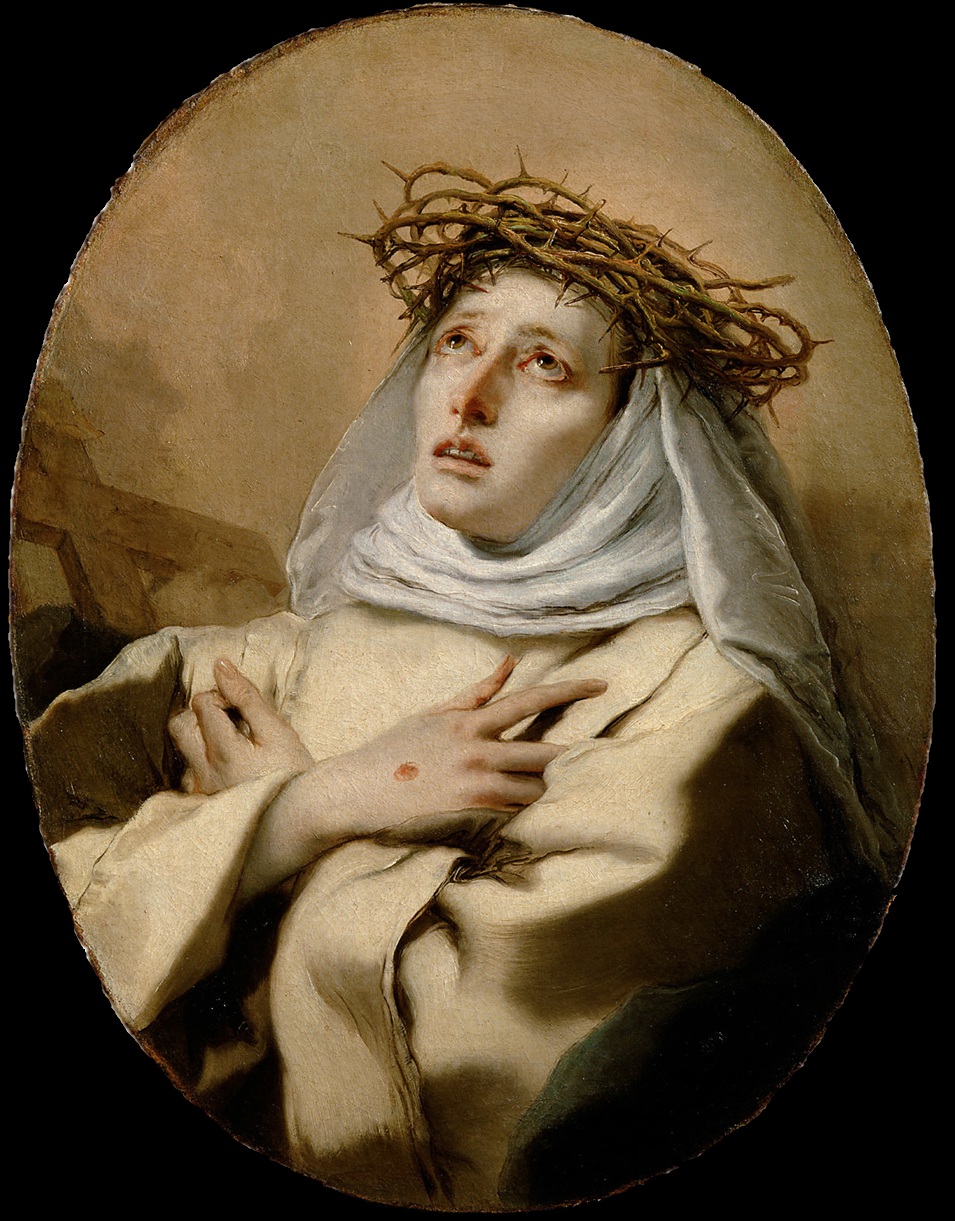
Mystic, mediator, counselor to popes, Doctor of the Church, third order Dominican, virgin, stigmatist, saint--St. Catherine of Siena had quite a resume!  She dedicated herself to God through the Dominican order as a lay member.  She was not a cloistered nun and could travel.  That was helpful, because as she became known as a holy woman, she gathered disciples and went around Italy to help resolve conflicts.  She was also sent to Avignon, France to convince the pope to return to Rome after the papacy was away for almost 70 years.  She received the stigmata, which are the wounds similar to Christ's wounds from the cross, but they were hidden from view.  

As a Doctor of the Church, St. Catherine is known for her book, The Dialogues, which came to her in a vision. In that vision God spoke to her about prayer and the importance of love and the necessity of charity and the joy of the Eucharist and how we can resist temptation.  She is one of 36 Doctors of the Church, four of whom are women.

St. Catherine's way of dealing with people was both blunt and sophisticated.  She would let popes know what she believed to be God's way and would challenge them to follow it.  But she also prayed extensively and advised people on how they could lead holy lives.  We need to adapt Jesus' message of love to those whom we are witnessing.  We may need to be forthright in some situations and subtle in others.  Prudential judgment needs to guide us to be the best fishers of men.  St. Catherine of Siena, pray for us.

Thursday, March 12, 2015

March 18--St. Cyril of Jerusalem, Bishop and Doctor of the Church


"Is Jesus God or man?  Is he more God than man or more man than God?  Is he something else, and if so, what?"  These may seem to be odd questions for us today, but they were matters of extreme importance in the fourth and fifth centuries when our saint was alive.  St. Cyril of Jerusalem was the bishop of Jerusalem during the time of the Arian heresy.  A heresy is a false teaching that goes against the orthodox teaching of the Church.  The problem was that this heresy was supported by some bishops!  It taught that since there is only one God (true) then Jesus can't be God (false) since that would mean that there would be two gods (also false).  It was an enticing belief but it went against the Scriptures, Tradition, and the consistent teaching of the Magisterium.

So what was St. Cyril's role?  Since one of the bishops who consecrated him was Arian, it may have been "supposed" that he would support the Arians.  But it was not true!  He had a conflict with that same bishop and was exiled from Jerusalem.  He persevered and was later cleared.  He went to a council in 381and supported the use of the word "consubstantial" as applying to the Father and the Son reaffirming that there is only ONE God.

Sometimes we have difficulty with the Church, her teachings, and/or her leaders, priests, bishops, sisters, religion teachers, etc.  The Church is a divine institution, but it is also a human one as well.  Her members do sin and bring scandal to her.  The Holy Spirit has guaranteed us that the Church will never err in matters of faith and doctrine, but not necessarily about "policy" or the proper implementation of that policy or on the holiness or politeness or manners of her leaders.  We need to recognize our fallen human nature even as we strive to do God's will.  As St. Cyril persevered, we need to persevere in prayer for our leaders that they may do God's will in the best way possible.

Tuesday, January 13, 2015

January 24--St. Francis de Sales, Bishop and Doctor of the Church


The Reformation was 50 years old when St. Francis de Sales was born in 1567.  He was the son of an aristocratic family in the duchy of Savoy, which bordered France, Italy, and Switzerland.  He was educated as a lawyer and was set to become a senator and married to an heiress of Savoy when he declared his intentions to become a priest.  Although initially opposed by his father, the bishop of Geneva obtained for him a high position in the diocese, which satisfied his father.  At the age of 35 he became bishop of the Diocese of Geneva, which had become Calvinist during the Reformation.

Calvinism taught that God predestined those who were going to heaven and those who were going to hell before the universe was created.  According to John Calvin, God's sovereign will could not be stopped and no one could oppose what God had chosen for us.  This heresy against the gift of free will is what Francis faced, but he did so with kindness, learning, zeal, and holiness, so much so that he has been titled Doctor of Charity.  He also wrote extensively making him the patron saint of writers and journalists.

God gives all of us the gift of heaven through the Paschal Mystery of Jesus' death and resurrection.  But God does not force us to love him.  Nor does he force us to sin against him.  We have free will that allows us to respond to his love with love, or hate.  It is a great gift to be free, to be able to love, to be able to do God's will. With this gift we may win others to Christ by our love of him and of them as St. Francis de Sales demonstrated.

Monday, December 22, 2014

December 14--St. John of the Cross, Priest and Doctor of the Church

http://recoverysoul.files.wordpress.com/2012/02/st-john-cross.jpg

"Nobody expects the Spanish Inquisition!"  That line from Monty Python's Flying Circus sets off comedy sketches about the ineptitude of the inquisitors.  However, our saint of the day was not beset by British comics pretending to be ruthless interrogators; St. John of the Cross actually spent nine months in a jail cell being investigated by the Spanish Inquisition.

How is it that a saint who was the co-founder, along with St. Teresa of Avila, of the Discalced Carmelites, a mystic who wrote amazing poetry and described the dark night of the soul in which it seemed that God abandoned him, was arrested and thrown into prison?  It was because of his association with St. Teresa that he helped start the reform of his religious order in Spain.  Due to his efforts and misunderstandings by his superiors he was imprisoned and eventually released.  Through his sufferings he came to realize that "the soul must empty itself of self in order to be filled with God."

What is in our souls?  Is it desire pleasure, power, or prestige?  There is nothing wrong with the good things of this earth that bring us closer to God, but we must remember Jesus' admonition:  "No one can serve two masters.  He will either hate the one and love the other, or be devoted to one and despise the other.  You cannot serve God and mammon" (Mt. 6:24).  Is God at the center of our lives?  "For where your treasure is, there also will your heart be" (Mt. 6:21).  Nobody expects the Spanish Inquisition, but the difficulties and sufferings we face may help us to realize that we are utterly dependent upon God, who is our only treasure.

Monday, September 1, 2014

August 28--St. Augustine of Hippo, Bishop and Doctor of the Church


Sinner, heretic, gambler, playboy, philosopher, teacher, penitent, monk, priest, bishop, saint.  All these describe the same person, St. Augustine.  St. Augustine was the most influential person in developing and explaining Church doctrine in the first millennia after the first century.  He helped make clear the doctrines of Original Sin, the Trinity, grace, free will, Baptism, and more.  He was one of the four original Doctors of the Latin Church along with St. Ambrose, St. Gregory, and St. Jerome.

However, before he converted he was an opponent of the Catholic Church, belonging to a heretical group that said we have two wills, one good and one evil.  He had a mistress and an illegitimate son.  He was ambitious for fame and glory.  But he was also a searcher for truth.  That commitment to the truth eventually led him back to the faith of his mother, St. Monica.  All this is recorded in his great autobiography, The Confessions, which tells of his sinful youth and eventual conversion.

One of his famous lines from The Confessions is, "Our hearts are restless until they rest in you, O God."  God plants in our hearts the desire for God.  If we are faithful to that desire; if we are honestly searching for truth, we will find God already in our hearts.


Monday, June 2, 2014

June 13--St. Anthony of Padua, Priest and Doctor of the Church


“Tony, Tony, come on down. Something’s lost and can’t be found.” Grandmothers hand on this prayer for when we lose something. The “Tony” of this little prayer refers to St. Anthony of Padua, who is the patron saint of lost items. The reason for the prayer is because he prayed for the return of a Book of Psalms that was stolen from him. In the 13th century, books were very expensive due to the cost of reproducing them, which was by hand. The book was eventually returned to him.

St. Anthony is known for more than just this prayer. He was a Franciscan friar who became a powerful preacher and was even called the Evangelical Doctor. He was the first Franciscan to teach other Franciscans, with the permission of St. Francis of Assisi, and was renowned for his knowledge of Scripture and theology.

St. Anthony is also portrayed holding the child Jesus. There is a legend that Jesus appeared to St. Anthony in the form of a child. However, the image can also be a reminder that St. Anthony is a true follower of St. Francis, who loved Jesus so much to originate the first Christmas crèche. Another reason for the image is that St. Anthony presents the Incarnate Word of God, Jesus, to the whole world through his powerful preaching.

Losing objects is unfortunate and can even be devastating. But even more devastating is the loss of heaven. As the novena to St. Anthony says, “Let me rather lose all things than lose God, my supreme good. Let me never suffer the loss of my greatest treasure, eternal life with God. Amen.”

Sunday, March 23, 2014

April 4—St. Isidore of Seville, Bishop


The Church oftentimes names a person as a patron saint of a cause or group or even a nation.  For example, Mary, the Immaculate Conception is the patroness of the United States and St. Thomas Aquinas is the patron of Catholic schools.  However, there is no patron of the Internet.  Today’s saint has been proposed as the patron of the Internet because of his encyclopedia, which was used as a textbook for 900 years!


St. Isidore of Seville is considered the last of the Church Fathers.  He was the bishop of Seville, Spain and was influential in the conversion of the Visigoths in Spain in the seventh century.  He also established schools and seminaries, completed a Spanish version of the liturgy (Mozarabic), and played a major role in two councils in Spain.  His efforts inspired the education system of the Middle Ages.


We are fortunate to live in an age that values learning.  We have numerous junior colleges, colleges, and universities that educate our youth in various arts and disciplines.  We have numerous professions that contribute to the common good.  We owe their skills to men and women who have dedicated themselves to the vocation of teaching, the passing on of a lore of knowledge and the skill of processing that knowledge so that students may benefit society.  


But knowledge and skill are useless without wisdom.  “The fear of the Lord is the beginning of wisdom” (Ps. 111:10).  It is vital that we educate our youth not just in arts and disciplines that may benefit society, but also in the ways of God so that society, in turn, may benefit individuals respectful of Truth.  St. Isidore knew about learning, but he also knew about God and the necessity of faith to guide reason.