Showing posts with label Priest. Show all posts

Sunday, August 17, 2025

August 30--St. Fiacre, Priest and Abbot


The Catholic Church recognizes patron saints from Academics–St. Thomas Aquinas and St. Albert the Great to Zoology–St. Albert the Great again! Today’s saint is the patron saint of Gardeners. St. Fiacre was born in Ireland about A.D. 600 and died in A.D. 670 in France. He grew up in a monastery, was ordained a priest, and eventually became an abbot. As people came to him because of his reputation for holiness and healing he went to France to become a hermit. He built a hermitage for himself and a hospice for travelers about 50 miles northeast of Paris. There he planted a vegetable and herb garden and an oratory in honor of the Blessed Virgin Mary. He lived a life of self-denial, prayer, fasting, vigils and healing by laying on of hands. Veneration towards him seems to be based on his healing abilities as well as his holiness. His patronage of gardeners is based on his gardening abilities.

Every good act we do can be an act of love for God and others. Gardening may bring joy through the beauty of flowers and health through the nourishment of fruits, and vegetables. Tilling the soil may allow us to focus our minds and hearts on prayer to God in praise and on behalf of others. Tending the yard may bring peace. Scripture envisioned earthly paradise as a garden: “The LORD God then took the man and settled him in the garden of Eden, to cultivate and care for it” (Gn. 2:15). Furthermore: “You make the grass grow for the cattle and plants for people’s work to bring forth food from the earth, wine to gladden their hearts, oil to make their faces shine, and bread to sustain the human heart” (Ps. 104:14-15). St. Fiacre, pray for us.

Monday, May 26, 2025

June 2–St. Marcellinus and Peter, Priest and Exorcist, Martyrs


“To us, also, your servants, who, though sinners, hope in your abundant mercies, graciously grant some share and fellowship with your holy apostles and martyrs: with John the Baptist, Stephen, Matthias, Barnabas, (Ignatius, Alexander, Marcellinus, Peter, Felicity, Perpetua, Agatha, Lucy, Agnes, Cecilia, Anastasia) and all your saints; admit us, we beseech you, into their company, not weighing our merits, but granting us your pardon, through Christ our Lord.”

This is part of the First Eucharistic Prayer, the oldest eucharistic prayer in the Latin Rite. It contains the names of many saints, especially of martyrs, including Marcellinus and Peter. A catacomb outside Rome is named for them.

“The catacomb of Saints Marcellinus and Peter derives its name from the two martyrs buried within it. The story behind the life of these two martyrs goes back to the time of the Emperor Diocletian. St. Marcellinus and St. Peter were slain during the persecution of 304 AD - beheaded, in Rome. Before being killed, however, they were forced to dig their tomb with their own hands. The site of the terrible martyrdom of the two saints was known as ‘Selva Nera’ (meaning ‘Black Forest’), but after their death it was renamed ‘Selva Candida’, that is ‘White Forest’, along Via Cornelia.

“It was thanks to a Roman matron, who went with the name of Lucilla, that the bodies of the two martyrs were brought to Via Casilina, at the site called ad Duas Lauros. With the translocation of the saints’ bodies, the Christian cemetery, already in use, was dedicated in their memory.” (http://www.catacombeditalia.va)

Martyrs are the heroes of the faith, the men and women who gave their lives for their love of Christ. We honor them in our prayers and we ask for their prayers. Sts. Marcellinus and Peter, pray for us.

Monday, March 31, 2025

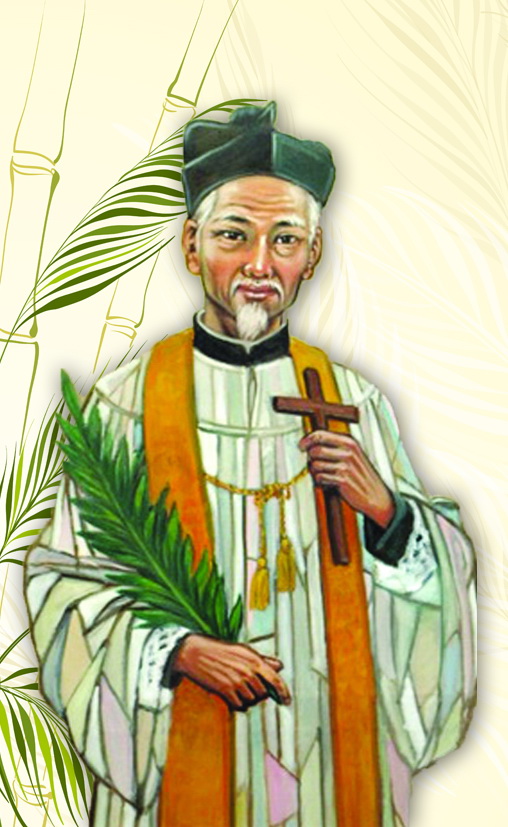
April 6--St. Paul Le-Bao Tinh, Priest and Martyr


Vietnam was evangelized by Catholic missionaries from Portugal, Spain, and then later from France. St. Paul Le-Bao Tinh was born in Vietnam in 1793. He was sent to a Catholic seminary at the age of twelve, after which he lived as a hermit until the local bishop asked him to bring missionary priests to Laos. In 1841 persecution began. He was arrested and spent seven years in prison in Hanoi. His sentence of death was commuted in 1848. He returned to the seminary and was ordained a priest. In 1855 he was again arrested and sentenced to death. In 1857 he was decapitated, as was the original St. Paul of Tarsus. St. John Paul II canonized him in 1988.

In both persecutions we have his words describing his suffering and his readiness for death: “I, Paul, bound in chains for the sake of Christ, send to you from prison salutations which are many and final… The prison is truly a living example of hell: to chains, shackles and manacles, are added anger, vengeance, lies, obscene conversations, brawls, evil acts, swearing, slander, plus boredom, sadness, mosquitoes and flies… I write these things so that your hearts might burst with desire to be martyrs, and that your prayers might strengthen me, who lives in the arena of combat.”

"My body is in your hands, please torture it as you wish, I am very happy, without any complaint. It dies but will rise again in glory tomorrow. As for my soul, it belongs to God, nothing can make me sacrifice it, no one can shake my faith. Christianity is the right religion, the true religion. I have loved and kept that religion since I was a child, and even if I die, I cannot abandon it." St. Paul Le-Bao Tinh, pray for us.

Monday, March 17, 2025

March 29–St. Berthold, Priest and Hermit


Mount Carmel was where Elijah defeated the prophets of Baal in 1 Kings 18. But it is also the location of the foundation of the Carmelite religious order. However, even before the Carmelites were founded other hermits and religious men lived together on Mt. Carmel. That seems to be the case with today’s saint. St. Berthold was a priest who went with the Crusaders on the Third Crusade. He “found himself in Antioch when it was being besieged by the Saracens. Through his urgings, the Christians in Antioch turned to prayer and penance, and the city was delivered.”

It is said that he built “a monastery and church on Mount Carmel and dedicated the church in honor of the prophet [Elijah]... and lived out his days on Mount Carmel, ruling the community he had founded for forty-five years until his death about 1195. His example and way of life stamped the beginnings of the Carmelite Order,” which was formally founded later. The Carmelites have given us numerous saints, especially mystics, such as St. John of the Cross, St. Teresa of Avila, and St. Thérèse of Lisieux, all Doctors of the Church.

There is much fruit that can grow from small seeds. This was true of St. Berthold and it can be true of us. Every moment is an opportunity to do the will of God. Whatever we are doing, we can offer it up in love to God. It can be a moment of suffering, and thus we can participate in Christ’s sufferings. It can be a moment of joy, and thus we can rejoice in the gifts God has given us. It can be a moment of silence, such as when Jesus prayed to his Father. We need to offer each moment to God! St. Berthold, pray for us.

Monday, February 17, 2025

February 27--St. Gregory of Narek, Monk, Priest, and Doctor of the Church


Lex orandi, lex credendi.” “The law of what is prayed is the law of what is believed.” This Latin phrase summarizes the impact and relationship of prayer and faith. As the Catechism states: “The law of prayer is the law of faith: the Church believes as she prays.” (1124).

Thus: Saint Gregory of Narek was a mystic, monk, priest, and, as declared by Pope Francis, Doctor of the Church. Living in the Kingdom of Armenia, modern Turkey (born about 951, died about 1003), Gregory and his brother were raised by their uncle in a monastery, which he eventually entered. He then taught there and wrote commentaries and prayers. His most famous work is The Book of Lamentations, a collection of ninety-five prayers, each beginning: “Speaking with God from the Depths of the Heart.” The prayers were expressions of love and dependency on God’s mercy. “He believed his book was written not only for himself, his monks, or the Armenian people, but for all people, for the entire world.” In other words, St. Gregory proclaimed the Gospel in the prayers he composed.

Here is the conclusion of his final prayer: Prepare the earth for the day of light and let the soil bloom and bring forth fruit, heavenly cup of life-giving blood, ever sacrificed, never running dry, all for the salvation and life of the souls in eternal rest. And though my body die in sin, with Your grace and compassion, may I be strengthened in You, cleansed of sin through You, and renewed by You with life everlasting, and at the resurrection of the righteous be deemed worthy of Your Father’s blessing. To Him together with You, all glory, and with the Holy Spirit, praise and resounding thanks, now, always and forever, Amen. St. Gregory of Narek, pray for us!

Sunday, August 11, 2024

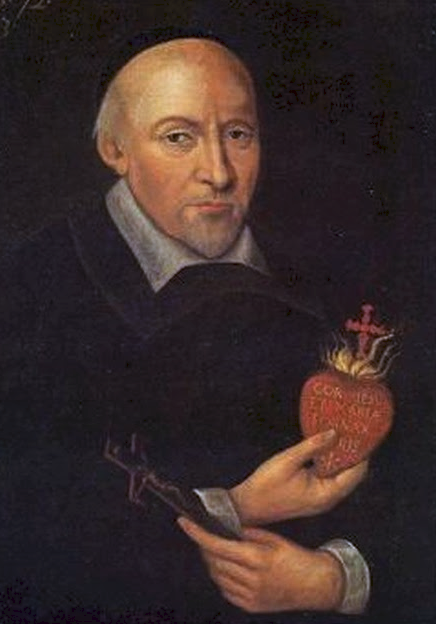
August 19–St. John Eudes, Priest and Founder

Anonymous, St. John Eudes, Public Domain, Wikimedia Commons.


Priests are the backbone of parish life. A good pastor can help his parish grow in love for God and each other, building parish life. But how does one become a good priest? That was the problem that today’s saint, St. John Eudes, faced when he decided to found the Congregation of Jesus and Mary. He founded and staffed three seminaries. St. John Eudes (1601-1680) was ordained in 1625 in France and eight years later became a parish missionary, going from parish to parish to preach renewal, giving 110 missions.

Pope Benedict XVI, in a general audience during the Year of the Priest in 2009, said, “Prompted by a lucid awareness of the grave need for spiritual assistance in which souls lay because of the inadequacy of the majority of the clergy, the Saint, who was a parish priest, founded a congregation specifically dedicated to the formation of priests. He founded his first seminary in the university town of Caen, a particularly appreciated experience which he very soon extended to other dioceses. The path of holiness, which he took himself and proposed to his followers, was founded on steadfast trust in the love that God had revealed to humanity in the priestly Heart of Christ and in the maternal Heart of Mary. In those times of cruelty, of the loss of interiority, he turned to the heart to speak to the heart, a saying of the Psalms very well interpreted by St Augustine. He wanted to recall people, men and women and especially future priests, to the heart by showing them the priestly Heart of Christ and the motherly Heart of Mary. Every priest must be a witness and an apostle of this love for Christ's Heart and Mary's Heart.” We need good priests! St. John Eudes, pray for us!

Saturday, March 16, 2024

March 27--Bl. Francesco Faà di Bruno, Priest and Founder

Faà di Bruno’s Formula

“Science and faith do not mix.” Wrong! We have many giants of science and mathematics who were faithful members of the Catholic Church, including Galileo, Pasteur, Mendel, Copernicus, Pascal, Bacon, and ​​Lemaître, who developed the Big Bang Theory. We can also include today’s saint, Bl. Francesco Faà di Bruno, among them as a mathematician for whom Faà di Bruno’s Formula is named. Born in northern Italy in 1825 to parents of nobility, he had a wide-ranging career as an army officer, a professor of mathematics and recipient of a Doctor of Science degree from the Universities of Paris and Turin, a friend of St. John Bosco, social reformer, and overseer of the construction of a church in Turin, Italy. However, that was not enough for him! He discerned a vocation to the priesthood and was finally ordained at age 51. He founded the Minim Sisters of St. Zita in 1881 to provide aid to maids and domestic servants, later unmarried mothers, and then, prostitutes.

Pope St. John Paul II said of him in his beatification homily: “He used to say: ‘Giving oneself to God is equivalent to giving oneself to a superior activity, which drags us along like the swollen and tumultuous waters of a raging torrent. . .’. From the love for God came that love for ‘neighbor’, which pushed Francesco Faà di Bruno onto the path of the poor, the humble, the defenseless, making him a giant of faith and charity. Thus was born a whole series of works and welfare activities which are not easy to list. Even in the scientific field he was able to bear his coherent testimony as a believer, in a period in which dedication to science seemed incompatible with a serious commitment to faith.” Science and faith DO mix! Bl. Francesco, pray for us!


Saturday, November 18, 2023

December 3--St. Francis Xavier, Priest and Religious

Portrait of St. Francis Xavier by Unknown Artist licensed under public domain.

He was the most famous missionary since St. Paul! He traveled to India, Malaysia, the Maluku Islands, Japan, and China. He converted about 30,000 souls. He evangelized in native languages, adapted to native cultures, and promoted native clergy. He co-founded the Society of Jesus, the Jesuits, and was named “Patron of Catholic Missions” by Pope Pius XI. That is quite a résumé for today’s saint, St. Francis Xavier!

Pope Benedict XVI wrote: “St. Francis Xavier … saw as his own mission ‘opening new ways of access’ to the Gospel ‘in the immense Continent of Asia’. His apostolate in the Orient lasted barely 10 years, but in the four and half centuries that the Society of Jesus has existed it has proven wonderfully fruitful, for his example inspired a multitude of missionary vocations among young Jesuits and he remains a reference point for the continuation of missionary activity in the great countries of the Asian Continent.”

Jesus commissioned the Apostles and, through them, us as well: “Go, therefore, and make disciples of all nations, baptizing them in the name of the Father, and of the Son, and of the holy Spirit, teaching them to observe all that I have commanded you. And behold, I am with you always, until the end of the age” (Mt. 28:19-20). We do not have to go to India or Japan or China. We just need to go to our families or neighbors or colleagues or friends. They need to see and hear in us that we have something great to share: Jesus loves us and them. The Church welcomes us all into her midst. We just need to repent of our sins and live as the saints Jesus calls us to be. What greater missionary effort is there than to love our neighbors?


Monday, October 2, 2023

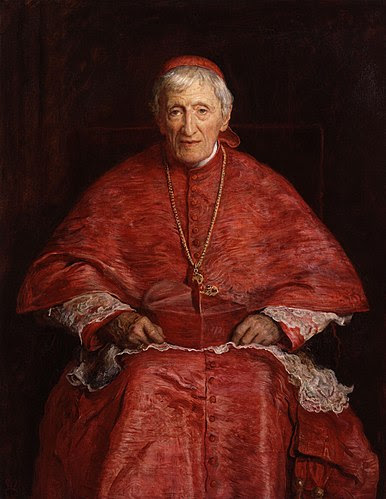
October 9--St. John Henry Newman, Priest

John Henry Newman, by Sir John Everett Millais, 1st Bt (died 1896), licensed under Public Domain.

“God has created me to do him some definite service; He has committed some work to me which he has not committed to another. I have my mission; I never may know it in this life, but I shall be told it in the next. I have a part in a great work; I am a link in a chain, a bond of connection between persons. He has not created me for naught. I shall do good, I shall do His work; I shall be an angel of peace, a preacher of truth in my own place, while not intending it, if I do but keep His commandments and serve Him in my calling.”

St. John Henry Newman was a late-comer to Catholicism. Born in 1801, he became an Anglican priest in 1825 and leader of the Oxford Movement, which tried to move the Church of England closer to Catholicism. Eventually, he saw that he could not be an Anglican and converted to Catholicism in 1845 and ordained a Catholic priest in 1847. He wrote extensively in theology, apologetics, education, and more. He is known today for his teachings on the development of doctrine, which were taken up in Vatican II in the Dogmatic Constitution on Divine Revelation, Dei verbum: ″[T]he understanding of the things and words handed down grows, through the contemplation and study of believers, [...] [which] tends continually towards the fullness of divine truth” (8). He was created cardinal in 1879 without becoming a bishop and died in 1890. He was beatified by Pope Benedict XVI in 2010 and canonized by Pope Francis in 2019.

St. John Henry Newman was a brilliant, humble, and holy man. Saints like him are models for us, so that we may “keep His commandments and serve Him in [our] calling.”

Monday, July 10, 2023

July 27–St. Titus Brandsma, Priest, Religious, and Martyr


We need martyrs! “The blood of the martyrs is the seed of Christians” according to Tertullian and also to St. John Paul II. The twentieth century was filled with martyrs in Mexico, Spain, Nazi-occupied Europe, Communist-controlled countries, and anti-Catholic dictatorships and governments. This has spilled into the twenty-first century as well. “Martyrs are revered with particular devotion by the People of God who see in them a living portrayal of Christ's Passion.”

Today’s saint was a “witness” (the meaning of the word martyr) to Jesus’ Passion in Nazi-occupied Netherlands. Born in 1881, St. Titus Brandsma grew up on a dairy farm and entered the Carmelite order in 1898. He was ordained a priest in 1905, received his doctorate, helped found the Catholic University of Nijmegen, and taught philosophy and history of mysticism there. He also became a journalist, which led to his arrest by the Nazis in 1942. He was hand-delivering a letter from the Dutch bishops to editors of Catholic newspaper editors to prohibit publishing official Nazi documents and was arrested and sent to Dachau where he was killed by an injection of carbolic acid. “In 1985, Pope St. John Paul II declared Titus Blessed, saying that he “‘answered hate with love.’"

We need martyrs to show that Jesus’ sacrifice of love is lived out in the lives and deaths of his faithful ones! We need martyrs to bolster the faith of our brothers and sisters in Christ! We need martyrs to convert the hearts of those who oppose, harass, torture, persecute, arrest, unjustly convict, and unjustly imprison and kill! We need martyrs to proclaim the truths of faith, hope, and love in Christ Jesus! We need martyrs to be “a life-giving sap of unity for the Church, the Mystical Body of Christ.” St. Titus Brandsma, pray for us.

Tuesday, June 20, 2023

July 10--Bl. Faustino Villanueva y Villanueva, Priest and Martyr

http://newsaints.faithweb.com/martyrs/Guatemala.htm

What does it mean to be a martyr? Pope Francis has beatified many martyrs, including those killed during the civil war in Guatemala from 1954-1996. Why were they martyred? The Vatican biography for their beatification states: “From 1980, a systematic persecution against the Church began, overwhelming priests, religious and lay people under the pretext that they were ‘enemies of the state’. … The ten martyrs [of Quiché] … were killed in Guatemala between 1980 and 1991 … for being committed to and protecting the dignity of the poor.”

The following is from a Spanish newspaper article: “Faustino Villanueva was born on February 15, 1931 in Yesa, where his parents were also from. He entered the apostolic school of the Missionaries of the Sacred Heart, in Valladolid, as a child. He professed in 1949 and was ordained a priest in 1956. He went as a volunteer to the mission of Quiché (Guatemala) in 1959, where he remained until his martyrdom, which occurred in the parish office on July 10, 1980, after twenty-one years of fruitful missionary service to the poorest. A month before he died, he wrote to his mother, reiterating his desire to remain in the mission despite the prevailing violence: ‘We cannot leave the people abandoned.’ He died machine-gunned by two young hitmen in the parish office of Joyabaj (El Quiché) on July 10, 1980.

“Those who knew him affirm that ‘he was simply good, evangelical in his non-existent flirtations with power and prestige; so charmingly familiar and unfussy; so clearly biased in favor of the marginalized indigenous, of the favorite downtrodden peasants of the Gospel; of the voiceless.... However, this evangelical Faustino Villanueva was shot mercilessly. And not by mistake. He had long been on a sinister death row list. Guilty of siding with the poor and marginalized.’”

Monday, February 27, 2023

March 10--St. John Ogilvie, Martyr, Priest, and Religious


Is a person a martyr if charged with treason? Jesus was crucified on a political charge, as was today's saint. St. John Ogilvie was the eldest son of a Calvinist Scottish landowner. He was born in 1580 and educated as a Calvinist. He was then sent to the continent and educated by various Catholic groups including the Benedictines and Jesuits. He became Catholic in 1597, a Jesuit two years later, and a priest in 1610. He requested to be sent to Scotland as a missionary, which was illegal. He received permission and went there in 1613. He preached and celebrated Mass in private homes, but in 1614 was betrayed, arrested, and tried. He was tried for refusing to pledge allegiance to King James. After his conviction he was hanged and drawn. He was canonized in 1976.

So, back to the first question. The answer is yes. A person is declared a martyr in the Church if killed due to odium fidei, or hatred of the faith. St. John Ogilvie was killed because it was illegal to practice Catholicism in Scotland. Jesus was arrested and brought before Pilate, the Roman governor, under the charge of treason: "Now Jesus stood before the governor, and he questioned him, 'Are you the king of the Jews?' Jesus said, 'You say so.'" (Mt. 27:11) In both cases, a political charge was used to complete a religious act, martyrdom and crucifixion.

Will the practice of Catholicism in America be declared in opposition to the state? Will our faith be considered subversive if we oppose the popular will? Will it be a prohibited political act to oppose physician-assisted suicide, same-sex marriage, embryonic stem-cell research, or physical mutilation for the sake of self-identity? If so, be prepared for martyrdom and new saints. St. John Ogilvie, pray for us.

Sunday, December 11, 2022

December 23--St. John of Kanty, Priest and Professor


Superman's secret identity and alter-ego was Clark Kent, a mild-mannered reporter for the Daily Planet.  Superman got all the praise, while Clark just wrote news stories.  Well, today's saint is like both Superman and Clark Kent, but without having a secret identity or alter-ego.  

St. John of Kanty was a priest and professor of theology in Kraków, Poland in the 15th century.  He taught Sacred Scripture and was director of the theology department of the university he graduated from, which eventually became the Jagiellonian University, where St. John Paul II studied.  He would spend hours copying manuscripts on Scriptures, theology, and even physics!  He was mild-mannered in every way, thus a Clark Kent.

But he was also holy!  He was well known for his kindness, compassion, and humility, especially towards the poor and his students.  Thus, he was a model for others, a Superman, or as we call him, a SAINT!  He died on December 24, 1473, at the age of 83.  He is patron of Poland and Lithuania.

St. John of Kanty was precisely what Clark Kent/Superman was, a hero who lived an everyday, normal kind of life.  There are heroes/saints among us today; men and women who live lives of faith, hope, and charity in the events of everyday, normal life.  Who could they be?  

They could be members of your family who love, serve, and are good and kind.  They could be people we meet in the grocery store who are trying to find food to feed their families or supplies to keep their homes clean.  They could be people in the mall who are trying to find a gift as an expression of joy in knowing another child of God.  What better saint could we have this Christmas season?  St. John of Kanty, pray for us.

Saturday, December 11, 2021

December 23--St. John of Kanty, Priest

 *


It’s Christmas! Let’s celebrate! Wait, we have two days left and today’s a saint’s feast day! But why is there a feast day right before Christmas? Let’s look at the saint and find out. Our saint is St. John of Kanty, also known as St. John Cantius, a priest, philosopher, physicist, and theologian. He was born in 1390 in Kanty, Poland, became a priest and then a professor of theology at his alma mater at what would later be called the Jagiellonian University, where St. John Paul II graduated. As a physicist, he helped develop a theory of falling objects. He made pilgrimages to Jerusalem and Rome. He died on December 24, 1473 at the age of 83. This doesn’t speak a whole lot to sainthood! 

But wait, there’s more. Sainthood is based on holiness, not on achievement! St. John Cantius became “well known in the city for his generosity and compassion toward the poor, especially needy students at the university. He subsisted on what was strictly necessary to sustain his life, giving alms regularly to the poor.” His first biographer pointed out his extreme humility and charity by citing his motto: “Beware disturbing: it’s not sweetly pleasing,/Beware speaking ill: for taking back words is burdensome.” He became a popular saint in Poland, which was transferred to America by Polish immigrants. 

So, what we have here is a man who lived his life, did his work, ministered to others, and followed Jesus in the way Jesus called him. Thus, what we have here is a disciple of Christ, a saint! Humility and charity could be our watchwords to becoming “hidden” saints, those who are not necessarily famous, but are holy in all we think, say, and do. He’s a perfect saint for two days before Christmas! Have a blessed Christmas!

By image/photo was taken by Wikipedia and Wikimedia Commons user Ludwig Schneider.I would appreciate being notified if you use my work outside Wikimedia.Do not copy this image illegally by ignoring the terms of the license below, as it is not in the public domain. If you would like special permission to use, license, or purchase the image please contact me to negotiate terms.When reusing, please credit me as: Ludwig Schneider / Wikimedia. - Own work, CC BY-SA 3.0, https://commons.wikimedia.org/w/index.php?curid=11934694

Wednesday, November 10, 2021

November 23—Bl. Miguel Augustín Pro, Priest and Martyr 

*

Martyrdom is the supreme sacrifice a person can offer to God, the sacrifice of one’s own life in witness to the love of God for humanity. Today’s saint was a witness to the love of God in Mexico. Bl. Miguel Pro was born in 1891 and joined the Jesuits, being ordained in 1925 in Belgium. He was in Europe for his training because the Mexican government had oppressed religious orders causing the Jesuits to flee Mexico. When he returned to Mexico in 1926, he had to go underground to serve faithful Catholics. He was arrested and released in October 1926 but kept under watch by the government. In November 1927, an assassination attempt on a Mexican government official gave the state an opportunity to arrest Bl. Miguel and his brothers. The President of Mexico gave orders that Bl. Miguel be executed without trial. 

On November 23, 1927 he was led to a courtyard and faced a firing squad. “He blessed the soldiers, knelt, and briefly prayed quietly. Declining a blindfold, he faced his executioners with a crucifix in one hand and a rosary in the other and held his arms out in imitation of the crucified Christ and shouted out, ‘May God have mercy on you! May God bless you! Lord, Thou knowest that I am innocent! With all my heart I forgive my enemies!’ Before the firing squad was ordered to shoot, Pro raised his arms in imitation of Christ and shouted, … ‘Viva Cristo Rey!’ – ‘Long live Christ the King!’. When the initial shots of the firing squad failed to kill him, a soldier shot him at point-blank range.” Bl. Miguel was beatified in 1988 by Pope John Paul II. Martyrdom may not be required of us yet, but we need to be ready to witness for Christ.
*https://upload.wikimedia.org/wikipedia/commons/b/b9/Miguel_Pro%27s_execution_%281927%29.jpg  Grentidez, Public domain, via Wikimedia Commons

Monday, November 1, 2021

November 8—Bl. John Duns Scotus, Priest and Religious

*

It only took 685 years for today’s saint to be beatified after his death! John Duns was a Franciscan priest and friar born about 1265/66 and died in 1308. He is called Duns Scotus meaning Duns the Scot because he was from Scotland. He was a philosopher and theologian graduating from Oxford University. He is called “the Subtle Doctor” because of his complex and nuanced thought. He taught a metaphysical argument for the existence of God through the concepts of cause and effect. He also advocated for free will by stating that a person cannot stop what the person is doing if there is no free will; and yet people can stop what they are doing! 

He also defended the teaching of the Immaculate Conception of Mary, following St. Anselm of Canterbury’s principle: “God could do it, it was appropriate, therefore he did it!” In other words, according to Bl. Pope Pius IX, who infallibly defined the dogma of the Immaculate Conception in 1854: “At the moment of her conception, Mary was preserved free from the stain of original sin, in view of the merits of Jesus Christ.” 

Philosophy is the handmaiden of theology! What this means is that the Church uses philosophy to help us understand what God supernaturally reveals to us by using our natural reasoning ability, which God gave to us! We are not fideists, meaning, all we do is believe blindly and not think. Nor are we rationalists, meaning, all we do is use our own unaided reason as the ultimate basis of truth or falsehood and thus not believe. We believe and we think! One is a supernatural gift, faith, and the other is a natural gift, reason. By using both we can share what we believe in a rational manner. Bl. Duns Scotus, pray for us!

*https://upload.wikimedia.org/wikipedia/commons/c/ce/JohnDunsScotus_-_full.jpg 
Justus van Gent, Public domain, via Wikimedia Commons

Monday, September 6, 2021

September 12—Servant of God Thomas Frederick Price: Priest and Missionary


*

Until 1908, the United States Catholic Church was a missionary church, in other words, supervised by the Propagation of the Faith headquartered in the Vatican. Three years later, today’s saint-candidate, Fr. Price and three other men founded The Catholic Foreign Missionary Society of America, to spread the Good News to other people, notably in China. Today, Maryknoll consists of the Maryknoll Fathers and Brothers, the Maryknoll Sisters, and the Maryknoll Lay Missioners. The Maryknoll Affiliates are men and women who do educational mission service and immersion experiences within the Maryknoll Movement. 

 Fr. Price was from North Carolina and met Fr. James Walsh of Boston in 1910, as both were trying to promote a missionary society. They presented their plans to the American bishops and traveled to Rome where Pope St. Pius X gave approval in 1911. The four Maryknoll priests then went to Hong Kong, China in 1918 and began their efforts in Yangjiang on the South China Coast. Fr. Price suffered from physical ailments and developed appendicitis in 1919, dying on the feast of the Most Holy Name of Mary, September 12, 1919. His body was exhumed and transferred to the cemetery at Maryknoll, New York. 

 Fr. Price had a great devotion to the Blessed Virgin Mary. He visited Lourdes, France and learned about the apparitions to St. Bernadette. He even renamed the location of the headquarters of the CFMSA from Sunset Hill to Mary’s Knoll, giving rise to the name Maryknoll Missioners. Our Blessed Mother guides us to her son, Jesus. She intercedes for us and gives us her motherly love and protection. Our Lord, Jesus gave her to us through his beloved disciple at the cross on Calvary when he said, “Woman, behold, your son” and “Behold, your mother” (Jn. 19:26-27). Let us pray for Fr. Price’s canonization.
*https://maryknollsociety.org/wp-content/uploads/2018/08/mk-fr-thomas-price-adult-portrait-lores-scaled.jpg

Sunday, August 22, 2021

August 31—St. Raymond Nonnatus, Priest and Religious


*


Jesus sacrificed his life for the redemption of all humanity. That is the heart of the Paschal Mystery of Jesus’ suffering, death, Resurrection, and Ascension. As Christian disciples we also suffer each day and offer up the difficulties and trials as part of our participation in the Paschal Mystery so we may help others to come to Jesus and ourselves to heaven. But imagine a person ransoming someone with his own life, releasing another from slavery and thus becoming a slave. That happened to today’s saint. 

St. Raymond Nonnatus was born in Spain around 1203. The nickname Nonnatus is from the Latin meaning “not born” because he was delivered by caesarian section. He joined the Mercedarians, the Order of the Blessed Virgin Mary of Mercy, and was ordained a priest in 1222. The purpose of the order was to ransom Christians from Muslims who were held captive because they were Christian. St. Raymond ransomed 140 Christians from slavery in Valencia and then 250 captives in Algiers, North Africa by buying their freedom. He then went to Tunis and offered himself as hostage to free 28 Christians when his money ran out as fulfillment of the orders fourth vow, which was taken from Matthew’s Gospel to free the prisoner. However, according to legend, he was prevented from preaching the Good News by having his lips pierced and then closed with a padlock, only to be opened when he ate. He suffered this torment for eight months until other Mercedarians brought the original ransom. He died in 1240 at the age of 37. 

St. Raymond lived the corporal work of mercy at that time, ransom the captive. Let us help free others from the torment that imprisons them, whether it be physical, psychological, emotional, social, or whatever. St. Raymond, pray for us.

*https://static.wixstatic.com/media/61f7a5_6b30669f682c4b0282413ca2a9f7b575~mv2.jpg/v1/fill/w_667,h_1004,al_c,q_85/Vicente_Carducho%2C__Martirio_de_san_Ram%C3%B3n.webp

Sunday, August 15, 2021

August 25--St. Joseph Calasanz, Priest and Religious


*

Jesus taught, “Blessed are you who are poor, for the kingdom of God is yours” (Lk. 6:20). He also taught, “For I was hungry and you gave me food, I was thirsty and you gave me drink, a stranger and you welcomed me, naked and you clothed me, ill and you cared for me, in prison and you visited me” (Mt. 25:34-36). So, what happens when someone tries to live Jesus’ teaching? Sometimes they are praised, sometimes persecuted, sometimes both.

Today’s saint is one who experienced both praise and persecution for serving the poor. St. Joseph Calasanz was born to a minor Spanish noble family in 1557. He received the benefits of wealth, but rather than enjoying those benefits for himself, he became a priest and in Rome started the “first popular and free school in Europe” for the poor and abandoned children. He founded a school system he called the “Pious Schools” in 1616. He founded an order to run the schools called the Piarists, Latin for pious, in 1617. His order took the three standard vows, plus a fourth vow “to dedicate their lives to the education of youth.” 

 However, his work caused opposition. “Many rich were threatened by the thought of underprivileged people learning new ideas.” He was a friend of Galileo and helped him when it was unpopular. His own order suffered internal strife due to the sins and power of some of its members to the point St. Joseph was pushed out as superior general. The order was suppressed in 1646. He died in 1648, “convinced that his Order and his dream would not die.” The Order was restored twenty years later, and he was canonized in 1767 and declared the “Heavenly Patron of all Christian popular schools” by Pope Pius XII in 1948.

* The Last Communion of St Joseph of Calasanz

by Francisco Goya
1819
Oil on canvas, 250 x 180 cm
Escuelas Pías de San Antón, Madrid

Monday, July 26, 2021

August 13—Bl. Michael McGivney, Priest

*

“A priest walks into a bar and says to an Irishman, ‘Do you want to serve the Church and also buy some insurance to protect your family when you die?’”  Not necessarily a funny joke, but perhaps a quick and accurate assessment of what today’s saint did for the working Catholic immigrant in the late 19th century America.  Fr. Michael J. McGivney was the eldest of 13 children born to Irish immigrant parents in 1852.  His father worked in a brass mill and was joined by Michael when he was 13.  However, he entered the seminary at 16 in Quebec, leaving at one point to help his mother raise his siblings when his father died in 1873.  He eventually was ordained in 1877 and served in New Haven, Connecticut.  While there he realized how the impact of the deaths of immigrants in grueling working conditions devastated families.    

In response, he founded the Knights of Columbus, which is the world’s largest men’s charitable fraternal organization with 2 million members worldwide.  Its four degrees, or levels, of membership are based on four watchwords:  Charity, Unity, Fraternity, and Patriotism.  In 2019, the order donated $187 million and 77 million man-hours to charity.  It has over $100 billion of life insurance in force and $24 billion of assets under management.  The order has thousands of councils throughout the world and men who have been recognized for their holiness:  five Servants of God, including Fr. Flanagan of Boys Town; two Venerables, including Archbishop Sheen; six Blesseds, including Carlos Manuel Rodríguez of Puerto Rico; and seven Saints, including six Mexican priests martyred for their faith during persecutions in the early 20th century.  Bl. Michael McGivney was a man of vision, holiness, and concern for others.  He embodied the essence of priestly life through his ministry and service. 

*https://commons.wikimedia.org/wiki/File:Michael_J_McGivney.jpg

Richard Whitney, CC BY-SA 3.0 <http://creativecommons.org/licenses/by-sa/3.0/>, via Wikimedia Commons