Showing posts with label Apostle. Show all posts
Tuesday, December 12, 2017
December 27--St. John, Apostle and Evangelist
“In the beginning was the Word, and the Word was with God, and the Word was God” (Jn. 1:1). With that sentence, we are introduced to Jesus, the Son of God, the Savior of the world, the Word, or in Greek, the Logos. John is the Apostle of Love. He is never named in the Gospel, but he is called the “beloved disciple,” or “the one whom Jesus loved,” a title that indicates his closeness with Jesus. He is the one who put his head on Jesus’ chest at the Last Supper. He was with Mary and Mary Magdalene at the foot of the cross when Jesus died. He took Mary and cared for her at Jesus’ command. At the end of his Gospel, he wrote: “But these are written that you may [come to] believe that Jesus is the Messiah, the Son of God, and that through this belief you may have life in his name” (Jn. 20:31). In 1 Jn. 4:8 he wrote: “Whoever is without love does not know God, for God is love.”
Love is the key to Jesus. He loves us. He calls us to love him in return. God’s grace is love, an invisible outpouring of God’s love into our hearts, so that we may love as God loves us: “Beloved, if God so loved us, we also must love one another” (1 Jn. 4:11). We are commanded to love as Jesus loved us (Jn. 13:34-35). In this way, we show our unity with God and one another. Love is the taste of Heaven that we can experience here on earth. As we love, we are drawn closer into the relationship of love that God has in himself—The Father eternally loving the beloved Son, who loves the Father in return; the love between them, the Holy Spirit. Thus, the final Word of salvation is LOVE.
Sunday, August 13, 2017
August 24: St. Bartholomew, Apostle
The only way we know St. Bartholomew from the New Testament is because his name is in the list of apostles. That's it! He is identified with the apostle Nathanael who, when told that the Messiah was from Nazareth, asked, "Can anything good come from Nazareth?" (Jn. 1:46) Jesus paid him the compliment of saying that he was a true Israelite, without duplicity (Jn. 1:47). So, we know that Bartholomew was an honest man. We also know from legend that he died a martyr, undergoing the torture of having his skin cut off his body while still alive. As an apostle, he was a missionary to distant lands; some accounts have him preaching in Ethiopia and Mesopotamia, as well as India and Armenia.
Nevertheless, he was an apostle; one sent to preach the Good News. As an apostle, he had a special authority. It is on the apostles that Jesus built his Church. They are the ones who were trained by him, who were his closest friends and followers, who were called to witness to his mission. We are Christians because they spread the Good News to our ancestors.
However, Jesus gave ALL his disciples a commission: "Go, therefore, and make disciples of all nations, baptizing them in the name of the Father, and of the Son, and of the holy Spirit, teaching them to observe all that I have commanded you. And behold, I am with you always, until the end of the age." We are not apostles, but we are disciples. We go forth, in union with the successors of the apostles, the bishops and pope, to bring Christ to all the world, and even to our own neighborhood and workplace.
June 11--St. Barnabas, Apostle
St. Barnabas sold some of his property and gave the proceeds to the Jerusalem community. He introduced Paul to the apostles, vouching for Paul's change from persecutor to proponent of Christianity. When Paul escaped from Damascus back to his hometown of Tarsus, it was Barnabas who brought him to the Christian community of Antioch. Barnabas and Paul were also chosen to go forth and spread the Good News to the Jewish communities in Asia Minor. When the Jews did not believe, the Gentiles did. Some even called Barnabas the god Zeus and Paul the god Hermes. They were chosen to represent Antioch at the Council of Jerusalem in order to explain their success in converting Gentiles to Christianity. However, Barnabas and Paul had a falling out over whether or not to take Barnabas's cousin John Mark on a second missionary trip. They did eventually reconcile.
So, have you ever felt like the person who got things done, but didn’t necessarily get the recognition? Are you the behind-the-scenes person who does the planning, the organizing, the phone-calling, the recruiting, the writing, the cleaning, the donating? Have you had difficulties because your vision didn’t match your colleagues? Have you still worked cooperatively, because the goal was more important than you? You are valuable! You are a modern St. Barnabas!
Monday, June 8, 2015
May 14--St. Matthias, Apostle
"Hi. I'm the guy who replaced Judas!" That might be the opening line for today's saint, because that was precisely who he was, the successor to Judas! Why did the apostles choose a successor to Judas? Because Jesus chose twelve apostles to represent the twelve tribes of Israel. The apostles were going to be the foundation for the New Israel, the new People of God, the members of the New Covenant. So when Judas committed suicide the apostles continued with the first example of apostolic succession.
Peter led the apostles after Jesus' ascension and said, "For it is written in the Book of Psalms: May another take his office. Therefore, it is necessary that one of the men who accompanied us the whole time the Lord Jesus came and went among us, beginning from the baptism of John until the day on which was was taken up from us, become with us a witness to his resurrection" (Acts 1: 20-22). So they chose Matthias from among two suggested. Thus, he became the next apostle.
Apostolic succession is crucial in our understanding of the authority of the Church. From the apostles came the Apostolic Fathers, men who were instrumental in spreading the faith, including bishops like Ignatius of Antioch, Polycarp, and Clement of Rome. After them came the Fathers of the Church for the first centuries, most of them bishops, like Irenaeus of Lyons, Ambrose of Milan, Athanasius of Alexandria, Basil of Caesarea, Augustine of Hippo, John Chrysostom, Gregory the Great, and more. These are not just names of dead men from long ago, but rather the patriarchs of the Church who handed down the faith they received from the apostles, like Matthias.
May 3--Sts. Philip and James, Apostles
So you know the names of all the apostles. Okay, who was St. Philip and what did he do? How about St. James the Less? We know about these two only because they are mentioned in the Gospels as two of the twelve apostles. We know that Philip was from the same town as Peter and Andrew and that he brought Nathanael to Jesus, but other than that we have only a few stories about Philip; one when Jesus asked him where they should buy enough food to feed the 5000. Philip responded, "Two hundred days' wages worth of food would not be enough for each of them to have a little [bit]" (Jn 6:7). This would seem to indicate that Philip had some knowledge of logistics and supplies. Beyond those few stories, we have from legend that he was stoned to death after preaching the Gospel.
Of St. James, son of Alphaeus, also known as James the Less to distinguish him from James, the brother of John, we only know his name and the fact that he was an apostle. That's it! However as an apostle, he was chosen by Jesus to go forth and spread the Good News. His anonymity did not prevent him from doing God's will once he was filled with the Holy Spirit. According to legend, he also died a martyr's death.
What can we learn from these two apostles? Don't worry about fame. Don't worry about prestige. Don't worry about worldly success. Be faithful to the mission that we have been given. Be faithful to our calling as disciples. Be faithful to our faith. Sts. Philip and James, pray for us.
Saturday, October 18, 2014
September 21--St. Matthew, Apostle and Evangelist
"TAX COLLECTOR!" The word itself sounds like an insult. Jesus even used the word as an insult when he spoke of the process of correcting a brother who sins: "If he refuses to listen even to the Church, then treat him as you would a Gentile or a tax collector" (Mt. 18:17). And yet Jesus chose Matthew, a TAX COLLECTOR, to be an apostle. Surely, someone could have warned him that choosing a TAX COLLECTOR would not be good for his public image. But Jesus did not choose Matthew for image. He chose him because Matthew fit into his plan of salvation for the world.
Matthew wrote his Gospel for a community of Gentile and Jewish Christians. He wanted to show how Jesus was the fulfillment of all the prophecies of the Old Testament. Jesus was the new lawgiver greater than Moses; he was the new king greater than David. He fulfilled the covenant promised to Abraham that all nations would be blessed through Abraham when the Magi from different lands brought gifts of gold, frankincense, and myrrh after Jesus' birth
Apostle, evangelist, and yes, former tax collector. Matthew does not focus on his own deficiencies, but rather on the grace of God. Matthew gives us the version of the Our Father with which we are most familiar. It reminds us to "forgive us our trespasses, as we forgive those who trespass against us." That means forgiving our enemies, our friends, our family, and even ourselves. Matthew took the insult of tax collector and turned it into an opportunity for grace offered by Jesus.
Friday, July 25, 2014
July 25--St. James, Apostle
Ambition is defined as strong desire to do or to achieve something, typically requiring determination and hard work. It is a good thing to have, depending on what we are ambitious for. St. James was ambitious, but not always for the Kingdom of God. His mother, St. Salome, once asked for the seats of honor for him and his brother, St. John, on the right and left of Jesus in the kingdom. This was an ambition for worldly glory that Jesus rejected for himself and his followers. Jesus' response was to remind them that glory in the Kingdom of God meant drinking of the cup that he drank from. The glory of God is about love and sacrifice and service.
St. James was able to drink of the cup of love, sacrifice, and service. He became the first apostle to be martyred, killed by King Herod. He belonged to the inner circle of Jesus' followers with St. Peter and St. John, witnessing the Transfiguration and being called to pray with him in the Garden of Gethsemane. As an apostle he was sent forth to preach. According to legend, St. James traveled to Spain and proclaimed the Gospel. The shrine at Santiago de Compostela in northwest Spain is the site of relics thought to be his. It has been the site of a pilgrimage for about 1,000 years. Every year over a hundred thousand pilgrims travel there.
As we can see, ambition for God, for love, and its necessary elements of sacrifice and service, is worthy of our efforts. We are called to be zealous in our faith, share the Good News of salvation by our lives, our deeds, and our words, as St. James did.
Sunday, January 12, 2014
November 30—St. Andrew, Apostle
St. Andrew was the first apostle called by Jesus. John the Baptist pointed out Jesus to him and the future apostle, John: "'Behold the Lamb of God.' The two disciples heard what he said and followed Jesus. Jesus turned and saw them following him and said to them, 'What are you looking for?' They said to him, 'Rabbi' (which translated means Teacher), 'where are you staying?' He said to them, 'Come, and you will see.' He found his own brother Simon and told him, 'We have found the Messiah'" (Jn. 36-39, 41).
What are we looking for? Success, a career, comfort, money, stability, respect, adventure, love? God has planted in our hearts a desire for him. St. Augustine wrote, "Our hearts are restless until they rest in you." God wants us to look for him. He wants us to find him. It is in our deepest desires that God calls us to him. When we hear the call we need to respond with love.
Andrew responded, in love, by bring his brother Simon Peter to Jesus. Who do we bring to Jesus? Who do we love? We are called to bring our spouses, our children, our colleagues, and everyone we meet to a closer relationship with Jesus. By our actions and prayers we can be more like St. Andrew.
Specifically, we can honor Jesus in the hearts of others. God rests in the deepest recesses of our hearts. He speaks to us from there. He calls us to respond with love to his presence in the hearts of every human being. Heart speaks to heart in love. And where there is love, there is God. Then God sends us out as disciples to bring his love to the world. St. Andrew, pray for us.
October 28—Sts. Simon and Jude, Apostles
Of the twelve apostles, Simon, who was called a Zealot, and
Jude Thaddeus, are two of the lesser known.
The Zealots were an organization in Palestine dedicated to getting rid
of the Romans. However, it is unclear whether Simon was a
part of the group. He is mentioned in
all lists of the apostles. Jude is
mentioned under two names, Judas and Thaddeus, with the listing of the apostles
and once more in John’s Gospel at the Last Supper. Otherwise, there is nothing known of these
two men.
Some apostles are definitely more important than others. Peter, James, and John get a lot of press in
the gospels. We also hear from Andrew,
Matthew, and Thomas. But the rest go
about following Jesus in relative obscurity.
As apostles Simon and Jude were sent to preach the Good News of Jesus
Christ and, according to tradition, they were martyred for their faith. St. Jude comes down to us as the patron saint
of impossible causes.
So what can we gain from knowing about them? That even the apostles spread the word of God
in humility. They are the first ones
sent, which is what the word apostle means.
But that they did not get a lot of recognition did not bother them. They weren’t about bragging about their
positions as apostles or attracting attention to themselves. They did what God wanted them to do as
servants, drawing attention to their Master, Jesus Christ. Our challenge is to remember to spread the
Good News without making it about us. It
is about Jesus.
Sunday, August 18, 2013
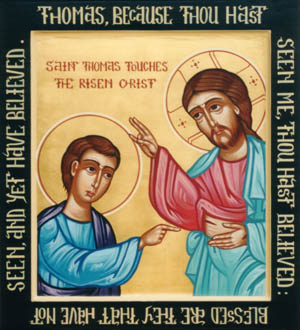
July 3--St. Thomas, Apostle
St. Thomas was one of the twelve Apostles, men who were sent
out to evangelize and catechize. We know
about him primarily from the gospels, especially the Gospel of John where he is
described as doubting the Resurrection.
And yet, when Jesus appears to the Eleven on the Sunday after the
Resurrection, Thomas is awestruck, saying: “My Lord and my God,” which connects
with the very first verse of John’s gospel:
“In the beginning was the Word, and the Word was with God, and the Word
was God.” Thomas’s declaration of faith
leads to Jesus’ response: “Have you come
to believe because you have seen me?
Blessed are those who have not seen and have believed” (Jn 20:29).
“Doubting Thomas” is the consummate modern person. He decided not to believe unless he could
see. That very well may describe many of
us in our modern age. We have been
conditioned to not accept those things which cannot be proven to our
satisfaction. We have transferred our
faith from belief in that which cannot be seen, touched, tasted, smelled, or
heard—spiritual realities—to faith in that which can be experienced by our
senses.
However, seeing is not believing; it is seeing. Can we ‘see’ love? or hope? or courage? or
perseverance? No, we ‘see’ people
expressing those realities in their words or actions. “Faith is the realization of what is hoped for and evidence of things not seen” (Heb 11:1). “Believing Thomas” is our model; the man who
professed belief in Jesus as Lord and God.
We are the ones “who have not seen and have believed.” We need to maintain and share our faith by
our words and actions so that others may ‘see’ Christ in us.
June 29--Sts. Peter and Paul, Apostles
It is rare when a saint gets more than one day in the
liturgical calendar. The Blessed Virgin
Mary has numerous feast days throughout the year. St. John the Baptist has two days and St.
Joseph has two days, but Sts. Peter and Paul have three each, including one day
for the both of them. Their importance
in the early Church forever links them together. They both died in Rome during the persecution
of the emperor, Nero. Before that, they
both worked together to bring Christianity to the Gentiles as shown in the Acts
of the Apostles at the Council of Jerusalem.
Both wrote epistles, Peter had two, Paul had 13. They were both apostles, Peter as one of the
original twelve and Paul as one specially chosen by Jesus when he was on the
road to Damascus. They are the main
protagonists in the Acts of the Apostles, Peter in the first part and Paul in
the second.
Both Peter and Paul shared in the ministry of spreading the
Good News of Jesus Christ. Peter was the
leader of the entire Church community, the shepherd appointed by Jesus to watch
over his flock. Paul was the founder of
numerous communities in Asia Minor and Greece, including most of the places to
whom he wrote epistles.
When portrayed in art, Peter is often shown as holding keys,
recalling the passage from Mt. 16:19—“I will give you the keys to the kingdom
of heaven.” This symbolized the role of
Peter as pope, the one who is the visible sign of the unity of the Church. Paul is often portrayed in art with a sword,
which is how he was martyred, or a book, symbolizing his letters in the New
Testament.
Both Peter and Paul are essential for us today. Peter’s role as shepherd-pope reminds us of
the importance of the Magisterium and the need to follow its teaching. Paul’s role as missionary-letter writer
reminds us of the importance of Scripture and Tradition in following
Jesus. Both remind us of the importance
of witnessing to the faith in Jesus.
Since both were martyred in Rome, Peter, according to tradition on an
upside-down cross, and Paul by beheading, this shows the primacy of Rome and
her bishop, the pope, in leading the Church throughout the world.
Subscribe to:
Posts (Atom)