Sunday, December 1, 2019

November 18--St. Rose Philippine Duchesne, Religious and Missionary

File:DuchesneRSCJ.jpg*
“Go West, middle-aged woman.” That is where today’s saint, St. Rose Philippine Duchesne, went to fulfill her calling in America, teaching among the pioneers and Native Americans of the American frontier of Missouri and Kansas.

Born in 1769, St. Rose started out as a nun in a French convent in the late 18th century. During the French Revolution, her convent closed, and she took it upon herself to care for the poor and sick, opened a school for street children, and helped priests. After that she joined the Society of the Sacred Heart, where she became a superior and a supervisor of the novitiate. But she still longed to go to America to work among the Native Americans. She finally got the chance when she was 49. She and four other sisters sailed to New Orleans and up the Mississippi to St. Louis, where she started the first free school for girls west of the Mississippi in St. Charles, Missouri. She also founded the first Catholic Native American school. At the age of 72, retired and in poor health, she went to a new mission in Sugar Creek, Kansas, about 50 miles south of Kansas City and worked among the Potawatomi. She could not teach, but prayed while others taught. She was named “Woman-Who-Prays-Always.” She died in 1852 at the age of 83 and canonized in 1988.

What does it take to be a pioneer? It doesn’t mean “Go West” in location, but rather “Go West” in love; go to those who need the most help, the poor, the outcast, the young, the hurting, the homeless. Expect hardship and suffering, but do so to offer it up in love for the grace of God to be showered on those whom we serve, as well as ourselves.

*https://commons.wikimedia.org/wiki/File:DuchesneRSCJ.jpg

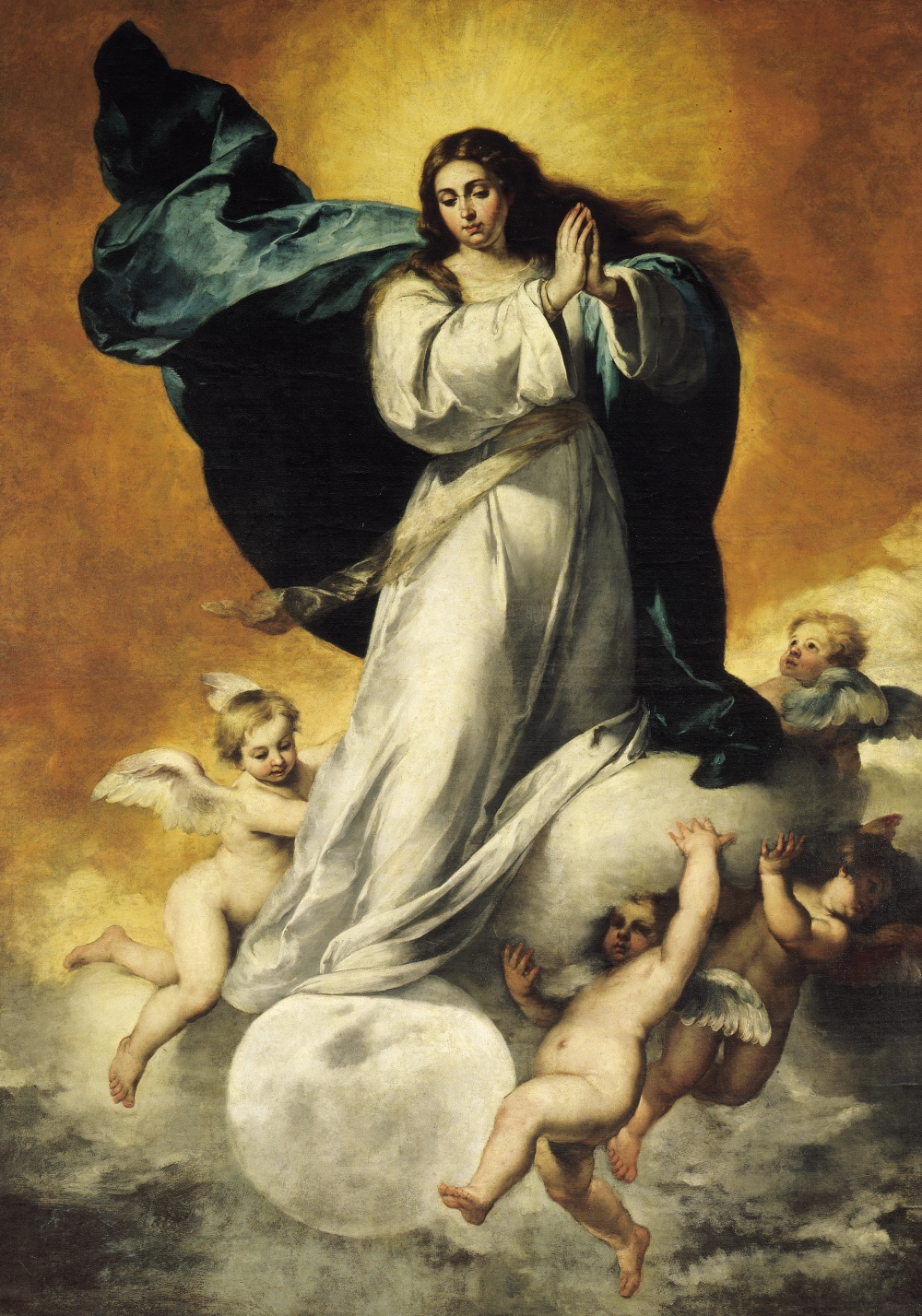
December 8--The Immaculate Conception of the Blessed Virgin Mary

*

First and foremost: The Immaculate Conception is about the conception of MARY, NOT JESUS. We celebrate her birthday on September 8, nine months later. The conception of Jesus is celebrated on March 25, the feast of the Annunciation, when the Angel Gabriel came to Mary and declared God’s will for her that she become the Mother of God. The virgin birth of Jesus is then celebrated nine months later on December 25!

So, now that we have that straight, what is the Immaculate Conception? The Immaculate Conception is the dogma, as defined by Pope Pius IX in 1854, that Mary was conceived in her mother’s womb without the stain of Original Sin. She is immaculate, or pure! She had the fullness of God’s sanctifying grace in her life from the moment of the beginning of her existence. How do we know this? From God’s Revelation. In Luke’s Gospel, the Angel Gabriel declared to Mary: “Hail, favored one! The Lord is with you.” (Lk. 1:28) This also comes to us as: “Hail (Mary) full of grace, the Lord is with thee.” Sound familiar? It is the beginning of the “Hail Mary”. It continues: “Blessed art thou among women,” which is from the greeting Elizabeth gave to Mary in Luke 1:41. Further: "And blessed is the fruit of thy womb, Jesus." Mary always points to Jesus!

Does this mean that Mary did not need salvation from Jesus Christ? No! Her fullness of grace was given to her by God in anticipation of the sacrifice of Jesus Christ. But why was she given this gift and not the rest of us? Because she is the Mother of God! She was given this special gift in anticipation of her fiat, or yes, to God’s request that she become the Mother of God.  A side note:  She is the patroness of the United States of America!  And so, we pray: Immaculate Mary, pray for us.
*By Bartolomé Esteban Murillo - [2], Public Domain, https://commons.wikimedia.org/w/index.php?curid=3118612

Sunday, November 3, 2019

November 12--St. Josaphat, Bishop and Martyr


*


In 1995, Pope St. John Paul II declared: “The Church must breathe with her two lungs!” (Ut Unum Sint, 54) What he meant was that the Church was only breathing with one lung, namely the Western Church. He declared that we needed the Eastern Church as well. The Catholic Church has been separated from her Eastern Orthodox sister churches since 1054. However, since then, there have been efforts at union. One prominent event toward union was the Union of Brest in 1596. Seven Orthodox bishops in Lithuania/Poland/Ukraine came into full communion with the pope, while still retaining their Eastern Rites.

Why is this important for our saint? He became an archbishop in one of these dioceses after 1596. St. Josaphat was born in 1580 to Ruthenian Orthodox Catholic parents. After the Union of Brest he became a monk in 1604 in the Ruthenian Rite. His zeal for his faith led him to write catechisms and apologetics, defenses of the Church. He defended the rights of the Eastern Rite Churches, but some opposed him on the grounds that he was trying to “go Latin” and not be faithful to the Eastern traditions.

In 1623, an Orthodox priest insulted St. Josaphat and tried to force his way into the archbishop’s residence. St. Josaphat had him removed, but he had assembled a mob, which then attacked St. Josaphat, shooting him and hitting him in the head with a battle axe, killing him. He was canonized in 1867 as a martyr.

The Eastern Orthodox and Roman Catholic Churches have the same sacraments, the same faith, and the same love of God. However, the difference between the two is the role of the pope. Pope St. John Paul II wrote about the need for unification. May the prayers of St. Josaphat bring us into communion with each other.

*https://commons.wikimedia.org/wiki/File:St_Josaphat_Zbarazh.jpg


Sunday, October 27, 2019

November 3--St. Martin de Porres, Religious

*

Humility is the hallmark of holiness. Such is true for today’s saint. St. Martin de Porres was born of a Spanish conquistador and a freed slave woman in 1579. He became a lay brother in Lima, Peru. He was trained as a physician, but he also had the gift of healing. His monastery became a place of healing for the poor of Peru.

But where does humility come in? St. Martin did not want anyone to know of his gift of healing, so he would use an herb or some other device to hide his gift. However, he was found out by the Archbishop of Mexico, who was passing through Lima. The archbishop was in great pain and suffering from a fever. He knew of St. Martin’s healing ability and sent for him. The Dominican superior sent him immediately to the archbishop before St. Martin could gather his healing materials. When he arrived at the archbishop’s residence, the archbishop ordered him to reach out his hand. St. Martin did not want to, but the archbishop required obedience of St. Martin. He stretched out his hand and put it on the archbishop’s chest, taking away his pain. The archbishop required him to leave his hand on his chest and his fever and illness disappeared. St. Martin was embarrassed at this and retreated to the monastery.

As Pope St. John XXIII remarked of him at his canonization in 1962: "He tried with all his might to redeem the guilty; lovingly he comforted the sick; he provided food, clothing and medicine for the poor; he helped, as best he could, farm labourers and Negroes, as well as mulattoes, who were looked upon at that time as akin to slaves: thus he deserved to be called by the name the people gave him: 'Martin of Charity.'"

*https://www.google.com/url?sa=i&source=images&cd=&ved=2ahUKEwjJ0NmAhr7lAhUTJjQIHVcRAhEQjRx6BAgBEAQ&url=https%3A%2F%2Fwww.flickr.com%2Fphotos%2Fpaullew%2F7149072617&psig=AOvVaw3MKis4MmM1tshCNVM3t6ce&ust=1572320906588295

Sunday, October 20, 2019

October 30--St. Alphonsus Rodriguez, Religious

*

Can a doorkeeper become a saint? In other words, can someone who spends his life receiving visitors, running errands, delivering messages, giving advice to the troubled, searching for others at the door of a college become a saint? Yes! St. Alphonsus Rodriguez did just that for 46 years! It seems an unlikely way to become a saint, but it was the way that God called him and the way he responded.

St. Alphonsus Rodriguez was born in Spain in 1532, left school at 14 when his father died to help his mother run the family business. He married at 26 but became a widower at 31 with one surviving child. His mother and child also died soon thereafter, and he sold the business. His life seemed to be one of failure and misery, but there was more to await him. He decided to enter the Jesuits at the age of 39, but they refused him because of his lack of education. One year later, after some remedial education in Latin, he was accepted as a lay brother, never to become a priest. He was assigned to be porter, or doorkeeper, at a Jesuit college on Majorca, where he served the rest of his life until he died in 1617 at the age of 85.  He was canonized in 1888.

A porter is a humble position, one also held by Bl. Solanus Casey of Detroit. However, it allows the person to be present to others at all times of day and in all cases of need. St. Alphonsus was a full-time minister to everyone he met. Every person he greeted was Jesus Christ! He became a spiritual advisor to the Jesuit students, including St. Peter Claver. When not at the door, he was in prayer. Humility is key to holiness, and so we pray:  St. Alphonsus Rodriguez, pray for us.


*https://commons.wikimedia.org/wiki/File:Francisco_de_Zurbar%C3%A1n_069.jpg

Sunday, October 13, 2019

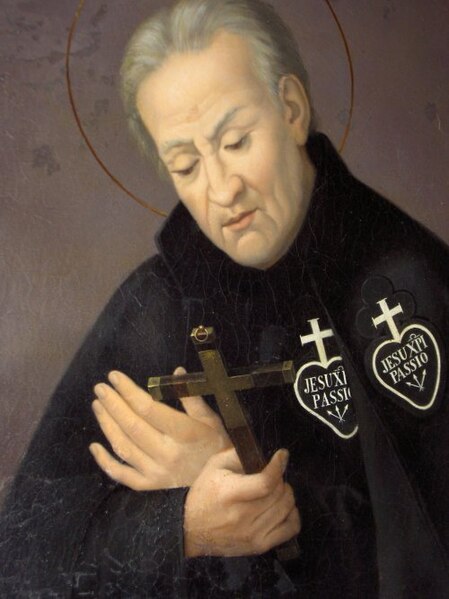
October 20--St. Paul of the Cross, Priest

File:Paul de la croix.jpg*

Passionate—showing or caused by strong feelings or a strong belief. Passion—strong and barely controllable emotion. The Passion—the sufferings and death of Jesus Christ. Passionist—member of the Congregation of the Passion of Jesus Christ founded by St. Paul of the Cross with special emphasis on and devotion to the Passion of Jesus Christ. Our saint today is the founder of a religious congregation dedicated completely to preaching missions and the contemplative life; in other words, a combining of the best aspects of the Jesuits and the Trappist monks.

St. Paul of the Cross was born in 1694 in Italy of parents of modest means. At the age of 26 he had a vision of Our Lady appearing to him in a black habit with a white insignia in the shape of a heart bearing Jesus’ name and a cross. This became emblematic of his dedication to the Passion of Jesus. With his brother John Baptist, he founded the Passionists. He spent his life preaching parish missions, praying, writing letters, and leading a life of austerity, as if in perpetual retreat, which is what his houses were called. He had the ability to heal, prophesy, and read consciences. He wanted people to have a greater awareness of the meaning and the value of Passion of Christ for each person and for the world. He died in Rome in 1775 and was canonized in 1867.

Mel Gibson’s The Passion of the Christ, released in 2004, is about the last hours of Jesus Christ. It is a two-hour bloody, torturous, excruciating meditation upon what we proclaim, the Paschal Mystery of Jesus Christ. Simply, Jesus suffered and died for us. We should not ever forget the sacrifice and mercy of God for us. St. Paul of the Cross, pray for us.


*https://commons.wikimedia.org/wiki/File:Paul_de_la_croix.jpg


Sunday, October 6, 2019

October 16--St. Hedwig, Religious


File:MOs810 WG 2 2018 (Wloclawek Lake) (Saint Hedwig church in Stara Biała) (6).jpg*

For many people today, the name Hedwig summons images of a snowy owl from the Harry Potter movies. However, the name Hedwig has a more sacred connection, St. Hedwig. She was born in Bavaria around 1174, married Henry, Duke of Silesia and together they had seven children. They lived in Silesia, which is part of present-day Poland and founded religious houses and hospitals. She took an active role in serving the poor. She was a peacemaker in a time of war. She attempted to reconcile her sons so they would not fight. She succeeded in keeping her husband and another duke from going to war. Henry died in 1238, over 50 years after their marriage. St. Hedwig then moved into the convent she helped found, although she did not take religious vows so that she could share her property with the poor. She died in 1243 and was canonized in 1267.

St. Hedwig was wealthy by virtue of being a duchess. However, she was not attached to her wealth, giving to the poor, being a benefactor to religious communities as well as to her country. Most of us have more than what we need and far more than what our recent ancestors had to live on. How well do we share our wealth? Are we attached to the “things” we have? Bl. Charles de Foucald wrote: “If God allows some people to pile up riches instead of making themselves poor as Jesus did, it is so that they may use what he has entrusted to them as loyal servants, in accordance with the Master’s will, to do spiritual and temporal good to others.” Our riches need to be shared so that we may bring about good as a matter of charity and of justice. St. Hedwig, pray for us.
* https://commons.wikimedia.org/wiki/File:MOs810_WG_2_2018_(Wloclawek_Lake)_(Saint_Hedwig_church_in_Stara_Bia%C5%82a)_(6).jpg