Showing posts with label Martyr. Show all posts

Saturday, September 6, 2025

September 16--St. Cyprian of Carthange, Bishop and Martyr


Galerius Maximus: "Are you Thascius Cyprianus?"
Cyprian: "I am."
Galerius: "The most sacred Emperors have commanded you to conform to the Roman rites."
Cyprian: "I refuse."
Galerius: "Take heed for yourself."
Cyprian: "Do as you are bid; in so clear a case I may not take heed."
Galerius: "You have long lived an irreligious life, and have drawn together a number of men bound by an unlawful association, and professed yourself an open enemy to the gods and the religion of Rome; and the pious, most sacred and august Emperors ... have endeavoured in vain to bring you back to conformity with their religious observances; whereas therefore you have been apprehended as principal and ringleader in these infamous crimes, you shall be made an example to those whom you have wickedly associated with you; the authority of law shall be ratified in your blood. It is the sentence of this court that Thascius Cyprianus be executed with the sword." 
Cyprian: "Thanks be to God."

Thus, the trial and sentencing of St. Cyprian of Carthage in A.D. 258 under Emperor Valerian. He had survived the Decian persecution eight years earlier by going into hiding. However, many had criticized him for that. He explained that he needed to be pastor for his flock, whereas in the latter persecution he explained that he needed to be an example. In between, when the persecution had been relaxed, many who had lapsed from the faith in fear of martyrdom desired to return to the fold. St. Cyprian approved, but only after an appropriate public penance. He was opposed by those who wanted no penance and those who wanted no readmission! Pope St. Cornelius, whose feast day Cyprian shares, agreed with him. Reconciliation is a necessary sacrament for us as well! St. Cyprian, pray for us.

Monday, July 14, 2025

July 25--St. Christopher, Martyr


Whatever happened to St. Christopher? We know that he was a martyr under the persecution of the Emperor Decius in the third century in Lycea in present-dayTurkey, but we do not know anything else about him. Because of that, the Church removed him from the liturgical calendar. However, that does not mean that the Church demoted him or denied his existence. He is still on the Roman Martyrology, the approved list of saints in the Catholic Church.

In the Middle Ages a story spread about St. Christopher. The legend states that he was a giant who wished to serve the strongest, most powerful king. He started out serving a Christian king who crossed himself whenever he heard the devil’s name. Thus St. Christopher went to serve the devil who shuddered at the sight of the cross of Christ. Thus St. Christopher went to serve Christ. He was told by a hermit he would find Christ by carrying people across a river. “After Christopher had performed this service for some time, a little child asked him to take him across the river. During the crossing, the river became swollen and the child seemed as heavy as lead, so much that Christopher could scarcely carry him and found himself in great difficulty. When he finally reached the other side, he said to the child: ‘You have put me in the greatest danger. I do not think the whole world could have been as heavy on my shoulders as you were.’ The child replied: ‘You had on your shoulders not only the whole world but Him who made it. I am Christ your king, whom you are serving by this work.’ The child then vanished.” Thus, he is the patron of travelers.

St. Christopher is still a saint! St. Christopher, pray for us.

Monday, May 26, 2025

June 2–St. Marcellinus and Peter, Priest and Exorcist, Martyrs


“To us, also, your servants, who, though sinners, hope in your abundant mercies, graciously grant some share and fellowship with your holy apostles and martyrs: with John the Baptist, Stephen, Matthias, Barnabas, (Ignatius, Alexander, Marcellinus, Peter, Felicity, Perpetua, Agatha, Lucy, Agnes, Cecilia, Anastasia) and all your saints; admit us, we beseech you, into their company, not weighing our merits, but granting us your pardon, through Christ our Lord.”

This is part of the First Eucharistic Prayer, the oldest eucharistic prayer in the Latin Rite. It contains the names of many saints, especially of martyrs, including Marcellinus and Peter. A catacomb outside Rome is named for them.

“The catacomb of Saints Marcellinus and Peter derives its name from the two martyrs buried within it. The story behind the life of these two martyrs goes back to the time of the Emperor Diocletian. St. Marcellinus and St. Peter were slain during the persecution of 304 AD - beheaded, in Rome. Before being killed, however, they were forced to dig their tomb with their own hands. The site of the terrible martyrdom of the two saints was known as ‘Selva Nera’ (meaning ‘Black Forest’), but after their death it was renamed ‘Selva Candida’, that is ‘White Forest’, along Via Cornelia.

“It was thanks to a Roman matron, who went with the name of Lucilla, that the bodies of the two martyrs were brought to Via Casilina, at the site called ad Duas Lauros. With the translocation of the saints’ bodies, the Christian cemetery, already in use, was dedicated in their memory.” (http://www.catacombeditalia.va)

Martyrs are the heroes of the faith, the men and women who gave their lives for their love of Christ. We honor them in our prayers and we ask for their prayers. Sts. Marcellinus and Peter, pray for us.

Tuesday, May 13, 2025

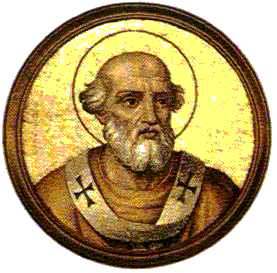
May 18--St. John I, Pope and Martyr


“Habemus Papam!”  At the time of this writing, May of 2025, the conclave of cardinals in Rome elected Robert Prevost, of Chicago, Illinois, U.S.A., Pope Leo XIV.  We pray for him and his successful tenure as 267th pope and shepherd of the Catholic Church.  Well and good!


We also honor St. John I, pope and martyr, who was elected in AD 523 and was martyred in AD 526 at the hands of a heretic king.  St. Martin I was the last pope to be martyred in AD 653.  Nonetheless, every pope is the successor to Peter, the Rock, who was told by Jesus:  “‘Amen, amen, I say to you, when you were younger, you used to dress yourself and go where you wanted; but when you grow old, you will stretch out your hands, and someone else will dress you and lead you where you do not want to go.’  He said this signifying by what kind of death he would glorify God. And when he had said this, he said to him, ‘Follow me.’”


Pope St. John I was martyred because he succeeded in accomplishing what Theodoric, the Arian King of Italy, requested of him:  accommodations with the Byzantine emperor to avoid persecution of the Arians in the East.  Such was St. John’s success that Theodoric suspected him of conspiracy with the emperor and thus imprisoned him upon his return to Italy with the favorable news!  St. John died in prison.  


Every pope is called to witness the faith.  Pope Leo XIV stated: “I also want to … walk together with you, as a united Church always seeking peace, justice, always trying to work as men and women faithful to Jesus Christ, without fear, to proclaim the Gospel, to be missionaries.”  St. John I, pray for us!

Sunday, April 27, 2025

May 4--St. Florian, Martyr


The Catholic Church has patron saints for just about everything under the sun: animals–St. Francis of Assisi; Catholic schools–St. Thomas Aquinas; actors–St. Genesius; soldiers–St. George; bakers–St. Elizabeth of Hungary; and today’s saint, St. Florian, patron of firefighters. St. Florian was born in AD 250 in present-day Austria. He joined the Roman army and was in charge of fire brigades as part of his duties. He became a Christian, was discovered, arrested, and sentenced to be burned at the stake in 304 under the persecution of Emperor Diocletian. “Standing on the funeral pyre, Florian is reputed to have challenged the Roman soldiers to light the fire, saying ‘If you wish to know that I am not afraid of your torture, light the fire, and in the name of the Lord I will climb onto it.’ Apprehensive of his words, the soldiers did not burn Florian, but executed him by drowning him in the Enns River with a millstone tied around his neck instead.”

The reason we have patron saints is because they are men, women, and children to whom we can relate, whether because of their lives, their jobs, their circumstances, their deaths or what have you! Patron saints are people who we appeal to for help because we can relate to their experiences and we know they can relate to ours. St. Florian was a firefighter and a martyr. He lived his faith through his life and through his death. People look to us as role models as well! We are husbands, wives, mothers, fathers, workers, victims of illness or accidents. We need to live our faith through our lives. We can guide others and pray for them as their patrons, just as the patron saints guide us and pray for us. St. Florian, patron of firefighters, pray for us!

Thursday, April 3, 2025

April 13–St. Martin I, Pope and Martyr


What happens when one does the right thing for the right reason in the right way but then is arrested, convicted, and exiled? He, St. Martin I, becomes the last pope to be martyred. Pope St. Martin I became pope in AD 649. What he did that got him arrested and martyred in 653 by the emperor was to condemn the heresy of Monothelitism, which the emperor supported.


Monothelitism stated that Jesus had only one will, a divine will, but not a human will. This was over 200 years after the Council of Chalcedon adopted the Tome of Pope St. Leo the Great, which had declared that Jesus Christ was one divine person with two natures, one divine and one human. To say that Jesus had one divine will is to deny him a human will and thus any human freedom in what he did or said. To say that he had only a divine will means that he was not really human because humans have a human will. Another problem with Monothelitism is that if Jesus only had a divine will then our human will is not saved. “What is not assumed is not saved,” according to St. Athanasius. God not only became incarnate by assuming human nature, but also by assuming all that it means to be human, and that means having a human will!


St. Martin I taught the truth and suffered: “Then Jesus said to his disciples, ‘Whoever wishes to come after me must deny himself, take up his cross, and follow me’” (Mt. 16:24). We are all called to love, to take up our crosses, and follow Jesus. This will lead to suffering, but we offer it up in turn to Jesus, who loves and strengthens us. Pope St. Martin I, pray for us.

Monday, March 31, 2025

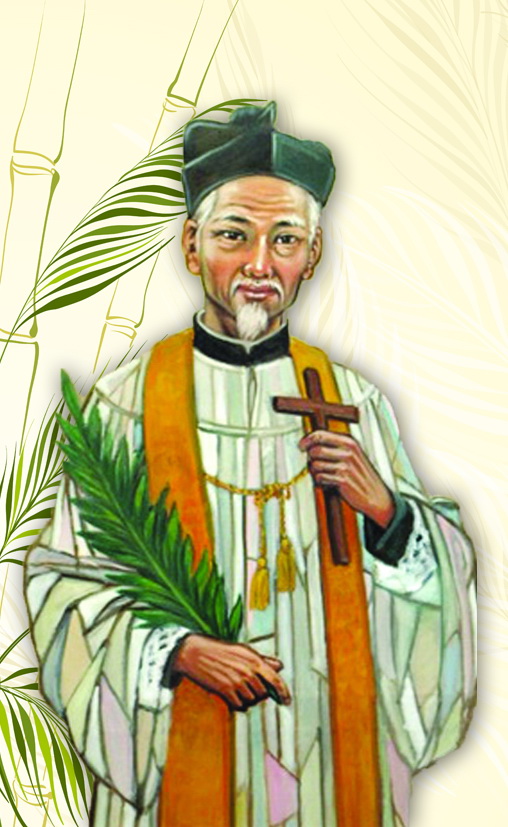
April 6--St. Paul Le-Bao Tinh, Priest and Martyr


Vietnam was evangelized by Catholic missionaries from Portugal, Spain, and then later from France. St. Paul Le-Bao Tinh was born in Vietnam in 1793. He was sent to a Catholic seminary at the age of twelve, after which he lived as a hermit until the local bishop asked him to bring missionary priests to Laos. In 1841 persecution began. He was arrested and spent seven years in prison in Hanoi. His sentence of death was commuted in 1848. He returned to the seminary and was ordained a priest. In 1855 he was again arrested and sentenced to death. In 1857 he was decapitated, as was the original St. Paul of Tarsus. St. John Paul II canonized him in 1988.

In both persecutions we have his words describing his suffering and his readiness for death: “I, Paul, bound in chains for the sake of Christ, send to you from prison salutations which are many and final… The prison is truly a living example of hell: to chains, shackles and manacles, are added anger, vengeance, lies, obscene conversations, brawls, evil acts, swearing, slander, plus boredom, sadness, mosquitoes and flies… I write these things so that your hearts might burst with desire to be martyrs, and that your prayers might strengthen me, who lives in the arena of combat.”

"My body is in your hands, please torture it as you wish, I am very happy, without any complaint. It dies but will rise again in glory tomorrow. As for my soul, it belongs to God, nothing can make me sacrifice it, no one can shake my faith. Christianity is the right religion, the true religion. I have loved and kept that religion since I was a child, and even if I die, I cannot abandon it." St. Paul Le-Bao Tinh, pray for us.

Monday, March 24, 2025

March 31--St. Benjamin, Deacon and Martyr


Vatican II reestablished the order of the diaconate as a “proper and permanent rank of the hierarchy:” “It is the duty of the deacon... to administer baptism solemnly, to be custodian and dispenser of the Eucharist, to assist at and bless marriages in the name of the Church, to bring Viaticum to the dying, to read the Sacred Scripture to the faithful, to instruct and exhort the people, to preside over the worship and prayer of the faithful, to administer sacramentals, to officiate at funeral and burial services” (Lumen gentium, 29).

Today’s saint was a deacon in this same manner in Persia in the 4th and 5th centuries. St. Benjamin was martyred in AD 424 during a persecution through two kings of Persia and for about forty years. The Eastern Roman Emperor Theodosius II was able to obtain his release after being imprisoned but with the condition that he not preach. St. Benjamin “declared it was his duty to preach about Christ and that he could not be silent.” He was then subjected to brutal torture, which killed him.

Today’s deacons may not be called to martyrdom, but they are called to preach the Gospel, to witness, and to serve the People of God in the ways directed by Vatican II. According to a study commissioned by the USCCB in 2021-2022, there were over 20,000 permanent deacons, with more than half of them in active ministry. We have been blessed by this ministry. Thus, we need to continue to promote vocations to the diaconate as well as to the priestly and religious vocations. The People of God need men and women to dedicate themselves to serving others so we may come closer to God. Be open to God’s call. St. Benjamin, pray for us.

Monday, June 3, 2024

July 7--The Blessed Ulma Family, Martyrs


The Church has beatified and canonized married couples, as well as members of the same family, but only one family has been beatified together as martyrs, the Blessed Ulma Family. Pope Francis spoke of them on the day of their beatification:

“Today in Markowa, Poland, the martyrs Józef and Wiktoria Ulma, and their seven children, were beatified: an entire family exterminated by the Nazis on 24 March 1944 for having given shelter to a number of persecuted Jews. They opposed the hatred and violence that characterized that time with evangelical love. May this Polish family, which represented a ray of light in the darkness of the Second World War, be for all of us a model to imitate in the zeal for goodness and service to those in need.…”

Jesus said: “No one has greater love than this, to lay down one’s life for one’s friends” (Jn. 15:13). The Ulmas gave the ultimate sacrifice of love, their lives, in order to protect and save eight Jews. However, they were all denounced so that the lands of the Jewish family could be taken away. All were killed by immediate and summary execution as a sign to the Polish people to not hide Jews. The Jews were executed first, then, in front of their children, Józef and Wiktoria, who was pregnant, and finally the other six children aged eight, seven, six, four, three, and two. They were buried in front of their house, but later, relatives exhumed and reburied the bodies, including the unnamed infant boy, who was born during the execution.

This is a terrible and tragic story, except that it is not! True, the execution of both Jews and Catholics is horrific. But the love and sacrifice shown by such martyrdoms is heroic. Blessed Ulmas, pray for us!


Sunday, June 2, 2024

June 20--Martyrs of Ireland, Bishops, Priests, and Laity


In 1992 Pope John Paul II beatified seventeen martyrs killed under English rulers, including Elizabeth I and Oliver Cromwell, between 1584 and 1654. They included three bishops, seven priests, one brother, five laymen and one laywoman. The pope proclaimed:

“And how can we fail to sing the praises of the seventeen Irish Martyrs being beatified today?…

“We admire them for their personal courage. We thank them for the example of their fidelity in difficult circumstances, a fidelity which is more than an example: it is a heritage of the Irish people and a responsibility to be lived up to in every age.

“In a decisive hour, a whole people chose to stand firmly by its covenant with God: ‘All the words which the Lord has spoken we will do’.… The religious and political turmoil through which these witnesses lived was marked by grave intolerance on every side. Their victory lay precisely in going to death with no hatred in their hearts. They lived and died for Love. Many of them publicly forgave all those who had contributed in any way to their martyrdom.

“The Martyrs' significance for today lies in the fact that their testimony shatters the vain claim to live one's life or to build a model of society without an integral vision of our human destiny, without reference to our eternal calling, without transcendence.…

“To the Martyrs' intercession I commend the whole people of Ireland: their hopes and joys, their needs and difficulties. May everyone rejoice in the honor paid to these witnesses to the faith. God sustained them in their trials. He comforted them and granted them the crown of victory. May he also support those who work for reconciliation and peace in Ireland today!

“Blessed Irish Martyrs, intercede for the beloved Irish people!”


June 15–St. Vitus, Martyr


https://www.saintforaminute.com/saints/saint_vitus

Many early martyrs of the Church were legendary, meaning that they may have had a life that was not historical by modern standards, but did have some basis in fact. That is probably the case with today’s saint. St. Vitus, according to legend, lived and died during the worst persecutions of the early Church under the reign of Emperor Diocletian in the early 300s. He was said to be about twelve years old and was taken to Rome to drive out a demon that had possessed the son of Diocletian. He was successful in the exorcism but was still tortured and died a martyr. One version has him being boiled in oil.

Given this legend it seems a wonder that he is still listed in the Roman Martyrology, the official book of saints in the Catholic Church. Nonetheless, there were quite a few martyrs under Diocletian’s rule and St. Vitus is one of them. Veneration spread very early and fast with a shrine dedicated to him by the fifth century spreading especially to Slavic lands, including Bohemia, Serbia, Bulgaria, and Croatia. He is the patron saint of actors, comedians, and dancers due to the tradition from 16th century Germany that by dancing before a statue of St. Vitus on his feast day people could gain a year’s good health.

Does this mean the Catholic Church made up martyrs to take advantage of people? No! Persecution of Christians was, and is, quite real. A December 2023 National Catholic Register article stated: “A report from the watchdog group Open Doors found that the persecution of Christians is at the highest point in three decades. It found that some of the worst locations for Christians were North Korea, Somalia, Yemen, Eritrea, Libya, Nigeria, Pakistan, Iran, Sudan and India.” St. Vitus, pray for us!

Monday, January 15, 2024

January 23--St. Vincent of Saragossa, Deacon and Martyr

St. Vincent of Saragossa by Tomás Giner licensed under public domain. 

As St. Stephen, a deacon, was the first martyr of the Church, so St. Vincent of Saragossa, also a deacon, was the first martyr of Spain. St. Vincent was commissioned by his bishop, St. Valerius, to preach throughout his diocese because he had a speech impediment. When the Roman Emperor Diocletian began his empire-wide persecution in the late third century both St. Vincent and St. Valerius were brought before the governor. St. Vincent was promised freedom if he would throw the Bible into a fire. He refused. “Speaking on behalf of his bishop, he informed the judge that they were ready to suffer everything for their faith, and that they could pay no heed either to threats or promises.” Thus, St. Vincent was tortured and cast into prison and died. St. Valerius was exiled. St. Vincent fulfilled his vocation as a Christian in dying for Christ and as a deacon in assisting and preaching on behalf of his bishop.

Vatican II restored the permanent diaconate and Pope St. Paul VI implemented the restoration in 1967. As of 2022 there were about 13,500 active permanent deacons in the United States. Deacons assist the bishop or priest at the altar and bring communion to the sick and shut-ins. They may preach the Gospel and give a homily. They are ordinary ministers of Baptism and can assist at and bless marriages, officiate at funeral and burial services. Many deacons are involved in pastoral care for parishes or work in parish ministerial and non-ministerial positions. However, 95% of active deacons are at least 50 years old, and their numbers are declining. “Permanent deacons are essential to the Church’s ministry of love and service, especially to the poor and vulnerable,” said Bishop Boyea of Lansing. Please pray for vocations. St. Vincent, pray for us.

Monday, September 18, 2023

September 26--Sts. Cosmas and Damian, Martyrs

The Martyrdom of Saints Cosmas and Damian by Fra Angelico licensed under Public Domain.


What if your doctor did not charge you for services rendered because the doctor was Christian? Would that cause you to pay a little more attention to the beliefs? Sts. Cosmas and Damian were twin brothers and physicians who did not charge for their services. By their charity many were attracted to Christianity. They were arrested and martyred during the reign of Emperor Diocletian in the third century, who had conducted the most systematic and oppressive persecution of the Roman era. Reports of their martyrdoms spread quickly and they were venerated in both the East and West. They are included in the Roman canon of the Mass: “In communion with those whose memory we venerate, especially the glorious ever-Virgin Mary, Mother of our God and Lord, Jesus Christ, † and blessed Joseph, her Spouse, your blessed Apostles and Martyrs, … Cosmas and Damian and all your Saints; we ask that through their merits and prayers, in all things we may be defended by your protecting help.”

So what can we learn from them? Do we offer our services for free? That does occur in many fields including the legal, financial, and medical professions. The term used for this is pro bono, short for pro bono publico, “for the public good.” That is one thing to gain, but Sts. Cosmas and Damian did not practice medicine for free just for the public good. They offered their services because they were disciples of Christ. We are called to be disciples of Christ in our homes, in our parishes, in our workplaces, and in our communities. Are people attracted to Christianity because of who we are and what we do as disciples? If so, we have won souls to Jesus. If not, why not, pray tell? Sts. Cosmas and Damian, pray for us.

Tuesday, August 1, 2023

August 7--St. Sixtus II, Pope and Martyr, and Companions, Martyrs


From the time of St. Peter to the legalization of Christianity by Emperor Constantine I in A.D. 313, 27 of the 31 popes were martyred! That is a rate of 87%. Talk about “most dangerous jobs!” And these were not ordinary executions by today’s standards. The popes were crucified, beheaded, tied to an anchor and tossed into the sea, worked to death, and killed by the sword, to name a few of the methods. And yet these men were willing to be successors to Peter to maintain the leadership of the Church.

Today’s saints were no different! Pope St. Sixtus II was pope from 257-258, being martyred on August 6, less than a year after his election. His companions were deacons of the Church. The most famous deacon at this time, St. Lawrence, was martyred four days later and has his own feast day. Pope St. Sixtus was arrested while saying Mass in the cemetery of St. Callistus under the persecution of the Emperor Valerian and executed. The following epitaph was placed on his tomb by Pope St. Damasus I:

“At the time when the sword pierced the bowels of the Mother, I, buried here, taught as Pastor the Word of God; when suddenly the soldiers rushed in and dragged me from the chair. The faithful offered their necks to the sword, but as soon as the Pastor saw the ones who wished to rob him of the palm (of martyrdom) he was the first to offer himself and his own head, not tolerating that the (pagan) frenzy should harm the others. Christ, who gives recompense, made manifest the Pastor's merit, preserving unharmed the flock.” We owe much to our shepherds. They are willing to undergo suffering for the sake of their sheep. Let us pray for our popes!

Monday, July 10, 2023

July 27–St. Titus Brandsma, Priest, Religious, and Martyr


We need martyrs! “The blood of the martyrs is the seed of Christians” according to Tertullian and also to St. John Paul II. The twentieth century was filled with martyrs in Mexico, Spain, Nazi-occupied Europe, Communist-controlled countries, and anti-Catholic dictatorships and governments. This has spilled into the twenty-first century as well. “Martyrs are revered with particular devotion by the People of God who see in them a living portrayal of Christ's Passion.”

Today’s saint was a “witness” (the meaning of the word martyr) to Jesus’ Passion in Nazi-occupied Netherlands. Born in 1881, St. Titus Brandsma grew up on a dairy farm and entered the Carmelite order in 1898. He was ordained a priest in 1905, received his doctorate, helped found the Catholic University of Nijmegen, and taught philosophy and history of mysticism there. He also became a journalist, which led to his arrest by the Nazis in 1942. He was hand-delivering a letter from the Dutch bishops to editors of Catholic newspaper editors to prohibit publishing official Nazi documents and was arrested and sent to Dachau where he was killed by an injection of carbolic acid. “In 1985, Pope St. John Paul II declared Titus Blessed, saying that he “‘answered hate with love.’"

We need martyrs to show that Jesus’ sacrifice of love is lived out in the lives and deaths of his faithful ones! We need martyrs to bolster the faith of our brothers and sisters in Christ! We need martyrs to convert the hearts of those who oppose, harass, torture, persecute, arrest, unjustly convict, and unjustly imprison and kill! We need martyrs to proclaim the truths of faith, hope, and love in Christ Jesus! We need martyrs to be “a life-giving sap of unity for the Church, the Mystical Body of Christ.” St. Titus Brandsma, pray for us.

Tuesday, June 20, 2023

July 10--Bl. Faustino Villanueva y Villanueva, Priest and Martyr

http://newsaints.faithweb.com/martyrs/Guatemala.htm

What does it mean to be a martyr? Pope Francis has beatified many martyrs, including those killed during the civil war in Guatemala from 1954-1996. Why were they martyred? The Vatican biography for their beatification states: “From 1980, a systematic persecution against the Church began, overwhelming priests, religious and lay people under the pretext that they were ‘enemies of the state’. … The ten martyrs [of Quiché] … were killed in Guatemala between 1980 and 1991 … for being committed to and protecting the dignity of the poor.”

The following is from a Spanish newspaper article: “Faustino Villanueva was born on February 15, 1931 in Yesa, where his parents were also from. He entered the apostolic school of the Missionaries of the Sacred Heart, in Valladolid, as a child. He professed in 1949 and was ordained a priest in 1956. He went as a volunteer to the mission of Quiché (Guatemala) in 1959, where he remained until his martyrdom, which occurred in the parish office on July 10, 1980, after twenty-one years of fruitful missionary service to the poorest. A month before he died, he wrote to his mother, reiterating his desire to remain in the mission despite the prevailing violence: ‘We cannot leave the people abandoned.’ He died machine-gunned by two young hitmen in the parish office of Joyabaj (El Quiché) on July 10, 1980.

“Those who knew him affirm that ‘he was simply good, evangelical in his non-existent flirtations with power and prestige; so charmingly familiar and unfussy; so clearly biased in favor of the marginalized indigenous, of the favorite downtrodden peasants of the Gospel; of the voiceless.... However, this evangelical Faustino Villanueva was shot mercilessly. And not by mistake. He had long been on a sinister death row list. Guilty of siding with the poor and marginalized.’”

Monday, February 27, 2023

March 10--St. John Ogilvie, Martyr, Priest, and Religious


Is a person a martyr if charged with treason? Jesus was crucified on a political charge, as was today's saint. St. John Ogilvie was the eldest son of a Calvinist Scottish landowner. He was born in 1580 and educated as a Calvinist. He was then sent to the continent and educated by various Catholic groups including the Benedictines and Jesuits. He became Catholic in 1597, a Jesuit two years later, and a priest in 1610. He requested to be sent to Scotland as a missionary, which was illegal. He received permission and went there in 1613. He preached and celebrated Mass in private homes, but in 1614 was betrayed, arrested, and tried. He was tried for refusing to pledge allegiance to King James. After his conviction he was hanged and drawn. He was canonized in 1976.

So, back to the first question. The answer is yes. A person is declared a martyr in the Church if killed due to odium fidei, or hatred of the faith. St. John Ogilvie was killed because it was illegal to practice Catholicism in Scotland. Jesus was arrested and brought before Pilate, the Roman governor, under the charge of treason: "Now Jesus stood before the governor, and he questioned him, 'Are you the king of the Jews?' Jesus said, 'You say so.'" (Mt. 27:11) In both cases, a political charge was used to complete a religious act, martyrdom and crucifixion.

Will the practice of Catholicism in America be declared in opposition to the state? Will our faith be considered subversive if we oppose the popular will? Will it be a prohibited political act to oppose physician-assisted suicide, same-sex marriage, embryonic stem-cell research, or physical mutilation for the sake of self-identity? If so, be prepared for martyrdom and new saints. St. John Ogilvie, pray for us.

Sunday, January 9, 2022

January 19—Sts. Marius, Martha, Audifax, and Abachum, Parents and Sons—Martyrs

*


Today we celebrate a family of martyrs! They were martyred in A.D. 270 in Rome. They buried other martyrs and then became the object of persecution and torture. Maris and his sons were beheaded, and their bodies burnt. Martha was drowned outside of Rome at a place now called Santa Ninfa. According to tradition, a Roman woman gathered the remains of the family and had them buried on her estate, which became a place of pilgrimage. They are inscribed in the Roman Martyrology, which is the official list of saints recognized by the Church. They are not on the General Roman Calendar because we only know with certainty their names and their place of burial.

How is it that a whole family could be martyred? They were willing to die for what they believed in. They were witnesses to their faith in Jesus Christ and the hope of the Resurrection. Are our families prepared to do the same? Do we believe to the point of witnessing to our faith in Jesus Christ? Are we willing to live lives of heroic virtue? Do people see in us what others saw in our saints—a love of God which can’t be denied or suppressed?

Do we live the Corporal and Spiritual Works of Mercy so that others cannot but see our faith? We need to clothe the naked, shelter the homeless, visit the sick and the imprisoned, give food and drink to the hungry and thirsty, bury the dead, instruct the ignorant, comfort the afflicted, warn the sinner, counsel the doubtful, bear wrongs patiently, forgive offenses patiently, and pray for the living and the dead. This is Jesus’ command! Then everyone will know we are Christians, by our love! May Sts. Marius, Martha, Audifax, and Abachum guide us and pray for us!

*https://www.akg-images.co.uk/archive/Fresco---Saints-Marius-Martha-Audifax-Abachum.-(Christian-Martyrs-)---Basilica-Santo-Stefano-Rotondo---Rome-2UMEBM5IHTJLT.html

Thursday, December 16, 2021

December 26--St. Stephen, Deacon and First Martyr

 *


On the first day of Christmas, we receive the gift of the birth of Jesus, the source of all salvation. On the second day of Christmas, we have the feast of the first martyr, St. Stephen. What we know of St. Stephen comes to us directly from the Acts of the Apostles. He was chosen as one of the seven deacons, who then served the Greek-speaking Jewish Christians in Jerusalem. But there is more to the story of St. Stephen.

He came to the attention of the Sanhedrin. He then explained the history of Israel to them and told them how Jesus fulfilled all that had been prophesied. “When they heard this, they were infuriated, and they ground their teeth at him. But he, filled with the holy Spirit, looked up intently to heaven and saw the glory of God and Jesus standing at the right hand of God, and he said, ‘Behold, I see the heavens opened and the Son of Man standing at the right hand of God.’ But they cried out in a loud voice, covered their ears, and rushed upon him together. They threw him out of the city, and began to stone him. The witnesses laid down their cloaks at the feet of a young man named Saul. As they were stoning Stephen, he called out, ‘Lord Jesus, receive my spirit.’ Then he fell to his knees and cried out in a loud voice, ‘Lord, do not hold this sin against them’; and when he said this, he fell asleep” (Acts 7:54-60). 

The feast of St. Stephen is immediately after Christmas to show us what discipleship truly means, the sacrifice of oneself in love of God for others, namely, martyrdom. May every day remind us of our call to discipleship. St. Stephen, pray for us.


* https://upload.wikimedia.org/wikipedia/commons/2/20/St_stephen.jpg  Jacopo & Domenico Tintoretto, Public domain, via Wikimedia Commons
 

Monday, December 6, 2021

December 13—St. Lucy, Virgin and Martyr

*


If you are a fan of C. S. Lewis, you may remember one of the main characters in his classic, The Lion, the Witch, and the Wardrobe, Lucy Pevensie. It was Lucy who brought the other Pevensie children to the magical land of Narnia and met its ruler, Aslan, the lion, who is an allegorical figure for Christ. She was the first to believe in Aslan and sometimes saw him when the rest didn’t. The name Lucy is from the Latin word, “lux”, meaning light. It is also the name of today’s saint. 

St. Lucy was one of the virgin martyrs mentioned in the Church’s Eucharistic canon. She was born about 283 and died during the worst persecution of Christians in the early Church under the Emperor Diocletian in 304. After her father’s death, her mother arranged for a marriage with a young man from a wealthy pagan family. However, St. Lucy had consecrated her virginity to God. Her dowry was distributed to the poor, but her betrothed objected and denounced her to the Governor of Syracuse, Sicily. Lucy was ordered to sacrifice to the emperor’s image. Upon refusal, she was sentenced to be defiled in a brothel. When guards came to take her away, she was unmovable. She was then killed by a sword to her throat. According to some legends her eyes were gouged out, leading to her patronage of the blind. 

So how does this relate to Lucy Pevensie? Both could SEE what others could not, Jesus, who said of himself: “I am the light of the world. Whoever follows me will not walk in darkness but will have the light of life” (Jn 8:12). Both followed Jesus, one in a magical land, the other to the land of eternal life. St. Lucy, pray for us.
*https://upload.wikimedia.org/wikipedia/commons/8/81/Santalucia.jpg