Showing posts with label Jesuits. Show all posts

Saturday, November 18, 2023

December 3--St. Francis Xavier, Priest and Religious

Portrait of St. Francis Xavier by Unknown Artist licensed under public domain.

He was the most famous missionary since St. Paul! He traveled to India, Malaysia, the Maluku Islands, Japan, and China. He converted about 30,000 souls. He evangelized in native languages, adapted to native cultures, and promoted native clergy. He co-founded the Society of Jesus, the Jesuits, and was named “Patron of Catholic Missions” by Pope Pius XI. That is quite a résumé for today’s saint, St. Francis Xavier!

Pope Benedict XVI wrote: “St. Francis Xavier … saw as his own mission ‘opening new ways of access’ to the Gospel ‘in the immense Continent of Asia’. His apostolate in the Orient lasted barely 10 years, but in the four and half centuries that the Society of Jesus has existed it has proven wonderfully fruitful, for his example inspired a multitude of missionary vocations among young Jesuits and he remains a reference point for the continuation of missionary activity in the great countries of the Asian Continent.”

Jesus commissioned the Apostles and, through them, us as well: “Go, therefore, and make disciples of all nations, baptizing them in the name of the Father, and of the Son, and of the holy Spirit, teaching them to observe all that I have commanded you. And behold, I am with you always, until the end of the age” (Mt. 28:19-20). We do not have to go to India or Japan or China. We just need to go to our families or neighbors or colleagues or friends. They need to see and hear in us that we have something great to share: Jesus loves us and them. The Church welcomes us all into her midst. We just need to repent of our sins and live as the saints Jesus calls us to be. What greater missionary effort is there than to love our neighbors?


Monday, February 27, 2023

March 10--St. John Ogilvie, Martyr, Priest, and Religious


Is a person a martyr if charged with treason? Jesus was crucified on a political charge, as was today's saint. St. John Ogilvie was the eldest son of a Calvinist Scottish landowner. He was born in 1580 and educated as a Calvinist. He was then sent to the continent and educated by various Catholic groups including the Benedictines and Jesuits. He became Catholic in 1597, a Jesuit two years later, and a priest in 1610. He requested to be sent to Scotland as a missionary, which was illegal. He received permission and went there in 1613. He preached and celebrated Mass in private homes, but in 1614 was betrayed, arrested, and tried. He was tried for refusing to pledge allegiance to King James. After his conviction he was hanged and drawn. He was canonized in 1976.

So, back to the first question. The answer is yes. A person is declared a martyr in the Church if killed due to odium fidei, or hatred of the faith. St. John Ogilvie was killed because it was illegal to practice Catholicism in Scotland. Jesus was arrested and brought before Pilate, the Roman governor, under the charge of treason: "Now Jesus stood before the governor, and he questioned him, 'Are you the king of the Jews?' Jesus said, 'You say so.'" (Mt. 27:11) In both cases, a political charge was used to complete a religious act, martyrdom and crucifixion.

Will the practice of Catholicism in America be declared in opposition to the state? Will our faith be considered subversive if we oppose the popular will? Will it be a prohibited political act to oppose physician-assisted suicide, same-sex marriage, embryonic stem-cell research, or physical mutilation for the sake of self-identity? If so, be prepared for martyrdom and new saints. St. John Ogilvie, pray for us.

Wednesday, November 10, 2021

November 23—Bl. Miguel Augustín Pro, Priest and Martyr 

*

Martyrdom is the supreme sacrifice a person can offer to God, the sacrifice of one’s own life in witness to the love of God for humanity. Today’s saint was a witness to the love of God in Mexico. Bl. Miguel Pro was born in 1891 and joined the Jesuits, being ordained in 1925 in Belgium. He was in Europe for his training because the Mexican government had oppressed religious orders causing the Jesuits to flee Mexico. When he returned to Mexico in 1926, he had to go underground to serve faithful Catholics. He was arrested and released in October 1926 but kept under watch by the government. In November 1927, an assassination attempt on a Mexican government official gave the state an opportunity to arrest Bl. Miguel and his brothers. The President of Mexico gave orders that Bl. Miguel be executed without trial. 

On November 23, 1927 he was led to a courtyard and faced a firing squad. “He blessed the soldiers, knelt, and briefly prayed quietly. Declining a blindfold, he faced his executioners with a crucifix in one hand and a rosary in the other and held his arms out in imitation of the crucified Christ and shouted out, ‘May God have mercy on you! May God bless you! Lord, Thou knowest that I am innocent! With all my heart I forgive my enemies!’ Before the firing squad was ordered to shoot, Pro raised his arms in imitation of Christ and shouted, … ‘Viva Cristo Rey!’ – ‘Long live Christ the King!’. When the initial shots of the firing squad failed to kill him, a soldier shot him at point-blank range.” Bl. Miguel was beatified in 1988 by Pope John Paul II. Martyrdom may not be required of us yet, but we need to be ready to witness for Christ.
*https://upload.wikimedia.org/wikipedia/commons/b/b9/Miguel_Pro%27s_execution_%281927%29.jpg  Grentidez, Public domain, via Wikimedia Commons

Sunday, October 20, 2019

October 30--St. Alphonsus Rodriguez, Religious

*

Can a doorkeeper become a saint? In other words, can someone who spends his life receiving visitors, running errands, delivering messages, giving advice to the troubled, searching for others at the door of a college become a saint? Yes! St. Alphonsus Rodriguez did just that for 46 years! It seems an unlikely way to become a saint, but it was the way that God called him and the way he responded.

St. Alphonsus Rodriguez was born in Spain in 1532, left school at 14 when his father died to help his mother run the family business. He married at 26 but became a widower at 31 with one surviving child. His mother and child also died soon thereafter, and he sold the business. His life seemed to be one of failure and misery, but there was more to await him. He decided to enter the Jesuits at the age of 39, but they refused him because of his lack of education. One year later, after some remedial education in Latin, he was accepted as a lay brother, never to become a priest. He was assigned to be porter, or doorkeeper, at a Jesuit college on Majorca, where he served the rest of his life until he died in 1617 at the age of 85.  He was canonized in 1888.

A porter is a humble position, one also held by Bl. Solanus Casey of Detroit. However, it allows the person to be present to others at all times of day and in all cases of need. St. Alphonsus was a full-time minister to everyone he met. Every person he greeted was Jesus Christ! He became a spiritual advisor to the Jesuit students, including St. Peter Claver. When not at the door, he was in prayer. Humility is key to holiness, and so we pray:  St. Alphonsus Rodriguez, pray for us.


*https://commons.wikimedia.org/wiki/File:Francisco_de_Zurbar%C3%A1n_069.jpg

Saturday, January 27, 2018

February 6--St. Paul Miki and Companions, Martyrs


Jesus told us to take up our cross, but that was figurative, right? Nobody has been crucified since the Roman persecutions. Wrong! St. Paul Miki and 25 other Japanese, European, and Mexican men and boys were crucified and lanced to death in 1597 in Nagasaki, Japan. Born the son of a Japanese military leader, St. Paul Miki was educated by the Jesuits and became a Jesuit brother preparing for priesthood. At his death he preached: “As I come to this supreme moment of my life, I am sure none of you would suppose I want to deceive you. And so I tell you plainly: there is no way to be saved except the Christian way. My religion teaches me to pardon my enemies and all who have offended me. I do gladly pardon the Emperor and all who have sought my death. I beg them to seek baptism and be Christians themselves.”

Japan had been evangelized by St. Francis Xavier and others in 1549 and was looked upon with favor by the Japanese authorities. About 200,000 Japanese had converted, including local rulers. However, this changed when political elements of trade started to concern the primary leader, Toyotomi Hideyoshi, and his successors to the point that they were outlawed, hunted, and executed. There are around 1,000 known martyrs of this period.

After Japan was opened to foreign interaction by Commodore Matthew Perry in 1853, it was discovered that thousands of Japanese in the Nagasaki area had maintained their faith for almost 250 years without priests through the rite of baptism. “The blood of the martyrs is the seed of the Church.” Today, there are 509,000 Catholics in Japan, less than one-half of one percent of the total population. St. Paul Miki and companions, pray for us.

Sunday, December 10, 2017

December 21--St. Peter Canisius, S.J., Priest and Doctor of the Church


“Holy Mary, Mother of God, pray for us sinners now, and at the hour of our death. Amen.” This phrase from the Hail Mary is not from Scripture. Instead, tradition has it that St. Peter Canisius added these words, which were then included in the Catechism of the Council of Trent.

St. Peter Canisius was from the Netherlands and became a Jesuit soon after the order was founded. He then spent his time in Germany doing what he could to bring the truth of Catholicism to a Lutheran population. He published a Catechism, imitating Martin Luther, which was highly successful in bringing people back to Catholicism. He founded schools and universities, visited the sick and imprisoned, attended the Council of Trent, wrote books, and more. He is considered the patron of the Catholic press because of his Catechism, which was printed in twelve languages during his lifetime and eventually in 26 languages.

He was known for his charity toward Protestants and his general opposition to debating them. He wanted to win them over with loving actions, rather than by contentious wrangling. He wrote: “Such people should be attracted and won to the simplicity of the faith as much by example as by argument.”

St. Peter Canisius also wrote, “If you have too much to do, with God’s help you will find time to do it all.” So, he helps us remember that Mary brings Jesus to us and us to Jesus through her intercession. He reminds us that love is about living truth humbly. He advised us to continue to do God’s will and God will help us. These are worthwhile admonitions as we prepare for the coming of Jesus into our hearts and homes this Christmas season.


Saturday, September 30, 2017

October 10--St. Francis Borgia, S.J., Priest and Religious


One of his great-grandfathers was a pope, another great-grandfather was a king of Spain, a grandfather was a bishop, and his father was a duke in Spain. Quite a pedigree! And yet, he wanted to become a monk. Before he joined the Jesuits, St. Francis Borgia, also became a duke and viceroy in Spain, married, had eight children, was a member of the court of Emperor Charles V, and wrote Church music. Wow! After his wife died, he joined the Jesuits and eventually became the third Superior General of the order. He was an amazing administrator and founded the Gregorian University in Rome as well as advised popes and kings.

Each of us has many gifts that God has given to us. How do we use them? Do we improve them or waste them? If we have the gift of persuasion, do we use it to help people come to God and the truth? If we have the gift of wealth, do we contribute to the Church and the community? If we have the gift of business acumen, do we sell goods and services at a fair price for the benefit of the people who buy them? If we have the gift of intellect, do we use it to think clearly? If we have the gift of healing, do we use it to bring health to others? If we have the gift of athleticism, do we use it for building our team? “All good giving and every perfect gift is from above, coming down from the Father of lights” (Jas 1:17). St. Francis Borgia used his gifts; use yours, to the glory of God.

Sunday, August 27, 2017

September 9--St. Peter Claver, S.J., Missionary


What is the worst situation that you could imagine finding yourself? Terminal illness? Perpetual debt? Permanent separation from your family? Now imagine that situation for every one of the 10,000 Africans that survived out of the 30,000 who were enslaved and placed like sardines on slave ships transported to Cartegena, Columbia each year in the early 17th century. Destitute, shackled, near death or dying; these were the souls to whom St. Peter Claver ministered for over thirty years, baptizing over 300,000. All the while he tended to their spiritual needs, he also brought food and medicine for their physical needs. He was named "worldwide patron of missionary work among black slaves" in 1888 by Pope Leo XIII.

Do we recognize the innate worth and dignity of those on the edges of society? They are children of God as much as you or I. Do we turn away from the person who is begging for money for food or transportation? Ah, but what if the "beggars" only want money for alcohol or drugs? We cannot contribute to what may have made them homeless. Of course not! But there are solutions to that; buy gift cards for local restaurants or prepaid gas cards. "Truly I tell you, whatever you did not do for one of the least of these, you did not do for me" (Mt. 25:45). We need to follow St. Peter Claver and care for the bodies and souls of our brothers and sisters.

Monday, December 22, 2014

October 19--Sts. Isaac Jogues, John de Brébeuf, and Companions, Priests, Religious, Martyrs


Every missionary land has what are called "proto-martyrs", the first martyrs in that land.  Today we celebrate North America's proto-martyrs.  These French Jesuits went to the Native Americans of Canada and the northern United States area in the mid-17th century.  They were missionaries to the Hurons, who were constantly being warred upon by the Iroquois.

St. Isaac Jogues was captured by the Iroquois, tortured, and forced to watch his Huron converts beaten and killed  He escaped and went back to France.  He desired to return to the missions and did so, but again was captured by a band of Mohawks, tomahawked and beheaded.

St. John de Brebeuf was the leader of the missionary group, due to his 20+ years experience in North America.  He wrote catecheisms and a dictionary in the Huron language.  He oversaw the conversion of 7,000 Hurons to Catholicism.  Eventually, he was captured by the Iroquois, tortured for four hours, and died.  The other six Jesuits suffered similar martyrdoms.  They were canonized in 1930.

Many of these men knew that their lives would end in martyrdom.  Some had vowed to stay in North America until their deaths as a sacrifice for the Native Americans.  Death as a sacrifice comes to us directly from Jesus.  He offered his life for our salvation.  The North American martyrs knew the likelihood of their deaths as martyrs and they rejoiced at participating in the sufferings of Jesus.  We can suffer a "white" martyrdom in that we offer our daily difficulties for the sake of the salvation of souls.  We can be like the North American martyrs.

Friday, July 25, 2014

July 14--St. Kateri Tekakwitha, Virgin

Is there a Native American saint?  Yes, St. Kateri Tekakwitha, also known as Lily of the Mohawks or Flower of the Algonquins, is the only Native American to be canonized.  She was born of a Mohawk father and a Christian Algonquin mother in 1656.  She was orphaned at the age of four and eventually converted to Christianity at 19 under the influence of the Jesuits who were missionaries in French Canada.  She also took a vow of virginity, which was extremely unusual.

She underwent other hardships as well.  Because she did not work on Sundays, she was not permitted to eat.  She was in danger in her village because she was Christian.  She left it and walked 200 miles to a Christian Native American village near Montreal.  She also survived smallpox, but with half her sight and severe disfigurement.  However, she accepted her crosses and spent long hours in prayer, charity, and penance.

Do we accept our crosses in our ordinary lives?  Let us listen to St. Kateri and follow her example:  "I am not my own; I have given myself to Jesus.  He must be my only love.  The state of helpless poverty that may befall me if I do not marry does not frighten me.  All I need is a little food and a few pieces of clothing.  With the work of my hands I shall always earn what is necessary and what is left over I'll give to my relatives and to the poor.  If I should become sick and unable to work, then I shall be like the Lord on the cross.  He will have mercy on me and help me, I am sure."

Thursday, July 24, 2014

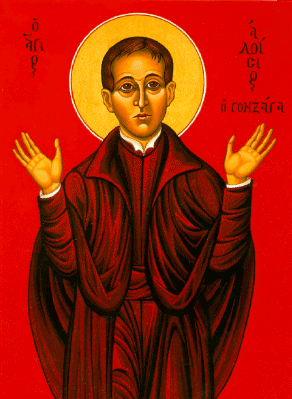
June 21—St. Aloysius Gonzaga, Religious


How can a young man living in Italy during the Renaissance, becoming a page in the court of Philip II of Spain be the patron saint of youth?  St. Aloysius Gonzaga is the patron saint of youth because he lived a holy life in the face of great temptations.  His father, a noble, wanted him to become a military hero, but at a young age he became attracted to a spiritual life. He eventually decided to join the Jesuits, even though many tried to persuade him to continue with a "normal" life as a nobleman.  He died at the age of 23 when he contracted the plague helping others.

Our "normal" lives today are not of nobility, but we do have lives of relative ease compared to the rest of the world and also history.  We have plenty of food, a car or two, cell phones, computers, multiple TVs, education, a house, and more.  We have a lot more! How do we resist the temptations of our age?  Those temptations are about ignoring those who we would rather not see, resisting service to others, complacency regarding important issues of our times, and more.

Youth tend to see hypocrisy in those who would give in to those temptations.  Youth tend to be idealistic and desire to find a better way of life for everyone. How can we foster their idealism and help them to bring about the kingdom of God on earth?  We can follow the example of the Jesuits, who teach about cura personalis, or care for the entire person.  We can also follow St. Aloysius Gonzaga, a youth who lived and died in service to others.

Sunday, August 18, 2013

July 31--St. Ignatius of Loyola, Priest


As founder of the Society of Jesus, St. Ignatius of Loyola has exerted influence on the Church and the world that is matched by few others.  Starting out as a soldier until wounded in battle, St. Ignatius read two books as he was recovering, the Bible and the lives of the saints.   Inspired by their dedication and heroism he decided to dedicate his life to God.  He eventually gathered a group of likewise dedicated men and they presented themselves to the pope.  He asked them to teach and be missionaries, two charisms, or gifts, for which they have been known ever since.

St. Ignatius was a talented administrator.  After he founded the Jesuits, he spent much of his time directing the order, founding schools, sending missionaries across the globe, and writing letters. Administration is not seen by many as a glamorous job.  It involves paperwork, logistics, communication, bureaucracy, and so forth.  Yet, due to his skills in all these areas, St. Ignatius was able to establish and promote the largest group of male religious in the world today.  There are over 17,000 men who are Jesuit priests, scholastics (men training to become priests), brothers, and novices.  There are 28 Jesuit universities and colleges in the United States and over 50 high schools.  The time and expertise of the men and the strength of these institutions have impacted the lives of many throughout the country.  St. Ignatius had as his motto, Ad majorem dei gloriam, “To the greater glory of God”.  Would that we dedicated ourselves, as did St. Ignatius and the Jesuits, to the greater glory of God.