Monday, June 19, 2023

June 25--St. Prosper of Aquitaine, Holy Man and Theologian


Can we do good without the grace of God? Or is God’s grace required for us to do any good? This was the heart of the question behind semi-Pelagianism in the fifth century. St. Augustine taught that we can only do good if God gives us grace. St. John Cassian and St. Vincent of Lerins taught that we have free will which allows us to choose good without God’s grace. Augustine’s position led to the problem of double predestination, which taught that God’s grace is irresistible! Cassian’s and Vincent’s position led to the problem of doing good without God! Both issues have significant problems and neither was completely accepted by the Church.

Here is where our saint comes in. Prosper of Aquitaine was a layman from Aquitaine in southwestern France. He was familiar with the arguments of Cassian and Vincent and was able to summarize them to Augustine. This allowed Augustine to respond. After Augustine’s death Prosper interpreted Augustine’s work so that the extremes in his teaching could be avoided, keeping BOTH the necessity of God’s grace in doing good works AND the necessity of humans in freely using the gift of God’s grace to do the good God gives us the grace to do.

The Catholic Church often responds to controversial issues not with an “either/or” response, but with a “BOTH/AND” response. The “BOTH/AND” is nuanced and complete. We are for BOTH the mother AND the unborn child. We are BOTH pro-life AND pro-justice and peace. We are for BOTH the freedom of choice AND the truth of the good. We are BOTH body AND soul. Jesus is BOTH God AND man. We are BOTH saved AND praying for final perseverance. We are BOTH citizens of Heaven AND residents of Earth. St. Prosper, pray for us!


Monday, June 12, 2023

June 23--St. Joseph Cafasso, Priest

Enrico Reffo, Public domain, via Wikimedia Commons.

One of the corporal works of mercy is “visit the imprisoned.” Many of us don’t get that chance very often, if at all. Today’s saint not only had that chance, he made it one of his primary ministries. St. Joseph Cafasso lived from 1811-1860 in Turin, Italy. Ordained in 1833 he became a popular lecturer in moral theology, helping people to avoid scrupulosity and the error of believing venial sins are as bad as mortal sins. He was popular as a confessor. He also became a friend and advisor to St. John Bosco.

But it was through his work with prisoners condemned to death that showed his effectiveness in converting sinners. He accompanied sixty condemned men to their executions, considering these men as “hanged saints”. He was called “Priest of the Gallows” for his ministry. One story tells of how he led forty-five hardened criminals to confession by confronting the biggest and strongest by grabbing his beard. If the prisoner had wished he could have easily overcome the small and frail priest disabled by curvature of the spine. Instead, he allowed himself to be led by the saint, by the beard, to a corner where Fr. Cafasso prepared him for and heard his confession. The huge man was so overcome that, “He told [his fellow prisoners] he had never been so happy in his life. And his experience persuaded them all to go to confession.”

We may not be priests and we may not be in prison ministry, but we can pray for those who are. The United States has the sixth highest incarceration rate in the world with 531 per 100,000 people in jail or prison. More than likely we may know of someone who has been or is currently incarcerated. We can pray for them as well!


Monday, June 5, 2023

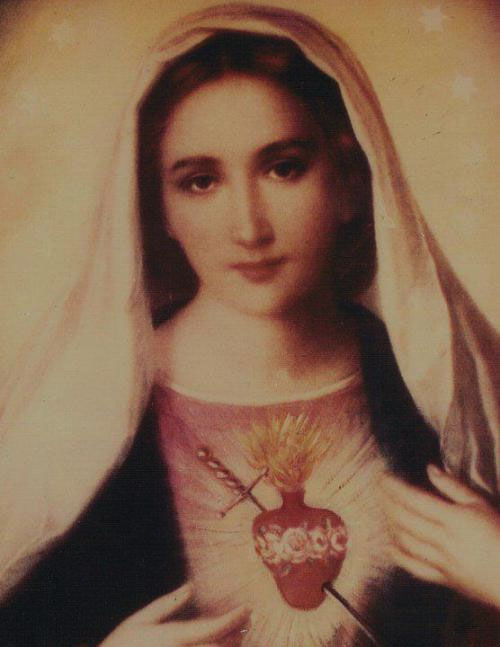
Saturday following the Second Sunday after Pentecost--Immaculate Heart of Mary


https://www.discerninghearts.com/catholic-podcasts/prayer-immaculate-heart-mary/

Prayer to Immaculate Heart of Mary

O Most Blessed Mother, heart of love, heart of mercy, ever listening, caring, consoling, hear our prayer. As your children, we implore your intercession with Jesus your Son. Receive with understanding and compassion the petitions we place before you today, especially those so deep in our heart.

We are comforted in knowing your heart is ever open to those who ask for your prayer. We trust to your gentle care and intercession, those whom we love and who are sick or lonely or hurting. Help all of us, Holy Mother, to bear our burdens in this life until we may share eternal life and peace with God forever.
Amen.

This prayer, found at the Discerning Hearts website, reminds us of the love God has for us; he gives us a mother so loving and pure, that we can go to him through her.  Mary leads us to Jesus, who shows us the Father.  Mary was with Jesus throughout his life.  She prompted his first miracle, the changing of water to wine at Cana for the benefit of the couple.  She was at his feet when he was crucified, suffering as only a mother can for a beloved son.  She was in the Upper Room with the disciples at Pentecost when the Holy Spirit came upon them.  She was the first and best disciple of Christ.  

She is our mother and she wants us to know and love her beloved Son that he may make us beloved sons and daughters of the Father, his true friends and holy disciples, and worthy temples of the Holy Spirit.  We ask for her intercession, especially through her Immaculate Heart, so we may be drawn up in love for God and for our brothers and sisters in Christ.  Immaculate Heart of Mary, pray for us.

Monday, May 29, 2023

First Sunday after Pentecost--Trinity Sunday


Pentecost signals the end of the Easter Season. But there are more solemnities that occur throughout Ordinary Time; the first of these is Trinity Sunday. The Trinity is the most fundamental dogma of the Church because it is about God. The Church in the fourth-seventh centuries dealt with the Arian Heresy, which stated that Jesus was not the same substance as the Father, in other words, Jesus was not God. This resulted in much tribulation in the Church. St. Jerome once wrote: “The whole world groaned, and was astonished to find itself Arian.” The Council of Nicea in A.D. 325 and the Council of Constantinople in A.D. 381 brought forth the Niceno-Constantinopolitan Creed, which is recited at every Sunday Mass. This contained the key word, homoousios, which is translated into English as “consubstantial.” God the Father, God the Son, and God the Holy Spirit are three persons in one God, a “triunity.”

The great defender of orthodoxy, St. Athanasius of Alexandria, taught: “We acknowledge the Trinity, holy and perfect, to consist of the Father, the Son and the Holy Spirit.  In this Trinity there is no intrusion of any alien element or of anything outside, nor is the Trinity a blend of creative and created being. It is a wholly creative and energizing reality, self-consistent and undivided in its active power, for the Father makes all things through the Word and in the Holy Spirit, and in this way the unity of the holy Trinity is preserved.”

At every Mass we have the great doxology before the Great Amen: “Through him, with him, in him, in the unity of the Holy Spirit, all glory and honor is yours almighty Father, forever and ever Amen.” We are united in our faith in God, who created us and saves us.


Saturday, April 1, 2023

April 16--Divine Mercy Sunday


"O my Jesus, forgive us our sins, save us from the fires of Hell and lead all souls to Heaven, especially those most in need of Thy Mercy. Amen." (Fatima Prayer)

This message of mercy was also given to St. Faustina Kowalska by Jesus himself on the night of Sunday, February 22, 1931: "Paint an image according to the pattern you see, with the signature: 'Jesus, I trust in You' (in Polish: 'Jezu, ufam Tobie'). I desire that this image be venerated, first in your chapel, and then throughout the world. I promise that the soul that will venerate this image will not perish" (Notebook I, Items 47 and 48).

Pope St. John Paul II promoted this devotion and, on the canonization of St. Faustina in 2000, promulgated the celebration of the Sunday of the Divine Mercy to be celebrated on the Second Sunday of Easter. On Divine Mercy Sunday in 2001 Pope St. John Paul stated: "Jesus said to St. Faustina one day: 'Humanity will never find peace until it turns with trust to Divine Mercy'. Divine Mercy! This is the Easter gift that the Church receives from the risen Christ and offers to humanity."

We are blessed to have this devotion to turn us to God's Divine Mercy. He wants us to turn from our sins and, like a loving father, throw his arms around us to shelter us in his forgiving love. "For God so loved the world that he gave his only Son, so that everyone who believes in him might not perish but might have eternal life" (Jn. 3:16). Pope Francis declared an Extraordinary Jubilee Year of Mercy in 2016 to emphasize God's merciful love. We are also called to be merciful: "Be merciful, just as [also] your Father is merciful" (Lk. 6:36).


Thursday, March 30, 2023

April 9, 2023--Easter Sunday


https://www.wallpaperflare.com/easter-easter-sunday-cross-holiday-christian-text-communication-wallpaper-gebom

Jesus Christ is risen today, Alleluia!
Our triumphant holy day, Alleluia!
Who did once upon the cross, Alleluia!
Suffer to redeem our loss. Alleluia!

Hymns of praise then let us sing, Alleluia!
Unto Christ, our heavenly king, Alleluia!
Who endured the cross and grave, Alleluia!
Sinners to redeem and save. Alleluia!

But the pains which he endured, Alleluia!
Our salvation have procured; Alleluia!
Now above the sky he's king, Alleluia!
Where the angels ever sing. Alleluia!

Sing we to our God above, Alleluia!
Praise eternal as his love; Alleluia!
Praise him, all you heavenly host, Alleluia!
Father, Son, and Holy Ghost. Alleluia!

This is the day we have been waiting for, the day of our salvation verified! Jesus rose from the grave! He conquered death! He lives again, no more to die! Jesus invites us to live with him forever! All we have to do is accept the invitation! His proclamation of salvation is simple: “This is the time of fulfillment. The kingdom of God is at hand. Repent, and believe in the gospel” (Mk. 1:15).

After he fully suffered for us and sacrificed his life for our sake, he rose from the dead. If we are waiting for a sign from God, THIS IS IT! This means that our lives have meaning within the context of God's everlasting love for us. We are now called to live each day anew as the dawn of our salvation. We are now called to live as Jesus taught us. We are now called to see Jesus in our neighbor, our colleague, our family, our brother who is begging on the corner, our sister who is raising her children without their father, our son who is in prison, our daughter who is on the street. We are now called to love AS JESUS LOVED US.

Sunday, March 26, 2023

April 4--St. Benedict the African, Religious

St. Benedict of Palermo attributed to Juan Pascual de Mena, photograph by Maia C licensed under 2.0 Generic (CC BY-NC-ND 2.0).


St. Benedict the African, also known as Benedetto Manasseri, was born in Messina, Sicily, Italy in 1526 to slaves brought from Africa who converted to Catholicism.  He was freed and worked as a shepherd and farmer.  At the age of 21 he was publicly insulted due to his skin color and he did not respond in kind.  Because of this, he was invited to join a group of hermits living the Rule of St. Francis of Assisi.  He served as a cook for the community and at age 28 became leader of the group.  At age 38 Pope Pius VI disbanded hermit groups and encouraged the members to join the Order of St. Francis.  St. Benedict became a lay brother to a group in Palermo, Sicily.  He started there as a cook and then became Master of Novices and Guardian of the Community even though he never became a priest.  He taught the Scriptures and had healing abilities, which attracted visitors to the monastery.  After his time as leader, he went back to being cook.  He died in 1589.

"Benedict is remembered for his patience and understanding when confronted with racial prejudice and taunts. He was declared a patron saint of African Americans,along with the Dominican lay brother, [St.] Martin de Porres. In the United States, at least seven historically Black Catholic parishes bear his name, including" St. Benedict the Moor Church in Omaha, Nebraska.

Injustice needs to be confronted in all its manifestations.  This is especially true for America with its history of slavery, racism, and lynchings!  However, St. Benedict showed heroism, as did Dr. Martin Luther King, Jr., by not responding to insult with violence.  He turned the other cheek, not as a victim, but as a witness to the love of Jesus.  St. Benedict, pray for us.