Showing posts with label Corporal Works of Mercy. Show all posts

Sunday, September 15, 2024

September 26--Sts. Cosmas and Damian, Martyrs


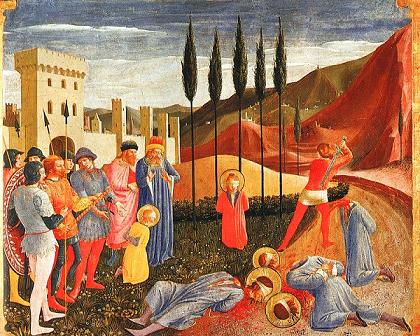
Their names are in the Roman canon: “In communion with those whose memory we venerate,… your blessed apostles and martyrs, Peter and Paul, Andrew,… Cosmas and Damian and all your saints.” Today’s saints are twin brothers who practiced medicine and surgery for free, and thus called “unmercenaries” or “silverless” in Greek, in order to bring people to the Christian faith. Sts. Cosmas and Damian were Arabs living in the Roman province of Cilicia, which today is the southern coast of Turkey. They were martyred during the reign of the Emperor Diocletian in the late third or early fourth century. Diocletian tried to exterminate Christianity from the Roman Empire and was quite successful in raising martyrs to God, including Cosmas and Damian by beheading. Although this is the extent of what is known about them, their story became popular and they were venerated widely throughout Europe.

We honor Sts. Cosmas and Damian because of their willingness to suffer and die as Jesus did. However, they were missionary disciples using their skill in medicine to heal for free as Jesus did. “The Catholic Church is the world's largest non-governmental provider of health care….” “It can be said in general, however, that Catholic hospitals provide a great deal of free or poorly compensated inpatient care and primary care services through clinics and medical outreach programs for the uninsured. Often, Catholic hospitals become known as a ‘provider of last resort’ for uninsured and underinsured citizens.”

Visit the sick is one of the corporal works of mercy as prescribed in Mt. 25:31-46. We can follow the examples of Sts. Cosmas and Damian by healing others, whether physically, emotionally, or spiritually. We may dedicate ourselves to the healing ministries or those who are in our lives. Sts. Cosmas and Damian, pray for us!


Monday, June 12, 2023

June 23--St. Joseph Cafasso, Priest

Enrico Reffo, Public domain, via Wikimedia Commons.

One of the corporal works of mercy is “visit the imprisoned.” Many of us don’t get that chance very often, if at all. Today’s saint not only had that chance, he made it one of his primary ministries. St. Joseph Cafasso lived from 1811-1860 in Turin, Italy. Ordained in 1833 he became a popular lecturer in moral theology, helping people to avoid scrupulosity and the error of believing venial sins are as bad as mortal sins. He was popular as a confessor. He also became a friend and advisor to St. John Bosco.

But it was through his work with prisoners condemned to death that showed his effectiveness in converting sinners. He accompanied sixty condemned men to their executions, considering these men as “hanged saints”. He was called “Priest of the Gallows” for his ministry. One story tells of how he led forty-five hardened criminals to confession by confronting the biggest and strongest by grabbing his beard. If the prisoner had wished he could have easily overcome the small and frail priest disabled by curvature of the spine. Instead, he allowed himself to be led by the saint, by the beard, to a corner where Fr. Cafasso prepared him for and heard his confession. The huge man was so overcome that, “He told [his fellow prisoners] he had never been so happy in his life. And his experience persuaded them all to go to confession.”

We may not be priests and we may not be in prison ministry, but we can pray for those who are. The United States has the sixth highest incarceration rate in the world with 531 per 100,000 people in jail or prison. More than likely we may know of someone who has been or is currently incarcerated. We can pray for them as well!


Sunday, January 9, 2022

January 19—Sts. Marius, Martha, Audifax, and Abachum, Parents and Sons—Martyrs

*


Today we celebrate a family of martyrs! They were martyred in A.D. 270 in Rome. They buried other martyrs and then became the object of persecution and torture. Maris and his sons were beheaded, and their bodies burnt. Martha was drowned outside of Rome at a place now called Santa Ninfa. According to tradition, a Roman woman gathered the remains of the family and had them buried on her estate, which became a place of pilgrimage. They are inscribed in the Roman Martyrology, which is the official list of saints recognized by the Church. They are not on the General Roman Calendar because we only know with certainty their names and their place of burial.

How is it that a whole family could be martyred? They were willing to die for what they believed in. They were witnesses to their faith in Jesus Christ and the hope of the Resurrection. Are our families prepared to do the same? Do we believe to the point of witnessing to our faith in Jesus Christ? Are we willing to live lives of heroic virtue? Do people see in us what others saw in our saints—a love of God which can’t be denied or suppressed?

Do we live the Corporal and Spiritual Works of Mercy so that others cannot but see our faith? We need to clothe the naked, shelter the homeless, visit the sick and the imprisoned, give food and drink to the hungry and thirsty, bury the dead, instruct the ignorant, comfort the afflicted, warn the sinner, counsel the doubtful, bear wrongs patiently, forgive offenses patiently, and pray for the living and the dead. This is Jesus’ command! Then everyone will know we are Christians, by our love! May Sts. Marius, Martha, Audifax, and Abachum guide us and pray for us!

*https://www.akg-images.co.uk/archive/Fresco---Saints-Marius-Martha-Audifax-Abachum.-(Christian-Martyrs-)---Basilica-Santo-Stefano-Rotondo---Rome-2UMEBM5IHTJLT.html

Sunday, August 22, 2021

August 31—St. Raymond Nonnatus, Priest and Religious


*


Jesus sacrificed his life for the redemption of all humanity. That is the heart of the Paschal Mystery of Jesus’ suffering, death, Resurrection, and Ascension. As Christian disciples we also suffer each day and offer up the difficulties and trials as part of our participation in the Paschal Mystery so we may help others to come to Jesus and ourselves to heaven. But imagine a person ransoming someone with his own life, releasing another from slavery and thus becoming a slave. That happened to today’s saint. 

St. Raymond Nonnatus was born in Spain around 1203. The nickname Nonnatus is from the Latin meaning “not born” because he was delivered by caesarian section. He joined the Mercedarians, the Order of the Blessed Virgin Mary of Mercy, and was ordained a priest in 1222. The purpose of the order was to ransom Christians from Muslims who were held captive because they were Christian. St. Raymond ransomed 140 Christians from slavery in Valencia and then 250 captives in Algiers, North Africa by buying their freedom. He then went to Tunis and offered himself as hostage to free 28 Christians when his money ran out as fulfillment of the orders fourth vow, which was taken from Matthew’s Gospel to free the prisoner. However, according to legend, he was prevented from preaching the Good News by having his lips pierced and then closed with a padlock, only to be opened when he ate. He suffered this torment for eight months until other Mercedarians brought the original ransom. He died in 1240 at the age of 37. 

St. Raymond lived the corporal work of mercy at that time, ransom the captive. Let us help free others from the torment that imprisons them, whether it be physical, psychological, emotional, social, or whatever. St. Raymond, pray for us.

*https://static.wixstatic.com/media/61f7a5_6b30669f682c4b0282413ca2a9f7b575~mv2.jpg/v1/fill/w_667,h_1004,al_c,q_85/Vicente_Carducho%2C__Martirio_de_san_Ram%C3%B3n.webp

Sunday, September 15, 2019

September 22--St. Thomas of Villanova, Bishop

File:Thomas von Villanova 17Jh.jpg*


“If you want God to hear your prayers, hear the voice of the poor. If you wish God to anticipate your wants, provide those of the indigent without waiting for them to ask you. Especially anticipate the needs of those who are ashamed to beg. To make them ask for alms is to make them buy it.”

Catholic social justice teaching emphasizes, as one of its major themes, the preferential option for the poor. Although we may think of Catholic social teaching as a modern development, it goes back to the Scriptures and the saints, such as today’s saint, St. Thomas of Villanova, who is quoted above.


St. Thomas was an Augustinian friar nominated Archbishop of Valencia, Spain in 1544. When he finally accepted the position under obedience, he donated the four thousand gold pieces given to him by the religious of the cathedral to furnish his residence to a local hospital in need of renovation. He wore the habit he received as a novice 28 years earlier. He mended it himself. He not only advocated direct action to serve the poor, he also worked at solving the structural foundations for poverty: “Charity is not just giving, rather removing the need of those who receive charity and liberating them from it when possible.” St. Thomas of Villanova died on September 8, 1555.

Jesus told us in the Parable of the Last Judgment, Mt. 25:31-46, to feed the hungry, clothe the naked, give drink to the thirsty, visit the sick and imprisoned, shelter the homeless, and bury the dead. The Corporal Works of Mercy are a distinguishing characteristic of a disciple of Jesus. But so is providing employment, education, advocacy, and justice. The Corporal Works of Mercy take care of immediate needs. We must also ameliorate the causes of poverty.


*https://commons.wikimedia.org/wiki/File:Thomas_von_Villanova_17Jh.jpg