Showing posts with label Arian Heresy. Show all posts

Tuesday, May 13, 2025

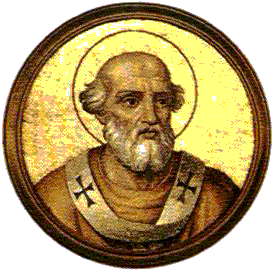
May 18--St. John I, Pope and Martyr


“Habemus Papam!”  At the time of this writing, May of 2025, the conclave of cardinals in Rome elected Robert Prevost, of Chicago, Illinois, U.S.A., Pope Leo XIV.  We pray for him and his successful tenure as 267th pope and shepherd of the Catholic Church.  Well and good!


We also honor St. John I, pope and martyr, who was elected in AD 523 and was martyred in AD 526 at the hands of a heretic king.  St. Martin I was the last pope to be martyred in AD 653.  Nonetheless, every pope is the successor to Peter, the Rock, who was told by Jesus:  “‘Amen, amen, I say to you, when you were younger, you used to dress yourself and go where you wanted; but when you grow old, you will stretch out your hands, and someone else will dress you and lead you where you do not want to go.’  He said this signifying by what kind of death he would glorify God. And when he had said this, he said to him, ‘Follow me.’”


Pope St. John I was martyred because he succeeded in accomplishing what Theodoric, the Arian King of Italy, requested of him:  accommodations with the Byzantine emperor to avoid persecution of the Arians in the East.  Such was St. John’s success that Theodoric suspected him of conspiracy with the emperor and thus imprisoned him upon his return to Italy with the favorable news!  St. John died in prison.  


Every pope is called to witness the faith.  Pope Leo XIV stated: “I also want to … walk together with you, as a united Church always seeking peace, justice, always trying to work as men and women faithful to Jesus Christ, without fear, to proclaim the Gospel, to be missionaries.”  St. John I, pray for us!

Sunday, March 3, 2024

March 13--St. Leander of Seville, Bishop

 San Leandro by Bartolomé Esteban Murillo, Public domain, via Wikimedia Commons.

“I believe in one God, the Father almighty, maker of heaven and earth, of all things visible and invisible.” “Our profession of faith begins with God, for God is the First and the Last, the beginning and the end of everything. The Credo begins with God the Father, for the Father is the first divine person of the Most Holy Trinity; our Creed begins with the creation of heaven and earth, for creation is the beginning and the foundation of all God's works” (CCC, 198). These words, which we say every Sunday during Mass, are an expression of our faith. This is the Niceno-Constantinopolitan, or Nicene Creed, formulated at the Councils of Nicea in 325 and Constantinople in 381.

We have today’s saint, St. Leander of Seville, to thank for this addition to the liturgy; he was bishop of Seville in the 6th century. The Visigoths had overrun Spain and were converted through the Arian heresy, which stated that Jesus was the first creation of God, but was not God. The Church was separated between Arian and Catholic bishops and peoples. St. Leander introduced the Creed as a way to help reinforce the orthodox Catholic faith among the people in 589 at the Third Council of Toledo. This brought about the conversion of the Visigoth King of Spain and the reconciliation of the Arian faction to the true faith of the Church. This version of the Creed also introduced the filioque clause, that the Holy Spirit proceeded from the Father and the Son, which spread to the rest of Latin-speaking Catholicism and was accepted throughout the Western Catholic Church by 1000.

It is necessary to know the faith in order to live the faith and to bring others to the truth, who is Jesus Christ. St. Leander, pray for us.

Monday, May 29, 2023

First Sunday after Pentecost--Trinity Sunday


Pentecost signals the end of the Easter Season. But there are more solemnities that occur throughout Ordinary Time; the first of these is Trinity Sunday. The Trinity is the most fundamental dogma of the Church because it is about God. The Church in the fourth-seventh centuries dealt with the Arian Heresy, which stated that Jesus was not the same substance as the Father, in other words, Jesus was not God. This resulted in much tribulation in the Church. St. Jerome once wrote: “The whole world groaned, and was astonished to find itself Arian.” The Council of Nicea in A.D. 325 and the Council of Constantinople in A.D. 381 brought forth the Niceno-Constantinopolitan Creed, which is recited at every Sunday Mass. This contained the key word, homoousios, which is translated into English as “consubstantial.” God the Father, God the Son, and God the Holy Spirit are three persons in one God, a “triunity.”

The great defender of orthodoxy, St. Athanasius of Alexandria, taught: “We acknowledge the Trinity, holy and perfect, to consist of the Father, the Son and the Holy Spirit.  In this Trinity there is no intrusion of any alien element or of anything outside, nor is the Trinity a blend of creative and created being. It is a wholly creative and energizing reality, self-consistent and undivided in its active power, for the Father makes all things through the Word and in the Holy Spirit, and in this way the unity of the holy Trinity is preserved.”

At every Mass we have the great doxology before the Great Amen: “Through him, with him, in him, in the unity of the Holy Spirit, all glory and honor is yours almighty Father, forever and ever Amen.” We are united in our faith in God, who created us and saves us.


Monday, February 20, 2023

February 26--St. Alexander of Alexandria, Bishop


How do bad ideas get started?  They could be misinterpretations or innovations or contradictions or attempted reforms.  But they have to come from somewhere!  One of the most divisive ideas in Church history was the idea that Jesus was NOT God, but merely a creature of God.  This was the Arian heresy of the 3rd, 4th, 5th, 6th, and 7th centuries; four hundred years of error that greatly afflicted the Church.

Our saint, St. Alexander of Alexandria, was the man who, at the very beginning, tried to stop Arius from spreading his heresy.  First, he tried to persuade Arius, then tried to correct him, and then called a synod to condemn him.  Arius took refuge with other bishops who agreed with him, which led to schism.  St. Alexander wrote letters explaining orthodox teaching and countering Arius's errors.  It finally got to the point where the emperor, Constantine I, intervened and recommended the calling of a general council at Nicea in 325.  St. Alexander, along with his deacon, St. Athanasius, was the leader of those who stood up for the faith of the Church.  The Council of Nicea gave us the Nicene Creed and the dogmatic declaration that Jesus is "God from God, Light from Light, true God from true God, begotten not made, consubstantial with the Father; through him all things were made."

So, how do bad ideas get started?  By focusing on only one aspect of a truth and ignoring the fullness of the truth.  Arius wanted to focus on the oneness of God, which is true.  But he ignored how God is also three persons.  We have the same problem today when Catholics want to speak of inclusion of all.  Inclusion can be a good thing if those we include accept the true faith!  If not, we cannot.

Monday, December 5, 2022

December 11-St. Damasus I, Pope

AlekjdsCC BY-SA 4.0, via Wikimedia Commons

He was pope, but he was opposed by a faction who elected another man pope, an anti-pope, which resulted in factional violence.  He was accused of murder and adultery, but eventually cleared himself in both civil court and a Church synod.  These are not particularly auspicious events in the life of a pope!

St. Damasus I, pope from A.D. 366-384, lived in the time of the Church when it was no longer officially persecuted.  Emperor Constantine I signed the Edict of Milan in A.D. 315, which allowed freedom of religion, thus finally legalizing Christianity.  The Catholic Church then enjoyed the privileges of peace!  During his papacy, the Catholic Church was named the state religion of the Roman Empire by Emperor Theodosius I in 380.  So, it fell to St. Damasus to make sure that the Catholic Church did not fall into error, condemning numerous heresies, especially Arianism, which taught that Jesus was not God!  He also commissioned St. Jerome, his personal secretary, to write an updated translation of the Bible into Latin, called the Vulgate.  He also called the Council of Rome in 382 to codify the official canon of Sacred Scripture, which was identical to that declared as dogma at the Council of Trent in the 16th century.

St. Damasus was quite a busy man, with controversies, successes, and setbacks.  How does his life reflect on today's situation?  One, popes are not universally liked.  Two, popes are not always appreciated for what they do and sometimes opposed.  Three, popes are given to us by God to do the hard work of shepherding Jesus' flock, which can be quite difficult.  Four, popes deserve our respect and prayers regardless of their popularity or ability to persuade us of God's ways for us.  May God give us holy men to shepherd us.

Friday, November 25, 2022

December 7--St. Ambrose, Bishop and Doctor of the Church


He initially refused the position of bishop, faced down an emperor, comforted a mother in her sorrows, and baptized the greatest philosopher of the first millennium.  Who is he?  None other than St. Ambrose of Milan, who became one of the first Doctors of the Church.  When the position of bishop opened in Milan in A.D. 374 he was serving as governor of the province.  He was not a baptized Christian, but the people acclaimed him bishop anyway, whereupon he ran away to hide.  Once, the emperor heard about the election, he affirmed it and Ambrose accepted, being baptize and ordained within the week.

However, once he became bishop, he invested his whole life into serving the people, correcting the heresy of Arianism, teaching orthodox theology in great homilies, and guiding the liturgy of Milan, which is called the Ambrosian Rite and still used today.  He confronted Emperor Theodosius in 390 after the emperor allowed/ordered the massacre of citizens of Thessalonica.  St. Ambrose required the emperor to do penance before he could receive the Eucharist.  Theodosius did so.  According to legend, he also comforted St. Monica when she came to him in tears:  "The child of those tears shall never perish."  That child was St. Augustine, who came to Milan to listen to St. Ambrose's sermons.  They gave him the intellectual grounding he needed to convert to Christianity, with St. Ambrose baptizing him.

St. Ambrose responded to God's call by giving his life over to God.  We, too, are called to give our lives to God.  We are called live our lives as disciples of Jesus:  loving, witnessing, serving, praying, worshiping, and working to bring about the Kingdom of God here on earth in our families, jobs, and associations.  We are called to the greatness of holiness!

Monday, January 3, 2022

January 13—St. Hilary of Poitiers, Bishop and Doctor of the Church

*

Is Jesus God or not? That was key question of the fourth century and beyond that faced the Church. Some, with Arius, said that since Jesus was “begotten of the Father,” that meant he was a creature, albeit the first creature of God. Others, with St. Athanasius, said that Jesus is “begotten, not made” and thus consubstantial with the God the Father. Today’s saint helped hammer home the truth of who Jesus is by his opposition to the Arians and support of St. Athanasius, so much so he was called “Hammer of the Arians” and “Athanasius of the West.”

Born about A.D. 310 in Poitiers, France to pagan parents, St. Hilary received a good pagan education, later studying Scripture, thus resulting in his conversion to Christianity, along with his wife and daughter. He was elected bishop of Poitiers around A.D 350. Even though Arianism was condemned at the Council of Nicaea in A.D. 325 it was still in force throughout the empire, much due to the efforts of different emperors. So St. Hilary attempted to get Arian bishops turned back to the true faith. He also wrote Emperor Constantius II to stop Arians persecuting orthodox Christians, which resulted in his exile in 356. After his exile in 361, he returned in Poitiers and continued to fight for the true understanding of the Trinity against the Arians. He died in 367.

Falsehoods and lies take a long time to die. They are like a many-headed hydra, which keeps sprouting new variations on lies that are condemned and refuted. We need to endure and persevere in living the Truth. St. Paul wrote: “No, in all these things we conquer overwhelmingly through him who loved us” (Rom. 8:37). We must remain faithful to the Truth of Jesus Christ. St. Hilary, pray for us.

*https://commons.wikimedia.org/wiki/File:Hilaryofpoitiers.jpg
Richard de Montbaston et collaborateurs., Public domain, via Wikimedia Commons

Saturday, December 18, 2021

January 2—Sts. Basil the Great and Gregory Nazianzen, Bishops and Doctors of the Church

 +


Jeopardy! time: This heresy from the third and fourth century taught Jesus was not God, but the first creature created by God. The correct Jeopardy! question: What is Arianism? Next Jeopardy! answer: These two bishops, along with St. Gregory of Nyssa, are known as the Cappadocian Fathers and opposed Arianism, which was condemned at the Council of Constantinople in 381, which provided the final version of the Nicene Creed. The correct Jeopardy! question: Who are Sts. Basil the Great and Gregory Nazianzen. 

Sts. Basil and Gregory Nazianzen were instrumental in contributing to the definition of the Trinity. They preached, taught, debated, and worked strenuously to bring the faithful who had been misled into thinking Jesus was not God and the Holy Spirit was not God back to the truth. God is “one substance (ousia) in three persons (hypostases)”. What this means is that the Father is God, Jesus is God, and the Holy Spirit is God, three persons, one God. But they are three persons in relationship to each other: The Father is NOT the Son; the Son is NOT the Holy Spirit; and the Holy Spirit is NOT the Father. They are in relationship with each other in a divine dance of love unified in the godhead. 

St. Basil, born in 330, first became a hermit, then later a monk, and eventually became Bishop of Caesarea in 370, dying in 379. Born in 329, St. Gregory Nazianzen, friend of St. Basil, is also called St. Gregory the Theologian for his advancement of the Trinity. He became a priest in 361, then Bishop of Sasima, and finally Bishop of Constantinople, dying in 390. Both men advanced the true faith through their teaching and holiness. They gave us a better understanding of the Trinity: Father, Son, and Holy Spirit. Amen!

* https://upload.wikimedia.org/wikipedia/commons/0/04/Basil_of_Caesarea.jpg  Unknown authorUnknown author, Public domain, via Wikimedia Commons
https://upload.wikimedia.org/wikipedia/commons/5/5d/Gregor-Chora_%28cropped%29.jpg  Unknown authorUnknown author, Copyrighted free use, via Wikimedia Commons

Monday, June 1, 2020

June 9—St. Ephrem the Syrian, Deacon and Doctor of the Church

*


I bet you learned your ABCs by singing the Alphabet Song. You may also know songs that tell what the planets are. You may have difficulty with the Star-Spangle Banner but try reciting it! I imagine you will break into song within the first five lines. Why is that? Music appeals to a different part of the brain and memorization is a lot easier when put to music. Today’s saint probably knew that. St. Ephrem, also known as the “Harp of the Holy Spirit,” would write over 400 hymns to counter the heretical songs then prevalent.

St. Ephrem was born in AD 306 in Nisibis, Syria, now located in Turkey. He became a deacon but declined the priesthood. He died around AD 373 and was named Doctor of the Church in 1920. When Nisibis fell to the Persians he moved to Edessa and founded a school to teach orthodoxy against Arianism, Manicheism, Gnosticism, and other teachings and religions. He used poetry and music to bring people to Christ. For example, he wrote a hymn about Mary, which also taught about the Incarnation:

“A wonder is Your mother: the Lord entered her
And became a servant; He entered able to speak
And He became silent in her, He entered her thundering
And His voice grew silent; He entered Shepherd of all;
A lamb He became in her; He emerged bleating.” (113, L. Gambero)


The New Evangelization is a method of bring Christ’s message to those who have already heard it. We need to speak, or as St. Ephrem did, sing the Good News. We need to engage our brothers and sisters to stir their hearts in the joy and peace of Christ’s love through the Holy Spirit’s inspiration. Let us follow in St. Ephrem’s “song” steps.
*https://commons.wikimedia.org/wiki/File:Ic%C3%B4ne_Ephrem_le_Syrien.jpg

Sunday, January 5, 2020

January 13--St. Hilary of Poitiers, Bishop and Doctor of the Church

File:Saint-Hilaire-de-Poitiers Reliquienschrein.jpg*


Arianism is the heresy that teaches that Jesus cannot be God because there is only one God and if Jesus is God, then there are two gods. Arius got it partially right and completely wrong. There is only one God AND Jesus is God: “I believe in one Lord Jesus Christ, the Only Begotten Son of God, born of the Father before all ages. God from God, Light from Light, true God from true God, begotten, not made, consubstantial with the Father” as it says in the Nicene Creed adopted at the Council of Nicaea in 325.

So, what does this have to do with our saint? St. Hilary of Poitiers was born in 315, was baptized in 350, and was acclaimed bishop in 353. As bishop he held the truth of the Catholic Church against Arianism and was banished by the emperors, who supported Arianism. St. Hilary wrote a major treatise against Arianism in order to teach why Jesus is God as well as the Son of God. St. Hilary died in 368. Arianism was condemned again in 381 and finally defeated in the sixth century in France.

Heresies start out as logical conclusions based on specific choices, but without taking into context the whole of the faith. For example, Arianism was based on the oneness of God, which is true. However, it did not take into account the faith that Jesus is God. And for that, hundreds of thousands, if not millions, were lured away from the true faith. People today are also lured away from the faith by denials of the truths of God. They rely on their own choices and make up their own faith and call it Catholic. We must stand true to the faith of Jesus in the Church, even if it means banishment from our society.


*https://commons.wikimedia.org/wiki/File:Saint-Hilaire-de-Poitiers_Reliquienschrein.jpg

Wednesday, December 27, 2017

January 10--St. Gregory of Nyssa, Bishop


His father was a saint. His older brother was a saint. His sister was a saint. His younger brother was a bishop. His mother was the daughter of a martyr. That’s quite a family. It didn’t automatically make him a saint, though. As a matter of fact, he started his adult life looking for a secular career after studying rhetoric. But he eventually responded to the call of being a bishop. He was deposed, but then restored to his rightful place. It was only after his older brother, St. Basil the Great, died that St. Gregory of Nyssa found his voice.

He lived at the time of the Arian heresy, which claimed that Jesus was a creature of God; the first creature, but definitely not God. Arianism was condemned in A.D. 325, but even when St. Gregory was made bishop in 371 it was still a serious problem. Emperor Theodosius called for a council in 381 to address the continuing problem. St. Gregory was a great proponent for the truth of the faith, that Jesus is consubstantial with the Father, and that the Holy Spirit is also consubstantial with the Father and the Son. In other words, he defended the truth of the Trinity, the greatest mystery of our faith.

We are not called to “understand” the mystery of the Trinity. Faith calls for trust. We trust that what we have been taught about God is true, because of who taught us, Jesus Christ. Jesus said that God is his Father. God is our Father, too, but not in the same way. Jesus is God. The Father is God. The Holy Spirit is God. We don’t explain it with a scientific or mathematical proof. We believe it, like we believe in love. St. Gregory of Nyssa, pray for us.

Thursday, March 12, 2015

March 18--St. Cyril of Jerusalem, Bishop and Doctor of the Church


"Is Jesus God or man?  Is he more God than man or more man than God?  Is he something else, and if so, what?"  These may seem to be odd questions for us today, but they were matters of extreme importance in the fourth and fifth centuries when our saint was alive.  St. Cyril of Jerusalem was the bishop of Jerusalem during the time of the Arian heresy.  A heresy is a false teaching that goes against the orthodox teaching of the Church.  The problem was that this heresy was supported by some bishops!  It taught that since there is only one God (true) then Jesus can't be God (false) since that would mean that there would be two gods (also false).  It was an enticing belief but it went against the Scriptures, Tradition, and the consistent teaching of the Magisterium.

So what was St. Cyril's role?  Since one of the bishops who consecrated him was Arian, it may have been "supposed" that he would support the Arians.  But it was not true!  He had a conflict with that same bishop and was exiled from Jerusalem.  He persevered and was later cleared.  He went to a council in 381and supported the use of the word "consubstantial" as applying to the Father and the Son reaffirming that there is only ONE God.

Sometimes we have difficulty with the Church, her teachings, and/or her leaders, priests, bishops, sisters, religion teachers, etc.  The Church is a divine institution, but it is also a human one as well.  Her members do sin and bring scandal to her.  The Holy Spirit has guaranteed us that the Church will never err in matters of faith and doctrine, but not necessarily about "policy" or the proper implementation of that policy or on the holiness or politeness or manners of her leaders.  We need to recognize our fallen human nature even as we strive to do God's will.  As St. Cyril persevered, we need to persevere in prayer for our leaders that they may do God's will in the best way possible.