Showing posts with label June. Show all posts

Monday, June 8, 2026

June 14--St. Elisha, Prophet


Prophet Elisha licensed under CC0 1.0 Universal Public Domain Dedication.

We don’t normally think of Old Testament persons as saints, but they can be. The Catechism of the Catholic Church states: “The patriarchs, prophets and certain other Old Testament figures have been and always will be honored as saints in all the Church’s liturgical traditions” (CCC 61). Today’s saint is included in that group, namely the prophet Elisha, the successor to Elijah.  He is included in the liturgical calendar of many Eastern Catholics, Orthodox Christians and the Carmelite religious order, who places its founding on Mount Carmel, where Sts. Elijah and Elisha spent much of their prophetic careers.

Elijah was considered the greatest of the Old Testament prophets and yet, Elisha received a double portion of his spirit when Elijah was taken up into heaven. What does that mean? It means that Elisha received acknowledgement as the “first-born” of Elijah, that he was the primary spiritual heir. Elisha continued the ministry of Elijah, performing twice as many miracles, including raising a man from the dead AFTER he had died! You can read about that in 2 Kings 13:20-21.

We are also spiritual heirs: “The Spirit itself bears witness with our spirit that we are children of God, and if children, then heirs, heirs of God and joint heirs with Christ, if only we suffer with him so that we may also be glorified with him” (Romans 8:16-17). Just as Elisha continued the work of Elijah, we continue the work of Jesus! And what was Jesus’ mission? To bring about the Kingdom of God. First he proclaimed it, then he achieved it through his death and resurrection. What do we do? First we proclaim Jesus and his message of salvation, then “we suffer with him so that we may also be glorified with him.” St. Elisha, pray for us!

Sunday, June 8, 2025

June 16--St. Lutgardis, Religious


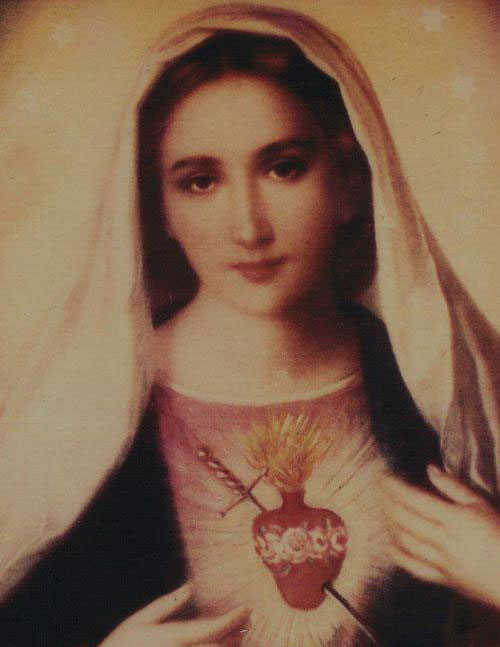
“Catholic Christians traditionally recognize June as the month of the Sacred Heart of Jesus. During this time, we call to mind Christ’s love for us, which is visible in a special way in the image of His pierced heart, and we pray that our own hearts might be conformed to His, calling us to love and respect all His people” (USCCB). St. Lutgardis is considered one of the saints who had a devotion to the Sacred Heart long before it was recognized in the Church as hers was the first recorded mystical revelation about the Sacred Heart.

St. Lutgardis was born in Tongeren, Belgium, in 1182 and died in 1246. She was sent to the convent at the age of twelve because her father lost her dowry in a bad business deal and thus could not afford to have her married according to the customs of the time. It was only later, when she had a vision of Jesus with his wounds, that she actually became a Benedictine nun. Still later, she joined the Cistercians, which followed a stricter observance of the Rule of St. Benedict. One vision was specifically about the Sacred Heart of Jesus. Jesus asked her what gift she would like to receive instead of the one she previously asked for. “‘Lord,’ said Lutgarde, ‘I would exchange it for your Heart.’ Christ then reached into Lutgarde and, removing her heart, replaced it with his own, at the same time hiding her heart within his breast.”

The Sacred Heart of Jesus is a profound reminder of God’s love for us through Jesus’ sacrifice: “For God so loved the world that he gave his only Son, so that everyone who believes in him might not perish but might have eternal life” (Jn. 3:16). St. Lutgardis, pray for us!

Sunday, June 1, 2025

June 8--St. Melania the Elder, Holy Woman


Many people ask what role women had in the early Church since they couldn’t be ordained. Luke tells us that Jesus was supported financially by women: “Afterward he journeyed from one town and village to another, preaching and proclaiming the good news of the kingdom of God. Accompanying him were the Twelve and some women who had been cured of evil spirits and infirmities, Mary, called Magdalene, from whom seven demons had gone out, Joanna, the wife of Herod’s steward Chuza, Susanna, and many others who provided for them out of their resources” (Lk. 8:1-3).

This is also true of today’s saint, St. Melania the Elder (born about 325, died about 410-417). She was from a high Roman family and became “one of the wealthiest citizens of the empire.” She was a convert and became known for her generosity and holiness. “She was one of the first Roman women to visit the Holy Land.” After her husband died she visited North Africa and presented a desert monastery with chests of silver. From there she went to Jerusalem and founded a convent and a monastery. She spent thirty-five years in the Holy Land. Her kinsman, St. Paulinus of Nola, wrote of her: “What a woman she is, if it is permissible to call such a manly Christian a woman! . . . she loftily cast herself down to a humble way of life, so that as a strong member of the weak sex she might censure indolent men.”

This may sound sexist. However, it is not a matter of sexism to insist that holiness can be attained by everyone, including women! The holiest person, after Jesus himself, is Mary, our beloved Mother. St. Melania expressed her holiness through humility and generosity, gifts God gave to her.

St. Melania the Elder, pray for us!

Monday, May 26, 2025

June 2–St. Marcellinus and Peter, Priest and Exorcist, Martyrs


“To us, also, your servants, who, though sinners, hope in your abundant mercies, graciously grant some share and fellowship with your holy apostles and martyrs: with John the Baptist, Stephen, Matthias, Barnabas, (Ignatius, Alexander, Marcellinus, Peter, Felicity, Perpetua, Agatha, Lucy, Agnes, Cecilia, Anastasia) and all your saints; admit us, we beseech you, into their company, not weighing our merits, but granting us your pardon, through Christ our Lord.”

This is part of the First Eucharistic Prayer, the oldest eucharistic prayer in the Latin Rite. It contains the names of many saints, especially of martyrs, including Marcellinus and Peter. A catacomb outside Rome is named for them.

“The catacomb of Saints Marcellinus and Peter derives its name from the two martyrs buried within it. The story behind the life of these two martyrs goes back to the time of the Emperor Diocletian. St. Marcellinus and St. Peter were slain during the persecution of 304 AD - beheaded, in Rome. Before being killed, however, they were forced to dig their tomb with their own hands. The site of the terrible martyrdom of the two saints was known as ‘Selva Nera’ (meaning ‘Black Forest’), but after their death it was renamed ‘Selva Candida’, that is ‘White Forest’, along Via Cornelia.

“It was thanks to a Roman matron, who went with the name of Lucilla, that the bodies of the two martyrs were brought to Via Casilina, at the site called ad Duas Lauros. With the translocation of the saints’ bodies, the Christian cemetery, already in use, was dedicated in their memory.” (http://www.catacombeditalia.va)

Martyrs are the heroes of the faith, the men and women who gave their lives for their love of Christ. We honor them in our prayers and we ask for their prayers. Sts. Marcellinus and Peter, pray for us.

Monday, June 3, 2024

June 30--Venerable Pierre Toussaint, Holy Man


The following is a sketch of Venerable Pierre Toussaint by the Archdiocese of New York Cultural Diversity Apostolate:

“Venerable Pierre Toussaint (1766-1853) was born a slave in Haiti and died a freeman in New York City. He is credited by many with being the father of Catholic Charities in New York. Pierre was instrumental in raising funds for the first Catholic orphanage and began the city’s first school for black children. He also helped to provide funds for the Oblate Sisters of Providence, a religious community of black nuns founded in Baltimore and played a vital role in providing resources to erect Old Saint Patrick’s Cathedral in Lower Manhattan. During a Yellow Fever epidemic when many of the city’s political leaders fled the city in search of healthier rural climates, Pierre Toussaint cared for the sick and the dying. He was a successful entrepreneur, who did not hesitate to share the fruits of his labor with others.

“In recognition of Pierre Toussaint’s virtuous life, the late Cardinal Cooke introduced Pierre’s cause for canonization at the Vatican in 1968. In December 1989, the late Cardinal O’Connor had the remains of Pierre Toussaint transferred from Lower Manhattan to St. Patrick’s Cathedral in midtown Manhattan where he is buried as the only lay person, alongside the former Cardinal-Archbishops of New York City. On December 17, 1997, Pope John Paul II declared Pierre Toussaint, Venerable, thus placing him firmly on the road to becoming North America’s first black saint. Venerable Pierre Toussaint was a man who was proud of his faith, proud of his culture and committed to serving others.”

We need saints to remind us that God is calling us to sainthood in our own time and in our own situation. We pray for Venerable Pierre Toussaint so he may pray for us.

Sunday, June 2, 2024

June 25--St. Maximus of Turin, Bishop


“It is obvious that we preach willingly and do the work of God joyfully. But when we see many of the brethren coming to church sluggishly and particularly on Sundays not taking part in the heavenly mysteries, we preach reluctantly–not because we dislike speaking but because our preaching oppresses the negligent rather than changes them. Therefore we preach reluctantly and cannot be silent. For our preaching brings either the kingdom or punishment to our congregation–the kingdom to believers but punishment to the faithless. For when a brother does not participate in the sacraments of the Lord, he is, before God, necessarily a deserter from the divine camp. And how can one excuse himself who, on the day of the sacraments, scorns the heavenly meal while preparing a meal at home for himself and, in seeing to his stomach’s needs, neglects his soul’s medicine?”

These blunt words are from a homily from today’s saint, St. Maximus of Turin. St. Maximus was bishop of an outlying town subject to barbarian incursions in the late fifth century. He is known for his sermons and homilies that have survived through the ages. He did not water down his message. He knew his flock and preached to their needs. He spoke about almsgiving: “Giving alms promises refreshment to people withered near to death by sin, like moisture revives what has been dried up.” He spoke about sin: “I indignantly press upon you your wrongdoing, first correcting you with spiritual blows and then enriching you with gifts of the pearl. I have chosen, I say, to lay blame on your sin with bitter accusation rather than to foster it with kindling dissimulation. For whoever does not reprove his brother when he sins is encouraging him, in a certain way, to sin.” St. Maximus, pray for us!

June 20--Martyrs of Ireland, Bishops, Priests, and Laity


In 1992 Pope John Paul II beatified seventeen martyrs killed under English rulers, including Elizabeth I and Oliver Cromwell, between 1584 and 1654. They included three bishops, seven priests, one brother, five laymen and one laywoman. The pope proclaimed:

“And how can we fail to sing the praises of the seventeen Irish Martyrs being beatified today?…

“We admire them for their personal courage. We thank them for the example of their fidelity in difficult circumstances, a fidelity which is more than an example: it is a heritage of the Irish people and a responsibility to be lived up to in every age.

“In a decisive hour, a whole people chose to stand firmly by its covenant with God: ‘All the words which the Lord has spoken we will do’.… The religious and political turmoil through which these witnesses lived was marked by grave intolerance on every side. Their victory lay precisely in going to death with no hatred in their hearts. They lived and died for Love. Many of them publicly forgave all those who had contributed in any way to their martyrdom.

“The Martyrs' significance for today lies in the fact that their testimony shatters the vain claim to live one's life or to build a model of society without an integral vision of our human destiny, without reference to our eternal calling, without transcendence.…

“To the Martyrs' intercession I commend the whole people of Ireland: their hopes and joys, their needs and difficulties. May everyone rejoice in the honor paid to these witnesses to the faith. God sustained them in their trials. He comforted them and granted them the crown of victory. May he also support those who work for reconciliation and peace in Ireland today!

“Blessed Irish Martyrs, intercede for the beloved Irish people!”


June 15–St. Vitus, Martyr


https://www.saintforaminute.com/saints/saint_vitus

Many early martyrs of the Church were legendary, meaning that they may have had a life that was not historical by modern standards, but did have some basis in fact. That is probably the case with today’s saint. St. Vitus, according to legend, lived and died during the worst persecutions of the early Church under the reign of Emperor Diocletian in the early 300s. He was said to be about twelve years old and was taken to Rome to drive out a demon that had possessed the son of Diocletian. He was successful in the exorcism but was still tortured and died a martyr. One version has him being boiled in oil.

Given this legend it seems a wonder that he is still listed in the Roman Martyrology, the official book of saints in the Catholic Church. Nonetheless, there were quite a few martyrs under Diocletian’s rule and St. Vitus is one of them. Veneration spread very early and fast with a shrine dedicated to him by the fifth century spreading especially to Slavic lands, including Bohemia, Serbia, Bulgaria, and Croatia. He is the patron saint of actors, comedians, and dancers due to the tradition from 16th century Germany that by dancing before a statue of St. Vitus on his feast day people could gain a year’s good health.

Does this mean the Catholic Church made up martyrs to take advantage of people? No! Persecution of Christians was, and is, quite real. A December 2023 National Catholic Register article stated: “A report from the watchdog group Open Doors found that the persecution of Christians is at the highest point in three decades. It found that some of the worst locations for Christians were North Korea, Somalia, Yemen, Eritrea, Libya, Nigeria, Pakistan, Iran, Sudan and India.” St. Vitus, pray for us!

Monday, May 13, 2024

May 19--Pentecost


Happy Birthday to our dear Mother Church! It was on Pentecost thousands of years ago when the Church was born to continue Jesus’ mission in the world; to help bring about forgiveness and offer salvation to humanity through Jesus Christ. The Holy Spirit descended upon the disciples so they could share the love of God with everyone they met. They were bestowed the gifts of the Holy Spirit so those gifts could enable others to come to God’s love.

Jesus commissioned them to spread the Good News: "Peace be with you.  As the Father has sent me, so I send you” (Jn. 20: 21). But first he said to wait for the Advocate, the Holy Spirit who would come upon them: “‘When the Advocate comes whom I will send you from the Father, the Spirit of truth that proceeds from the Father, he will testify to me. And you also testify, because you have been with me from the beginning’” (Jn. 15:26-27).

So now we have been commissioned and anointed. We have been given the gifts of the Holy Spirit: wisdom, understanding, counsel, fortitude, knowledge, piety, and fear of the Lord. We use them when we are called to testify to our faith. We have been given the fruits of the Holy Spirit: love, joy, peace, patience, kindness, generosity, faithfulness, gentleness, self-control. We live lives that demonstrate our commitment to Christ and his bride, the Church.

We trust in God to love us, to guide us, and to grace us so that we may be his witnesses and ambassadors to the world:

Come, Holy Spirit, fill the hearts of your faithful
and kindle in them the fire of your love.
Send forth your Spirit and they shall be created,
and you shall renew the face of the earth. Amen.

Sunday, April 28, 2024

Solemnity of the Ascension of the Lord


Ascension by Giotto, Public domain, via Wikimedia Commons.

“When they had gathered together they asked him,
‘Lord, are you at this time going to restore the kingdom to Israel?’
He answered them, ‘It is not for you to know the times or seasons
that the Father has established by his own authority.
But you will receive power when the Holy Spirit comes upon you,
and you will be my witnesses in Jerusalem,
throughout Judea and Samaria,
and to the ends of the earth.’
When he had said this, as they were looking on,
he was lifted up, and a cloud took him from their sight.
While they were looking intently at the sky as he was going,
suddenly two men dressed in white garments stood beside them.
They said, 
‘Men of Galilee,
why are you standing there looking at the sky?
This Jesus who has been taken up from you into heaven
will return in the same way as you have seen him going into heaven’” (Acts 1:6-11).

“Jesus said to his disciples:
‘Go into the whole world
and proclaim the gospel to every creature.
Whoever believes and is baptized will be saved;
whoever does not believe will be condemned.’
So then the Lord Jesus, after he spoke to them,
was taken up into heaven
and took his seat at the right hand of God.
But they went forth and preached everywhere,
while the Lord worked with them
and confirmed the word through accompanying signs” (Mk. 16:15-16, 19-20).

There we have it! Jesus’ mission is completed, but it is still ongoing. We are called to continue his mission; to go forth and evangelize and love and serve as he has done for us. We are called to participate in his mission so that we will also receive glory and honor as members of his body.

Monday, June 19, 2023

June 25--St. Prosper of Aquitaine, Holy Man and Theologian


Can we do good without the grace of God? Or is God’s grace required for us to do any good? This was the heart of the question behind semi-Pelagianism in the fifth century. St. Augustine taught that we can only do good if God gives us grace. St. John Cassian and St. Vincent of Lerins taught that we have free will which allows us to choose good without God’s grace. Augustine’s position led to the problem of double predestination, which taught that God’s grace is irresistible! Cassian’s and Vincent’s position led to the problem of doing good without God! Both issues have significant problems and neither was completely accepted by the Church.

Here is where our saint comes in. Prosper of Aquitaine was a layman from Aquitaine in southwestern France. He was familiar with the arguments of Cassian and Vincent and was able to summarize them to Augustine. This allowed Augustine to respond. After Augustine’s death Prosper interpreted Augustine’s work so that the extremes in his teaching could be avoided, keeping BOTH the necessity of God’s grace in doing good works AND the necessity of humans in freely using the gift of God’s grace to do the good God gives us the grace to do.

The Catholic Church often responds to controversial issues not with an “either/or” response, but with a “BOTH/AND” response. The “BOTH/AND” is nuanced and complete. We are for BOTH the mother AND the unborn child. We are BOTH pro-life AND pro-justice and peace. We are for BOTH the freedom of choice AND the truth of the good. We are BOTH body AND soul. Jesus is BOTH God AND man. We are BOTH saved AND praying for final perseverance. We are BOTH citizens of Heaven AND residents of Earth. St. Prosper, pray for us!


Monday, June 12, 2023

June 23--St. Joseph Cafasso, Priest

Enrico Reffo, Public domain, via Wikimedia Commons.

One of the corporal works of mercy is “visit the imprisoned.” Many of us don’t get that chance very often, if at all. Today’s saint not only had that chance, he made it one of his primary ministries. St. Joseph Cafasso lived from 1811-1860 in Turin, Italy. Ordained in 1833 he became a popular lecturer in moral theology, helping people to avoid scrupulosity and the error of believing venial sins are as bad as mortal sins. He was popular as a confessor. He also became a friend and advisor to St. John Bosco.

But it was through his work with prisoners condemned to death that showed his effectiveness in converting sinners. He accompanied sixty condemned men to their executions, considering these men as “hanged saints”. He was called “Priest of the Gallows” for his ministry. One story tells of how he led forty-five hardened criminals to confession by confronting the biggest and strongest by grabbing his beard. If the prisoner had wished he could have easily overcome the small and frail priest disabled by curvature of the spine. Instead, he allowed himself to be led by the saint, by the beard, to a corner where Fr. Cafasso prepared him for and heard his confession. The huge man was so overcome that, “He told [his fellow prisoners] he had never been so happy in his life. And his experience persuaded them all to go to confession.”

We may not be priests and we may not be in prison ministry, but we can pray for those who are. The United States has the sixth highest incarceration rate in the world with 531 per 100,000 people in jail or prison. More than likely we may know of someone who has been or is currently incarcerated. We can pray for them as well!


Monday, June 5, 2023

Saturday following the Second Sunday after Pentecost--Immaculate Heart of Mary


https://www.discerninghearts.com/catholic-podcasts/prayer-immaculate-heart-mary/

Prayer to Immaculate Heart of Mary

O Most Blessed Mother, heart of love, heart of mercy, ever listening, caring, consoling, hear our prayer. As your children, we implore your intercession with Jesus your Son. Receive with understanding and compassion the petitions we place before you today, especially those so deep in our heart.

We are comforted in knowing your heart is ever open to those who ask for your prayer. We trust to your gentle care and intercession, those whom we love and who are sick or lonely or hurting. Help all of us, Holy Mother, to bear our burdens in this life until we may share eternal life and peace with God forever.
Amen.

This prayer, found at the Discerning Hearts website, reminds us of the love God has for us; he gives us a mother so loving and pure, that we can go to him through her.  Mary leads us to Jesus, who shows us the Father.  Mary was with Jesus throughout his life.  She prompted his first miracle, the changing of water to wine at Cana for the benefit of the couple.  She was at his feet when he was crucified, suffering as only a mother can for a beloved son.  She was in the Upper Room with the disciples at Pentecost when the Holy Spirit came upon them.  She was the first and best disciple of Christ.  

She is our mother and she wants us to know and love her beloved Son that he may make us beloved sons and daughters of the Father, his true friends and holy disciples, and worthy temples of the Holy Spirit.  We ask for her intercession, especially through her Immaculate Heart, so we may be drawn up in love for God and for our brothers and sisters in Christ.  Immaculate Heart of Mary, pray for us.

Monday, May 29, 2023

First Sunday after Pentecost--Trinity Sunday


Pentecost signals the end of the Easter Season. But there are more solemnities that occur throughout Ordinary Time; the first of these is Trinity Sunday. The Trinity is the most fundamental dogma of the Church because it is about God. The Church in the fourth-seventh centuries dealt with the Arian Heresy, which stated that Jesus was not the same substance as the Father, in other words, Jesus was not God. This resulted in much tribulation in the Church. St. Jerome once wrote: “The whole world groaned, and was astonished to find itself Arian.” The Council of Nicea in A.D. 325 and the Council of Constantinople in A.D. 381 brought forth the Niceno-Constantinopolitan Creed, which is recited at every Sunday Mass. This contained the key word, homoousios, which is translated into English as “consubstantial.” God the Father, God the Son, and God the Holy Spirit are three persons in one God, a “triunity.”

The great defender of orthodoxy, St. Athanasius of Alexandria, taught: “We acknowledge the Trinity, holy and perfect, to consist of the Father, the Son and the Holy Spirit.  In this Trinity there is no intrusion of any alien element or of anything outside, nor is the Trinity a blend of creative and created being. It is a wholly creative and energizing reality, self-consistent and undivided in its active power, for the Father makes all things through the Word and in the Holy Spirit, and in this way the unity of the holy Trinity is preserved.”

At every Mass we have the great doxology before the Great Amen: “Through him, with him, in him, in the unity of the Holy Spirit, all glory and honor is yours almighty Father, forever and ever Amen.” We are united in our faith in God, who created us and saves us.


Sunday, June 13, 2021

June 26-St. Josemaría Escrivá: Priest

*

Is Opus Dei a secret cult?  Does it exert control over its members?  Does it promote physical penances?  Who is the man who founded it and why?  If we just recently read or watched The DaVinci Code these could be worthwhile questions.  That is, if we accept that it is a historical documentary, which it isn’t; it is pulp fiction and much of what is portrayed about Opus Dei is fiction.  


Opus Dei is a personal prelature of the Catholic Church, meaning it is an institution under the direct governance of the Vatican, rather than under a local bishop or head of a religious order.  Its members include about 93,000 laypersons and about 2,000 priests with about 70% of members living in private homes, leading family lives with secular careers and 30% living celibate lives in Opus Dei centers.  Self-mortification is an ancient Catholic practice—think fasting and abstinence for Lent—but it is promoted as a part of a person’s total life.  


St. Josemaría Escrivá, who founded the society in 1928 in Madrid, Spain, wrote, “Choose mortifications that don’t mortify others.”  In other words, do penance that will lead oneself and others to love of God.  St. Josemaría founded Opus Dei to help people become holy through sanctifying ordinary life.  “Saint Josemaría explained that Christians working in the world should not live ‘a kind of double life.  On the one hand, an interior life, a life of union with God; and on the other, a separate and distinct professional, social and family life.’  On the contrary:  ‘There is just one life, made of flesh and spirit.  And it is this life which has to become, in both soul and body, holy and filled with God.”  This is the essence of the Catholic life; what we are called to be and do! 

* https://www.flickr.com/photos/opus-dei/13599152113

Monday, June 7, 2021

June 6—Bl. Maria Laura Mainetti, Religious and Martyr

*

Sr. Maria Laura Mainetti was declared Blessed on June 6, 2021, the anniversary of her murder in 2000 by three teenage girls, former catechism students of hers. She was stabbed 19 times, the intent being for each one to stab her six times to represent the number 666. They originally told investigators they wanted to kill her for a game, but later said it was a satanic sacrifice. All three girls were convicted and sentenced as juveniles and released by 2008. They have since changed their names and relocated to other cities, starting families. 

 Sr. Mainetti was the superior of the Sisters of the Cross convent in Chiavenna in the Italian Alps, north of Milan. She was well known for her ministry to youth and poor people. She was lured to a park because one of the girls claimed to be considering an abortion. They made her kneel, beat her with a brick and pushed her head into a wall and stabbed her to death. Throughout the attack Sr. Mainetti prayed for them and asked God to forgive them. Her last words were, “Lord, forgive them.” She was declared a martyr by Pope Francis. 

 One of the girls later wrote a letter to Sr. Mainetti’s religious community: “I can have of her only a memory of love. And in addition to this, it also allowed me to believe in something that is neither God nor Satan, but which was a simple woman who defeated evil. Now in her I find comfort and the grace to endure everything. I always pray and I am sure she will help me become a better person.” This is as enduring a testimony as any to the power of God’s love as shown through God’s witness and martyr, Bl. Maria Laura Mainetti.
*https://catholicsaints.info/blessed-maria-laura-mainetti/

Tuesday, June 1, 2021

Second Friday after Trinity Sunday—Solemnity of the Most Sacred Heart of Jesus

*


The heart is a common symbol of love in our day, used in song and poetry, as well as everyday speech. So, it should be no surprise that the Church has a feast day dedicated to the Most Sacred Heart of Jesus, the one who loves us beyond love. The most significant promoter of the devotion to the Sacred Heart was St. Margraret Mary Alacoque of France in the 17th century. She received apparitions of the Sacred Heart and promoted its devotion. 

The first papal approval came from Pope Innocent VI in 1353 when he instituted a Mass in honor of the Sacred Heart. Pope Pius IX authorized the feast for the whole Church in 1856. Pope Leo XIII decreed a consecration of the world to the Sacred Heart of Jesus in 1899 as well as First Friday Devotions. Pope Pius XII wrote a letter instructing the Church on the devotion to the Sacred Heart in 1956 and Pope Benedict XVI reaffirmed the importance of this devotion in 2006. 

Pope Benedict wrote, “When we practice this devotion, not only do we recognize God's love with gratitude but we continue to open ourselves to this love so that our lives are ever more closely patterned upon it. God, who poured out his love ‘into our hearts through the Holy Spirit who has been given to us’ (cf. Rom 5: 5), invites us tirelessly to accept his love. The main aim of the invitation to give ourselves entirely to the saving love of Christ and to consecrate ourselves to it is, consequently, to bring about our relationship with God. This explains why the devotion, which is totally oriented to the love of God who sacrificed himself for us, has an irreplaceable importance for our faith and for our life in love.”

*https://live.staticflickr.com/2327/2317894926_8585f50d6b_c.jpg

Monday, June 15, 2020

June 22--St. Paulinus of Nola, Bishop

*

What is a friend? A companion; someone to be with and share time with. Aristotle said a friend is “a single soul in two bodies.” Holy friendship is beyond that. It is a companionship in Christ. Our saint today was a holy friend to many saints, Augustine, Ambrose, Martin of Tours, Jerome, and more.

St. Paulinus of Nola was a political man, becoming Governor of Campania in Italy in the fourth century at a young age, serving the people. However, he lost favor with the political authorities and learned the limits of earthly ambition. He went to learn from St. Ambrose and then went to his native land of Bordeaux and was baptized. He found a new friend in his wife Therasia of Barcelona, with whom he had a son. But after their son died a week after birth they saw that God had another path for them. They gave up all their possessions and moved back to Nola in Campania, where they lived as brother and sister in a community. He had been ordained in Barcelona and took up priestly duties in Nola, eventually being chosen as bishop.

He writes about holy friendship: “It is not surprising if, despite being far apart, we are present to each other and, without being acquainted, know each other, because we are members of one body, we have one head, we are steeped in one grace, we live on one loaf, we walk on one road and we dwell in the same house” (Ep. VI, 2). Jesus said to his disciples: “No one has greater love than this, to lay down one’s life for one’s friends. You are my friends if you do what I command you” (Jn. 15:13-14). Paulinus invites us to remember what true friendship is, life in Jesus Christ!

*https://commons.wikimedia.org/wiki/File:Linz_Dom_Fenster_09_img03.jpg

Tuesday, May 26, 2020

June 1—St. Justin, Martyr

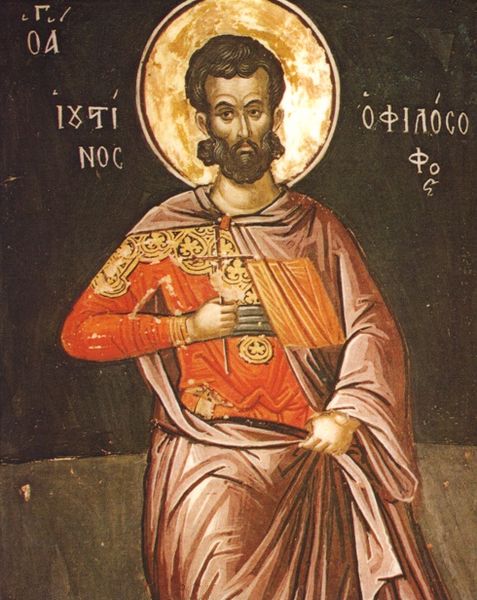
File:Saint Justin Martyr by Theophanes the Cretan.jpg*

Actually, he is called St. Justin Martyr, which is odd because no other saint is surnamed Martyr. Though his holiness led to his martyrdom, his occupation as philosopher also played a role in it as well. St. Justin was born in Samaria about A.D. 100 to pagan parents but converted in about 130. He was well educated in philosophy, following Stoicism, where virtue was the highest good and based on knowledge where “the key to happiness is freedom from desire… (and) an elevated moral code.” Then he followed Platonism, where abstract ideas are timeless and belong to a world independent of the physical world. Both these philosophies have truths that reason can discover.

However, it was not enough for him. He saw the need for more than what reason could give him. He needed Revelation. St. Justin was the first Christian philosopher and used philosophy to help understand Christian concepts, such as how God “must be everlasting, ineffable (His reality cannot be adequately expressed”, nameless, changeless, impassible (He cannot be affected from outside Himself), and without origin—the Creator of all that is.” These Greek ideas matched the God of Scriptures. He wrote many apologies, or defenses, of Christianity and taught that “Jesus was the ultimate philosopher, and he believed that all truth is one, hence all truth is the truth of God,” predating St. Thomas Aquinas’s teachings about truth by a millennium.

St. Justin Martyr was martyred during the reign of Marcus Aurelius, a philosopher as well as emperor, around the year 165 because he would not deny “Truth”. St. Justin used reason and Revelation together, using reason to lead to Revelation and then to help explain Revelation. Many people today think of Christianity as mindless and antagonistic to reason. Nothing could be further from the “Truth,” who is Jesus Christ.
*https://commons.wikimedia.org/wiki/File:Saint_Justin_Martyr_by_Theophanes_the_Cretan.jpg

Friday, June 14, 2019

Sunday after Trinity Sunday--Solemnity of Corpus Christi


The Solemnity of the Most Holy Body and Blood of Christ celebrates the real presence of Jesus in the Eucharist—Body, Blood, Soul, and Divinity. This is the faith of the Church and it always has been. Jesus states in the Gospel of John: “Amen, amen, I say to you, unless you eat the flesh of the Son of Man and drink his blood, you do not have life within you” Jn 6:53.

Early Christians were accused of cannibalism, which can “potentially be linked to [a]… principal Christian ritual, the celebration of the Eucharist. During this part of the service, the ‘body of Christ’ is consumed and his ‘blood’ drunk.” However, the Church Fathers confirmed the Real Presence of Jesus in the Eucharist. For example, St. Justin Martyr wrote: “For not as common bread nor common drink do we receive these; but since Jesus Christ our Savior was made incarnate by the word of God and had both flesh and blood for our salvation, so too, as we have been taught, the food that has been made into the Eucharist by the eucharistic prayer set down by him, and by the change of which our blood and flesh is nurtured, is both the flesh and blood of that incarnated Jesus.”

The Church eventually called the change of bread and wine into the Body and Blood of Jesus transubstantiation. This means that the appearance, taste, texture, smell still remains that of bread and wine, but the reality, or substance, changes into the Body, Blood, Soul, and Divinity of Jesus. It is no longer bread and wine, but Jesus! The Solemnity of Corpus Christi reaffirms our belief in what Jesus taught and celebrated and passed on to us.