Showing posts with label Eucharist. Show all posts

Sunday, September 14, 2025

September 25--St. Cleopas, Holy Man


There are a few people mentioned by name once or infrequently under singular circumstances in the Gospels, Simon of Cyrene, Jairus, Joanna, Mary of Clopas and today’s saint, St. Cleopas. St. Cleopas is mentioned in Luke’s Gospel as one of the two persons Jesus encountered on the road to Emmaus after the Resurrection, which may be the same occurrence stated in Mark 16:12-13 about the appearance to two disciples on their way to the country. Some think that this is the same person as Clopas, who is mentioned as the husband of Mary, one of the women present at the crucifixion of Jesus. Some traditions claim that he was the brother of St. Joseph and thus the uncle of Jesus. Others say that he was also the same person as Alphaeus, who was the father of James the Less, an Apostle of Jesus. It is difficult to know for sure, but we do know that he was a witness to the resurrected Jesus.

As a named witness to the Resurrection, St. Cleopas and his companion, perhaps his wife, were favored with a noteworthy appearance. They were on the road to Emmaus on the day of Jesus’ Resurrection when a stranger, Jesus, came up to them and walked with them. They shared their experience of the suffering, death, and resurrection of Jesus and their lack of understanding of the whole situation. Jesus explained to them the meaning of the Old Testament regarding his passion and death and then moved as to leave them. They invited him to stay and he “broke bread” with them. At that they recognized him and he disappeared. Think about it; this is the structure of the Mass–reading of Scriptures and the homily along with the sharing of the Eucharist! WOW! St. Cleopas, pray for us.


Sunday, September 29, 2024

October 12--Bl. Carlo Acutis, Holy Man


He is a saint for the 21st century! Blessed Carlo Acutis (1991-2006) “was an Italian website designer who documented Eucharistic miracles and approved Marian apparitions, and catalogued both on a website he designed before his death from leukaemia. Acutis was noted for his cheerfulness, computer skills, and devotion to the Eucharist, which became a core theme of his life.” Even though he died at the age of 15, he was beatified in 2020 and has been approved for canonization, possibly in 2025.

Here are some of his inspiring quotations:

  • “The Virgin Mary is the only woman in my life.”
  • “The more Eucharist we receive, the more we will become like Jesus, so that on earth we will have a foretaste of heaven.”
  • “By standing before the Eucharistic Christ, we become holy.”
  • “Continuously ask your guardian angel for help. Your guardian angel has to become your best friend.”
  • All people are born as originals but many die as photocopies.”
  • To always be close to Jesus, that’s my life plan”.
  • “Sadness is looking at ourselves, happiness is looking towards God.”
  • “Not me, but God.”
  • “The more Eucharist we receive, the more we will become like Jesus, so that on this earth we will have a foretaste of heaven".
  • “The only thing we have to ask God for, in prayer, is the desire to be holy.”
  • “Our soul is like a hot air balloon. If by chance there is a mortal sin, the soul falls to the ground. Confession is like the fire underneath the balloon enabling the soul to rise again. . . It is important to go to confession often.”
  • “Our goal must be infinite, not the finite. The infinite is our homeland. Heaven has been waiting for us forever.”
  • “The Eucharist is the highway to heaven.”
Bl. Carlo Acutis, pray for us!


Sunday, May 5, 2024

May 17--St. Paschal Baylon, Religious


The 10th National Eucharistic Congress is scheduled to take place July 17-21 in Indianapolis. One of the National Eucharistic Pilgrimage routes is through the Omaha Archdiocese with a Mass at St. Cecilia’s Cathedral June 23. We are in the midst of the three-year National Eucharistic Revival to help Catholics “revive our understanding of and devotion to the Most Holy Eucharist!” It is exactly what our saint of the day, St. Paschal Baylon, would have approved because he is the patron saint of Eucharistic Congresses.

St. Paschal lived in Spain from 1540-1592 during the Golden Age of the Church in Spain. He was a shepherd during his youth and became a Franciscan friar at the age of 24. As such he was a cook, gardener, beggar, and porter. “He is best remembered, however, as a contemplative and a mystic who experienced ecstatic visions during extended periods of prayer before the Holy Eucharist. It was the joy of his life to pray in adoration of the Blessed Sacrament.” Pope Leo XIII proclaimed him the patron saint of Eucharistic Congresses, calling him the “seraph of the Eucharist”: “Now, in the glorious ranks of those, the ardor of whose piety towards the great Mystery of the faith was more evident and overflowing, Paschal Baylon holds a most prominent place; for, being gifted with a soul which aspired above all things to Heaven, he embraced a severer mode of life, entering the Order of Minors of the Strict Observance, and from the contemplation of the Holy Eucharist he derived that science and wisdom which placed him, though formerly an unpolished and illiterate man, in a position to solve the most difficult questions of the faith.”

Let us pray before the tabernacle and adore Our Lord Jesus in the Eucharist. St. Paschal Baylon, pray for us!


Sunday, June 30, 2019

July 9—St. Veronica Giuliani, Abbess


Pope Emeritus Benedict XVI wrote one way we can combat scandal is through a greater reverence for the Eucharist: “The way people often simply receive the Holy Sacrament in communion as a matter of course shows that many see communion as a purely ceremonial gesture. Therefore, when thinking about what action is required first and foremost, it is rather obvious that we do not need another Church of our own design. Rather, what is required first and foremost is the renewal of the Faith in the Reality of Jesus Christ given to us in the Blessed Sacrament.” 

Today’s saint spoke of the joy of communion about 300 years ago! St. Veronica Giuliani was a holy woman who became novice mistress and abbess of her convent. She also received the stigmata of Christ, which caused her humiliation. However, she experienced a profound communion with God and shared that in her diary: “While I was about to go to Holy Communion, I seemed to be thrown wide open like a door flung open to welcome a close friend and then shut tight after his entry. So my heart was alone with him—alone with God. … Love makes the heart leap and dance. Love makes it exult and be festive. … Love possesses it and gives it everything. Love takes it over completely and dwells in it. But I am unable to say more because if I wished to relate all the effects that my heart experiences in the act of going to Holy Communion and also at other times, I would never finish saying everything. It is sufficient to say that communion is a … mansion of love itself.”

Jesus blesses us with his presence and brings us to holiness by giving us himself! Would that we remember what that really means! We would be focused on Jesus, joy, and holiness, rather than scandal.


Friday, June 14, 2019

Sunday after Trinity Sunday--Solemnity of Corpus Christi


The Solemnity of the Most Holy Body and Blood of Christ celebrates the real presence of Jesus in the Eucharist—Body, Blood, Soul, and Divinity. This is the faith of the Church and it always has been. Jesus states in the Gospel of John: “Amen, amen, I say to you, unless you eat the flesh of the Son of Man and drink his blood, you do not have life within you” Jn 6:53.

Early Christians were accused of cannibalism, which can “potentially be linked to [a]… principal Christian ritual, the celebration of the Eucharist. During this part of the service, the ‘body of Christ’ is consumed and his ‘blood’ drunk.” However, the Church Fathers confirmed the Real Presence of Jesus in the Eucharist. For example, St. Justin Martyr wrote: “For not as common bread nor common drink do we receive these; but since Jesus Christ our Savior was made incarnate by the word of God and had both flesh and blood for our salvation, so too, as we have been taught, the food that has been made into the Eucharist by the eucharistic prayer set down by him, and by the change of which our blood and flesh is nurtured, is both the flesh and blood of that incarnated Jesus.”

The Church eventually called the change of bread and wine into the Body and Blood of Jesus transubstantiation. This means that the appearance, taste, texture, smell still remains that of bread and wine, but the reality, or substance, changes into the Body, Blood, Soul, and Divinity of Jesus. It is no longer bread and wine, but Jesus! The Solemnity of Corpus Christi reaffirms our belief in what Jesus taught and celebrated and passed on to us.

Sunday, September 9, 2018

September 19--St. Januarius, Bishop and Martyr


If you like weird stories, here is a doozy! St. Januarius’s blood liquifies up to 18 times each year for the past 600 years! Keep in mind that St. Januarius has been dead since A.D. 305, when he was martyred under the Great Persecution of the emperor Diocletian, the last and worst persecution in the age of the martyrs. His blood has been kept in a reliquary and routinely liquifies on certain days, including his feast day of September 19. When Pope Francis visited Naples in 2015 the blood liquified, the first time that has happened in the presence of a pope in over 150 years. According to Neapolitans, when St. Januarius’s blood does not liquify on the usual days it is a sign of trouble to come. So why is liquification unusual? The fact of St. Januarius’s blood changing form is scientifically inexplicable, PERIOD! 

St. Januarius was a bishop and martyr, which makes him amazing enough! However, because of the constant liquification of his blood, or lack thereof, he is in the news quite a bit. We may not really know about him, except for this amazing miracle. What does this mean for us today? Perhaps it is to remind us of another miracle concerning blood.

There is a miracle that occurs every day throughout the world in every Catholic church: the transubstantiation of the bread and wine offered at the sacrifice of the Mass into the Body and Blood of Jesus. This miracle is seen and experienced by faithful. It is more amazing than the liquification of St. Januarius’s blood. We get to receive Jesus—Body, Blood, Soul, and Divinity—every time we receive the Eucharist. We honor St. Januarius for his witness and his miracle, but we worship our Lord, Jesus Christ for his great love and sacrifice for our salvation.

Monday, September 1, 2014

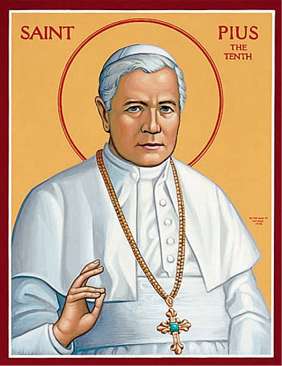
August 21--St. Pius X, Pope


The first pope to be declared a saint in the 20th century was also the first pope elected in the 20th century, Pope St. Pius X.  He came from peasant stock, which was unusual among papal candidates.  He accomplished many things as pope:  he lowered the age for first reception of Communion and Penance to the age of reason; began Catholic Action, an organization for the laity to be involved in service to the community; condemned the heresy of Modernism, which asserted that dogma could evolve over time; codified canon (Church) law; encouraged frequent reception of the sacraments; and led a holy life worthy of example.

What can we hope to follow from such a saint?  Undoubtedly, his humility.  He knew who he was and was respectful of his origins from poor peasant parents.  That did not limit his abilities or his responsibilities to respond to the opportunities that God set before him.  He led the People of God to live lives of greater holiness by the frequent reception of the sacraments.  He changed the practice of receiving Communion from about the age of 13 or 14 to about seven so we could receive Jesus earlier and more often.  Attendance at daily Mass became more common.  

Humility is knowing who we are.  We are children of God and the way we grow in our identity as children of God is by coming closer to God, especially in the sacraments of Reconciliation and Holy Communion.  So let us humbly follow the example of Pope St. Pius X by frequently going to Confession and receiving the Eucharist.