Showing posts with label Pope Francis. Show all posts

Monday, February 17, 2025

February 27--St. Gregory of Narek, Monk, Priest, and Doctor of the Church


“Lex orandi, lex credendi.” “The law of what is prayed is the law of what is believed.” This Latin phrase summarizes the impact and relationship of prayer and faith. As the Catechism states: “The law of prayer is the law of faith: the Church believes as she prays.” (1124).

Thus: Saint Gregory of Narek was a mystic, monk, priest, and, as declared by Pope Francis, Doctor of the Church. Living in the Kingdom of Armenia, modern Turkey (born about 951, died about 1003), Gregory and his brother were raised by their uncle in a monastery, which he eventually entered. He then taught there and wrote commentaries and prayers. His most famous work is The Book of Lamentations, a collection of ninety-five prayers, each beginning: “Speaking with God from the Depths of the Heart.” The prayers were expressions of love and dependency on God’s mercy. “He believed his book was written not only for himself, his monks, or the Armenian people, but for all people, for the entire world.” In other words, St. Gregory proclaimed the Gospel in the prayers he composed.

Here is the conclusion of his final prayer: Prepare the earth for the day of light and let the soil bloom and bring forth fruit, heavenly cup of life-giving blood, ever sacrificed, never running dry, all for the salvation and life of the souls in eternal rest. And though my body die in sin, with Your grace and compassion, may I be strengthened in You, cleansed of sin through You, and renewed by You with life everlasting, and at the resurrection of the righteous be deemed worthy of Your Father’s blessing. To Him together with You, all glory, and with the Holy Spirit, praise and resounding thanks, now, always and forever, Amen. St. Gregory of Narek, pray for us!

Sunday, September 29, 2024

October 12--Bl. Carlo Acutis, Holy Man


He is a saint for the 21st century! Blessed Carlo Acutis (1991-2006) “was an Italian website designer who documented Eucharistic miracles and approved Marian apparitions, and catalogued both on a website he designed before his death from leukaemia. Acutis was noted for his cheerfulness, computer skills, and devotion to the Eucharist, which became a core theme of his life.” Even though he died at the age of 15, he was beatified in 2020 and has been approved for canonization, possibly in 2025.

Here are some of his inspiring quotations:

  • “The Virgin Mary is the only woman in my life.”
  • “The more Eucharist we receive, the more we will become like Jesus, so that on earth we will have a foretaste of heaven.”
  • “By standing before the Eucharistic Christ, we become holy.”
  • “Continuously ask your guardian angel for help. Your guardian angel has to become your best friend.”
  • All people are born as originals but many die as photocopies.”
  • To always be close to Jesus, that’s my life plan”.
  • “Sadness is looking at ourselves, happiness is looking towards God.”
  • “Not me, but God.”
  • “The more Eucharist we receive, the more we will become like Jesus, so that on this earth we will have a foretaste of heaven".
  • “The only thing we have to ask God for, in prayer, is the desire to be holy.”
  • “Our soul is like a hot air balloon. If by chance there is a mortal sin, the soul falls to the ground. Confession is like the fire underneath the balloon enabling the soul to rise again. . . It is important to go to confession often.”
  • “Our goal must be infinite, not the finite. The infinite is our homeland. Heaven has been waiting for us forever.”
  • “The Eucharist is the highway to heaven.”
Bl. Carlo Acutis, pray for us!


Sunday, August 18, 2024

August 30--St. Euphrasia Eluvathingal, Virgin


The Church is not only Catholic, but catholic. The word catholic means universal. It was mentioned by St. Ignatius of Antioch in AD 110 to distinguish the Church from heretical groups. This is worthwhile for today’s saint because she is from India. The Catholic Church is all over the world! St. Euphrasia Eluvanthingal (1877-1952) was born in Karal State, which is on the Malabar Coast of India, where tradition has it that the apostle Thomas evangelized the people. She joined the Carmelite Order of the Syro-Malabar Church, which is an Eastern Catholic Church in union with Rome. She was a novice mistress at her convent and then Mother Superior. She became known as the “Praying Mother” due to her life of prayer and devotion to the Sacred Heart. She was canonized by Pope Francis in 2014. It is written of her: “Mother Euphrasia grew in humility, poverty and holiness as she completely obeyed the will of God every moment. The whole life of this virgin was full of continuous prayer, penance and reparation. Mother Euphrasia who found contentment in loving Jesus, her divine spouse, was always in the forefront in receiving censure and abuses. All those who approached her she helped with motherly love, prayer and good advice.”

The Church is one, holy, catholic, and apostolic. We are united as one through our faith and baptism. Sainthood is conferred on those who have demonstrated heroic virtue and holiness in their lives, giving us models to draw from. We are catholic in that we are all called to be with Jesus in community with the Catholic Church. We are apostolic because of the continuous succession of bishops and popes from Peter and the apostles. St. Euphrasia exemplified each of these marks through her life and holiness. St. Euphrasia, pray for us!

Saturday, November 18, 2023

December 10--Our Lady of Loreto

The Miracle of the Holy House of Loreto by Giovanni Battista Tiepolo licensed under public domain.


Our Lady of Loreto actually refers to the house in which Mary was born and lived! Tradition holds that it is where she experienced the Annunciation and where the Holy Family dwelled. Veneration of the Sancta Casa, or Holy House, in Nazareth is ancient. However, Loreto is located near the Adriatic Sea northeast of Rome. How, may we ask, did the Holy House get from Nazareth to Italy? This is where the story gets interesting!

According to one story angels carried the house from Galilee to Italy. However, some theorize that this actually refers to a medieval family called the Angelos, which is translated as “angels”. This makes sense in that it appears in Loreto in the late 13th century, around the time of the last of the Crusades. So why is there a feast celebrating a house and why is it called Our Lady of Loreto?

The house is important because it connects with Mary and the Incarnation of Christ. In 1995, St. John Paul II stated in a homily: “The threads of the history of the whole of humankind are tied anew in that house. It is the Shrine of the House of Nazareth, to which the Church that is in Italy is tied by providence, that the latter rediscovers a quickening reminder of the mystery of the Incarnation, thanks to which each man is called to the dignity of the Son of God.”

In 2019, Pope Francis directed this optional memorial to be celebrated and Cardinal Sarah wrote in the declaration: “This celebration will help all people, especially families, youth and religious to imitate the virtues of that perfect disciple of the Gospel, the Virgin Mother, who, in conceiving the Head of the Church also accepted us as her own.” Our Lady of Loreto, pray for us.

Monday, October 2, 2023

October 9--St. John Henry Newman, Priest

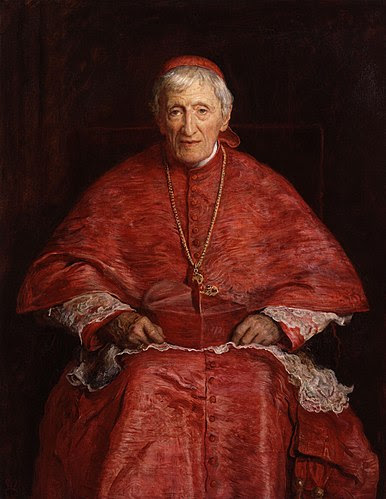
John Henry Newman, by Sir John Everett Millais, 1st Bt (died 1896), licensed under Public Domain.

“God has created me to do him some definite service; He has committed some work to me which he has not committed to another. I have my mission; I never may know it in this life, but I shall be told it in the next. I have a part in a great work; I am a link in a chain, a bond of connection between persons. He has not created me for naught. I shall do good, I shall do His work; I shall be an angel of peace, a preacher of truth in my own place, while not intending it, if I do but keep His commandments and serve Him in my calling.”

St. John Henry Newman was a late-comer to Catholicism. Born in 1801, he became an Anglican priest in 1825 and leader of the Oxford Movement, which tried to move the Church of England closer to Catholicism. Eventually, he saw that he could not be an Anglican and converted to Catholicism in 1845 and ordained a Catholic priest in 1847. He wrote extensively in theology, apologetics, education, and more. He is known today for his teachings on the development of doctrine, which were taken up in Vatican II in the Dogmatic Constitution on Divine Revelation, Dei verbum: ″[T]he understanding of the things and words handed down grows, through the contemplation and study of believers, [...] [which] tends continually towards the fullness of divine truth” (8). He was created cardinal in 1879 without becoming a bishop and died in 1890. He was beatified by Pope Benedict XVI in 2010 and canonized by Pope Francis in 2019.

St. John Henry Newman was a brilliant, humble, and holy man. Saints like him are models for us, so that we may “keep His commandments and serve Him in [our] calling.”

Monday, July 10, 2023

July 16--Bl. Guadalupe Ortiz, Holy Woman and Member of Opus Dei

 
https://catholicreadings.org/catholic-quotes/blessed-guadalupe-ortiz-de-landazuri-fernandez-de-heredia-saint-of-the-day-july-16/

Is there a conflict between science and religion? Many who believe science can answer every question (scientism) say yes and “that science alone can give us complete and reliable knowledge of reality.” Those who believe religion can give us truths say no because, as Pope St. John Paul II says: “Truth cannot contradict truth.” Truth can be found in both science and religion! Today’s saint is a witness to that truth!

Bl. Guadalupe Ortiz was both a scientist and a member of Opus Dei, a personal prelature composed of priests and laity who “spread the Christian message that every person is called to holiness and that every honest work can be sanctified.” She was born in Spain in 1916 and became a teacher in 1939. She met St. Josemaría Escrivá, the founder of Opus Dei, who admitted her to the movement. She then moved to Mexico to share the message of Opus Dei and began her doctorate. She also helped found a school for girls and a mobile medical clinic for the poor. She then moved to Rome to help St. Josemaría and at the same time worked on a research project, for which she received an award, and completed her doctorate. She died in 1975 after years of heart problems and was declared Blessed in 2019.

Pope Francis wrote for her beatification: “With the joy that came from knowing she was a daughter of God, as she had learned from Saint Josemaría himself, Guadalupe Ortiz placed her many human and spiritual qualities at the service of others, helping in a particular way other women and families in need of education and development. She did all this not with a proselytizing attitude but simply through her prayer and witness.” Science and religion are both true as Bl. Guadalupe Ortiz demonstrated!

Tuesday, June 20, 2023

July 10--Bl. Faustino Villanueva y Villanueva, Priest and Martyr

http://newsaints.faithweb.com/martyrs/Guatemala.htm

What does it mean to be a martyr? Pope Francis has beatified many martyrs, including those killed during the civil war in Guatemala from 1954-1996. Why were they martyred? The Vatican biography for their beatification states: “From 1980, a systematic persecution against the Church began, overwhelming priests, religious and lay people under the pretext that they were ‘enemies of the state’. … The ten martyrs [of Quiché] … were killed in Guatemala between 1980 and 1991 … for being committed to and protecting the dignity of the poor.”

The following is from a Spanish newspaper article: “Faustino Villanueva was born on February 15, 1931 in Yesa, where his parents were also from. He entered the apostolic school of the Missionaries of the Sacred Heart, in Valladolid, as a child. He professed in 1949 and was ordained a priest in 1956. He went as a volunteer to the mission of Quiché (Guatemala) in 1959, where he remained until his martyrdom, which occurred in the parish office on July 10, 1980, after twenty-one years of fruitful missionary service to the poorest. A month before he died, he wrote to his mother, reiterating his desire to remain in the mission despite the prevailing violence: ‘We cannot leave the people abandoned.’ He died machine-gunned by two young hitmen in the parish office of Joyabaj (El Quiché) on July 10, 1980.

“Those who knew him affirm that ‘he was simply good, evangelical in his non-existent flirtations with power and prestige; so charmingly familiar and unfussy; so clearly biased in favor of the marginalized indigenous, of the favorite downtrodden peasants of the Gospel; of the voiceless.... However, this evangelical Faustino Villanueva was shot mercilessly. And not by mistake. He had long been on a sinister death row list. Guilty of siding with the poor and marginalized.’”

Monday, March 8, 2021

March 19—Solemnity of St. Joseph, Husband of the Blessed Virgin Mary


*


Pope Francis has proclaimed a special “Year of St. Joseph.” This is in honor of the 150th anniversary of Blessed Pope Pius IX’s declaration of St. Joseph as Patron of the Universal Church. This provides “a wonderful opportunity to increase our love for St. Joseph and knowledge, ‘to encourage us to implore his intercession and to imitate his virtues and his zeal.’” It also offers many resources, catechetical material, and prayers/devotions to assist us in our celebration of the special year at https://www.usccb.org/saint-joseph.

One of those resources is his Apostolic Letter, Patris Corde, which means, “With a father’s heart.” He writes: “With a father’s heart: that is how Joseph loved Jesus, whom all four Gospels refer to as ‘the son of Joseph.’” He further writes, “I would like to share some personal reflections on this extraordinary figure, so close to our human experience. … My desire to do so increased during these months of pandemic, when we experienced, amid the crisis, how ‘our lives are woven together and sustained by ordinary people, people often overlooked. … How many fathers, mothers, grandparents and teachers are showing our children, in small everyday ways, how to accept and deal with a crisis by adjusting their routines, looking ahead and encouraging the practice of prayer. How many are praying, making sacrifices and interceding for the good of all.’ Each of us can discover in Joseph – the man who goes unnoticed, a daily, discreet and hidden presence – an intercessor, a support and a guide in times of trouble. Saint Joseph reminds us that those who appear hidden in the shadows can play an incomparable role in the history of salvation. A word of recognition and of gratitude is due to them all.” Take some time this Lent to read more.  St. Joseph, pray for us.


*https://www.usccb.org/saint-joseph

Friday, July 12, 2019

July 30--St. Peter Chrysologus, Bishop and Doctor of the Church


Pope Francis has placed the mercy of God as key to understanding God’s love in our lives. This was also true of today’s saint, Peter Chrysologus, who lived from A.D. 406-450 and was bishop of Ravenna, Italy. St. Peter was appointed bishop of the emperor’s administrative center in Italy when he was 27-years-old, probably at the emperor’s request.

He earned the title, “Chrysologus”, which means “golden-worded” because of his effective preaching and practical sermons. He is even called the “Doctor of Homilies” because of his simple, yet theologically profound words. He once said, “Ordinary language is dear to simple souls and sweet to the learned.”

He also spoke about how mercy is one of the three things through which faith stands firm, along with prayer and fasting: “When mercy dries up, fasting suffers drought, for mercy is to fasting what rain is to the earth. The one who fasts may prepare his heart, cleanse his flesh, pull out his vices and sow virtues. But if he does not sprinkle his plants with streams of mercy, he does not gather his harvest. O faster, when your mercy fasts, your field fasts too.”

“Lord, let your mercy be on us, as we place our trust in you” (Ps. 33:22). This could be the motto of St. Peter Chrysologus, or even of Pope Francis. Jesus told us in the parable of the unforgiving servant: “Should you not have had pity on your fellow servant, as I had pity on you?” (Mt. 18:33). He told the Pharisees: “Go and learn what this means: ‘I desire mercy, not sacrifice.’” He is also telling that to us! Pope Francis called an Extraordinary Jubilee Year of Mercy for 2015-2016. That may be over, but the purpose of the Jubilee Year is not. We are all called to holiness and a supreme expression of holiness is mercy!