Saturday, October 18, 2014

September 12--Most Holy Name of the Blessed Virgin Mary


"What's in a name.  That which we call a rose by any other name would smell as sweet...."  At least that is what Shakespeare wrote.  But is he correct?  Is Jesus just another name?  It means, "God saves."  What about Yahweh?  It means, "I am who I am."  These are not just any names.  They are the names of God.  Mary's name is also revered by Christians.  The feast of the Most Holy Name of the Blessed Virgin Mary has been a part of the Roman calendar since 1684.  It was suppressed in the 1969 reform of the Roman calendar, but reestablished in 2002 by Pope St. John Paul II, who was extremely devoted to the Blessed Mother.

The name Mary comes from the Hebrew word "Miryam", meaning "bitter".  Moses' sister was also named Miriam.  She is called a prophet.  The Song of Miriam is a part of the victory song after passing through the Red Sea (Ex.  15:21).  The Aramaic form of the word was "Maryam", which was eventually transformed into Greek "Mariam" or "Maria".  The origin of Mary's name does not give any indication as to her importance.  Rather, her name is important because she is the Mother of God!

Names indicate who we are.  They express our identity.  We are known by our names.  They show our relationships to oner another.  So, Mary is our Mother, the Mother of the Church, the Mother of God.  We give her name honor above every other name, save for God's.  Shakespeare was a brilliant poet, but an even greater poet wrote:  "A good name is more desirable than great riches, and high esteem, than gold and riches."  He happened to be inspired to write that line by God in Proverbs 22:1.

September 5--St. Teresa of Kolkatta (Calcutta), Religious


Just about everyone loves Mother Teresa.  She gave her life to serving the poorest of the poor of God in India.  She would go into the streets and find people who were dying, bring them to her a home for the dying, care for them, bathe them, and bury them.  She would beg people for food, clothing, buildings, whatever it took to help the poor.  She began the Missionaries of Charity religious order, which includes sisters, brothers, and priests.  She went all over the world speaking on behalf of the poor and speaking out against the evil of our age, abortion:  “It is a poverty to decide that a child must die so that you may live as you wish.” 

Blessed Teresa had difficulties as well.  She lived a "dark night of the soul."  God allowed her to be deprived of the consolation of the sense of God's presence in her life.  She was happy, not because she "felt" happy, but because she knew that God loved her, regardless of her feelings.  She knew real joy in service to God through her dedication to those who were loved by no one else except God and her.

We have difficulties in our lives when we don't "feel" happy.  Suffering is a part of life.  God did not promise to remove suffering from our lives once we committed ourselves to him.  Rather God promises us the joy of everlasting love.  Feelings are fleeting and they change.  Joy is an understanding and acceptance of the presence of God in our lives.  That is the true happiness that Mother Teresa knew, even though she did not feel it.  This can be our true happiness as well.

Monday, September 1, 2014

August 28--St. Augustine of Hippo, Bishop and Doctor of the Church


Sinner, heretic, gambler, playboy, philosopher, teacher, penitent, monk, priest, bishop, saint.  All these describe the same person, St. Augustine.  St. Augustine was the most influential person in developing and explaining Church doctrine in the first millennia after the first century.  He helped make clear the doctrines of Original Sin, the Trinity, grace, free will, Baptism, and more.  He was one of the four original Doctors of the Latin Church along with St. Ambrose, St. Gregory, and St. Jerome.

However, before he converted he was an opponent of the Catholic Church, belonging to a heretical group that said we have two wills, one good and one evil.  He had a mistress and an illegitimate son.  He was ambitious for fame and glory.  But he was also a searcher for truth.  That commitment to the truth eventually led him back to the faith of his mother, St. Monica.  All this is recorded in his great autobiography, The Confessions, which tells of his sinful youth and eventual conversion.

One of his famous lines from The Confessions is, "Our hearts are restless until they rest in you, O God."  God plants in our hearts the desire for God.  If we are faithful to that desire; if we are honestly searching for truth, we will find God already in our hearts.


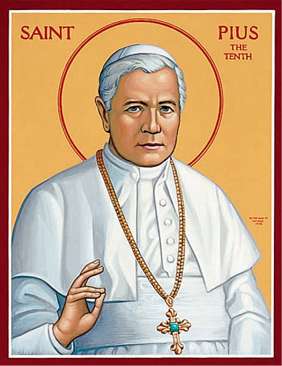
August 21--St. Pius X, Pope


The first pope to be declared a saint in the 20th century was also the first pope elected in the 20th century, Pope St. Pius X.  He came from peasant stock, which was unusual among papal candidates.  He accomplished many things as pope:  he lowered the age for first reception of Communion and Penance to the age of reason; began Catholic Action, an organization for the laity to be involved in service to the community; condemned the heresy of Modernism, which asserted that dogma could evolve over time; codified canon (Church) law; encouraged frequent reception of the sacraments; and led a holy life worthy of example.

What can we hope to follow from such a saint?  Undoubtedly, his humility.  He knew who he was and was respectful of his origins from poor peasant parents.  That did not limit his abilities or his responsibilities to respond to the opportunities that God set before him.  He led the People of God to live lives of greater holiness by the frequent reception of the sacraments.  He changed the practice of receiving Communion from about the age of 13 or 14 to about seven so we could receive Jesus earlier and more often.  Attendance at daily Mass became more common.  

Humility is knowing who we are.  We are children of God and the way we grow in our identity as children of God is by coming closer to God, especially in the sacraments of Reconciliation and Holy Communion.  So let us humbly follow the example of Pope St. Pius X by frequently going to Confession and receiving the Eucharist.

August 11--St. Clare of Assisi, Virgin


According to some, the Catholic Church oppresses women.  Their arguments are based on the principles of the world: power, autonomy, absolute equality, etc.  In their minds, if the Church does not support women's "reproductive rights" or women priests or the ability to choose which gender one wishes to be and so forth, the Church is thus against women.

However, that flies in the face of all the Church has done for women throughout the last two millennia and as embodied by today's saint, St. Clare of Assisi.  St. Clare was a follower of St. Francis of Assisi and founder of the Second Order, the Poor Clares.  She also completely accepted the gift of poverty as Francis had. She set up a convent in Assisi with a Rule that she wrote, allowing them to be free from property, surviving by means of the alms given to them by the Franciscan brothers.  This was completely different from every other women's religious order and it was due to her courage and perseverance.

Women have been at the heart of the Church going back to the Virgin Mary and continuing with the first person to whom the risen Jesus revealed himself, Mary Magdalene, to great martyrs like Sts. Perpetua and Felicity to great teachers of the Church like St. Macrina and St. Hildegard, to great leaders and founders of convents and religious orders like St. Bridget, St. Catherine of Siena, St. Clare, Bl. Teresa of Calcutta, to great doctors of the Church like St. Teresa of Avila and St. Therese of Liseux, to mothers like St. Gianna Beretta Molla, who gave her life instead of taking her baby's.  Mary is our mother and the Mother of the Church.  Women have influenced us throughout our lives.  Let us follow St. Clare's courageous example and leadership to help us live lives of holiness and virtue.


Tuesday, July 29, 2014

August 4--St. John Vianney, Priest


How does one become a priest?  First there needs to be a desire and ability to serve others.  Then there's the sense that God is calling that man to serve as a priest.  There also has to be discernment and evaluation by those who are responsible for the training and education of the candidate.  Finally the bishop, with help from the Vocations Director and the seminary rector, decides to accept and ordain the person to serve as a priest or to recommend a different path of service.  No man has a right to become a priest.

What about St. John Vianney?  Well, he had the desire and ability to serve and a strong sense of vocation, but he was not able to do well in his studies for the priesthood.  He had great difficulty listening to lectures in Latin.  But he persevered and was eventually ordained.  His zeal for the Lord also led him to become a great confessor, sitting in the confessional 11-16 hours a day reconciling God's people.  Thus, he was named patron saint of priests.


What does it mean to be a priest?  It means responding to God's call to serve in a special way; through ministering the sacraments, through preaching the Good News, and through leading God's people by a life of service.  We are called to love and serve the world in our daily lives, but priests are called to love and serve the People of God.  God has not stopped calling men to be priests; we just need to listen more carefully.  All of us are responsible for fostering priestly vocations through our prayers and our encouragement.


Friday, July 25, 2014

July 29--St. Martha, Friend of Jesus

   
Many times we think of St. Martha as a "busybody" saint, trying to get Jesus to tell her sister Mary to help her with the responsibilities of hospitality.  But we must not forget that she is also the woman who expressed complete faith in Jesus:  "I have come to believe that you are the Messiah, the Son of God, the one who is coming into the world" (Jn. 11:27).  It was after this confession of faith that Jesus raised her brother Lazarus from the the dead.  She and her sister and brother were friends of Jesus.  When he came to Jerusalem, he stayed with them.  That can be taken as a sign of trust.

Maybe we have a "Martha" in our families.  Perhaps she is the grandmother or the aunt or mother or sister who goes around the house with an apron on and a washcloth in her hand, constantly finding things to clean and chores to do.  Maybe she is always making sure that guests, both invited and pop-ins, are welcomed and cared for.  Maybe she is also the person who strongly influences our faith by her constant prayer with the Morning Offering glued to the medicine cabinet mirror.  Maybe she has her rosary with her, praying at moments of rest.  Maybe she has a print of the crucifixion of Jesus above her bed a or a picture of Jesus praying in the Garden of Gethsemane in the living room or a picture of the Last Supper in the dining room.

Martha is the patron saint of housewives, waiters, and waitresses.  These are the people who serve us and make sure that the necessities and niceties of hospitality are observed.  She is also very much the patron saint of those who love us and care for our everyday physical and spiritual needs.  They may not have the name of Martha, but they embrace her legacy.  May we be "Marthas" to others.