Showing posts with label Philosophy. Show all posts

Saturday, December 11, 2021

December 23--St. John of Kanty, Priest

 *


It’s Christmas! Let’s celebrate! Wait, we have two days left and today’s a saint’s feast day! But why is there a feast day right before Christmas? Let’s look at the saint and find out. Our saint is St. John of Kanty, also known as St. John Cantius, a priest, philosopher, physicist, and theologian. He was born in 1390 in Kanty, Poland, became a priest and then a professor of theology at his alma mater at what would later be called the Jagiellonian University, where St. John Paul II graduated. As a physicist, he helped develop a theory of falling objects. He made pilgrimages to Jerusalem and Rome. He died on December 24, 1473 at the age of 83. This doesn’t speak a whole lot to sainthood! 

But wait, there’s more. Sainthood is based on holiness, not on achievement! St. John Cantius became “well known in the city for his generosity and compassion toward the poor, especially needy students at the university. He subsisted on what was strictly necessary to sustain his life, giving alms regularly to the poor.” His first biographer pointed out his extreme humility and charity by citing his motto: “Beware disturbing: it’s not sweetly pleasing,/Beware speaking ill: for taking back words is burdensome.” He became a popular saint in Poland, which was transferred to America by Polish immigrants. 

So, what we have here is a man who lived his life, did his work, ministered to others, and followed Jesus in the way Jesus called him. Thus, what we have here is a disciple of Christ, a saint! Humility and charity could be our watchwords to becoming “hidden” saints, those who are not necessarily famous, but are holy in all we think, say, and do. He’s a perfect saint for two days before Christmas! Have a blessed Christmas!

By image/photo was taken by Wikipedia and Wikimedia Commons user Ludwig Schneider.I would appreciate being notified if you use my work outside Wikimedia.Do not copy this image illegally by ignoring the terms of the license below, as it is not in the public domain. If you would like special permission to use, license, or purchase the image please contact me to negotiate terms.When reusing, please credit me as: Ludwig Schneider / Wikimedia. - Own work, CC BY-SA 3.0, https://commons.wikimedia.org/w/index.php?curid=11934694

Monday, November 1, 2021

November 8—Bl. John Duns Scotus, Priest and Religious

*

It only took 685 years for today’s saint to be beatified after his death! John Duns was a Franciscan priest and friar born about 1265/66 and died in 1308. He is called Duns Scotus meaning Duns the Scot because he was from Scotland. He was a philosopher and theologian graduating from Oxford University. He is called “the Subtle Doctor” because of his complex and nuanced thought. He taught a metaphysical argument for the existence of God through the concepts of cause and effect. He also advocated for free will by stating that a person cannot stop what the person is doing if there is no free will; and yet people can stop what they are doing! 

He also defended the teaching of the Immaculate Conception of Mary, following St. Anselm of Canterbury’s principle: “God could do it, it was appropriate, therefore he did it!” In other words, according to Bl. Pope Pius IX, who infallibly defined the dogma of the Immaculate Conception in 1854: “At the moment of her conception, Mary was preserved free from the stain of original sin, in view of the merits of Jesus Christ.” 

Philosophy is the handmaiden of theology! What this means is that the Church uses philosophy to help us understand what God supernaturally reveals to us by using our natural reasoning ability, which God gave to us! We are not fideists, meaning, all we do is believe blindly and not think. Nor are we rationalists, meaning, all we do is use our own unaided reason as the ultimate basis of truth or falsehood and thus not believe. We believe and we think! One is a supernatural gift, faith, and the other is a natural gift, reason. By using both we can share what we believe in a rational manner. Bl. Duns Scotus, pray for us!

*https://upload.wikimedia.org/wikipedia/commons/c/ce/JohnDunsScotus_-_full.jpg 
Justus van Gent, Public domain, via Wikimedia Commons

Tuesday, May 26, 2020

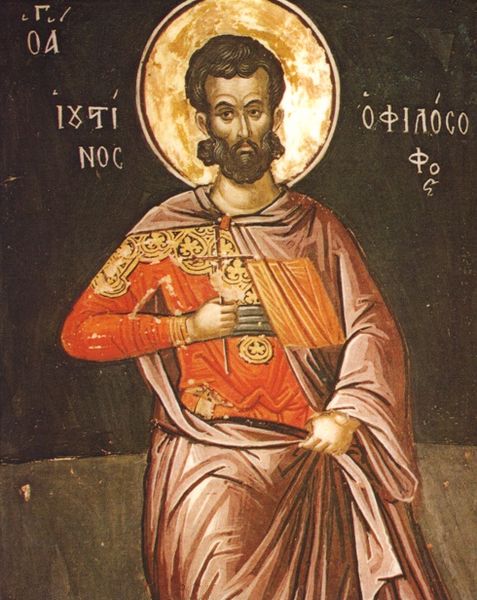
June 1—St. Justin, Martyr

File:Saint Justin Martyr by Theophanes the Cretan.jpg*

Actually, he is called St. Justin Martyr, which is odd because no other saint is surnamed Martyr. Though his holiness led to his martyrdom, his occupation as philosopher also played a role in it as well. St. Justin was born in Samaria about A.D. 100 to pagan parents but converted in about 130. He was well educated in philosophy, following Stoicism, where virtue was the highest good and based on knowledge where “the key to happiness is freedom from desire… (and) an elevated moral code.” Then he followed Platonism, where abstract ideas are timeless and belong to a world independent of the physical world. Both these philosophies have truths that reason can discover.

However, it was not enough for him. He saw the need for more than what reason could give him. He needed Revelation. St. Justin was the first Christian philosopher and used philosophy to help understand Christian concepts, such as how God “must be everlasting, ineffable (His reality cannot be adequately expressed”, nameless, changeless, impassible (He cannot be affected from outside Himself), and without origin—the Creator of all that is.” These Greek ideas matched the God of Scriptures. He wrote many apologies, or defenses, of Christianity and taught that “Jesus was the ultimate philosopher, and he believed that all truth is one, hence all truth is the truth of God,” predating St. Thomas Aquinas’s teachings about truth by a millennium.

St. Justin Martyr was martyred during the reign of Marcus Aurelius, a philosopher as well as emperor, around the year 165 because he would not deny “Truth”. St. Justin used reason and Revelation together, using reason to lead to Revelation and then to help explain Revelation. Many people today think of Christianity as mindless and antagonistic to reason. Nothing could be further from the “Truth,” who is Jesus Christ.
*https://commons.wikimedia.org/wiki/File:Saint_Justin_Martyr_by_Theophanes_the_Cretan.jpg

Monday, July 29, 2019

August 9--St. Teresa Benedicta of the Cross, Virgin and Martyr


Atheism has a hold on many in modern society on the grounds that immaterial things, like ideas and God, don’t exist; only material things, like bodies and matter, do. Atheism and materialism have many converts, including many scientists. They don’t seem to be able to deal with a reality that they can’t measure or perceive with their senses. Today’s saint, St. Teresa Benedicta of the Cross, born as Edith Stein, was one such atheist, as well as philosopher.

She was born in 1891 to a Jewish family in Germany. She became an atheist at age 14 and later a philosopher. However, her search for truth, and reading the autobiography of St. Teresa of Avila, led her to convert to Catholicism. She taught in the universities in Germany until her Jewish heritage required her to step down. She became a Discalced Carmelite in 1933 and was sent to Holland in 1938 to escape Nazi oppression. Arrested in 1942 after the Dutch bishops condemned the Nazis, she was sent to Auschwitz where she was martyred along with her sister.

As a philosopher, she developed a proof for the existence of God based on the existence of human beings and our egos, which are dependent on the existence of a higher being, who is not dependent on any other being for existing. God is! We are because God is. But St. Teresa Benedicta did not die for a philosophical abstraction. Some claim that it is only because of her Jewish heritage that she was killed. However, her martyrdom was directly connected to the Dutch bishops’ condemnation of the immorality of the Nazis and thus, she is a true martyr. She died because she believed in a loving God who died for us. Atheism cannot comprehend such a love!

Monday, September 1, 2014

August 28--St. Augustine of Hippo, Bishop and Doctor of the Church


Sinner, heretic, gambler, playboy, philosopher, teacher, penitent, monk, priest, bishop, saint.  All these describe the same person, St. Augustine.  St. Augustine was the most influential person in developing and explaining Church doctrine in the first millennia after the first century.  He helped make clear the doctrines of Original Sin, the Trinity, grace, free will, Baptism, and more.  He was one of the four original Doctors of the Latin Church along with St. Ambrose, St. Gregory, and St. Jerome.

However, before he converted he was an opponent of the Catholic Church, belonging to a heretical group that said we have two wills, one good and one evil.  He had a mistress and an illegitimate son.  He was ambitious for fame and glory.  But he was also a searcher for truth.  That commitment to the truth eventually led him back to the faith of his mother, St. Monica.  All this is recorded in his great autobiography, The Confessions, which tells of his sinful youth and eventual conversion.

One of his famous lines from The Confessions is, "Our hearts are restless until they rest in you, O God."  God plants in our hearts the desire for God.  If we are faithful to that desire; if we are honestly searching for truth, we will find God already in our hearts.