Monday, June 24, 2019

July 5—St. Anthony Zaccaria, Priest


In an age and society where an unborn child is accepted if it is a choice and not a gift, where gender is considered an autonomous decision rather than an accepted fact, and marriage is considered a lifestyle choice no matter who it may be with, the Catholic Church is opposed for loving and teaching according to Jesus and human nature. But today’s saint considered the opposition of others as a badge to be worn proudly, much as his favorite saint, St. Paul, did.

St. Anthony Zaccaria lived in the 16th century, during the Protestant Reformation. He studied medicine and became a doctor, but he wanted to serve the spiritual needs of others and so, became a priest. He started a religious order called the Clerks Regular of St. Paul, also called the Barnabites, a community of priests who took vows and lived by a rule, but lived and served in the world. St. Anthony trained his priests to follow the spirit of St. Paul:

“We should love and feel compassion for those who oppose us, rather than abhor and despise them, since they harm themselves and do us good, and adorn us with crowns of everlasting glory while they incite God’s anger against themselves. And even more than this, we should pray for them and not be overcome by evil, but overcome evil by goodness. We should heap good works like hot coals of burning love upon their heads, as our Apostle urges us to do (See Rom. 12:20). So that, when they become aware of our tolerance and gentleness they may undergo a change of heart and be prompted to turn in love to God….

When you are opposed for the truths of the faith, offer it up for the salvation of the other, much as St. Anthony did.




Friday, June 14, 2019

Sunday after Trinity Sunday--Solemnity of Corpus Christi


The Solemnity of the Most Holy Body and Blood of Christ celebrates the real presence of Jesus in the Eucharist—Body, Blood, Soul, and Divinity. This is the faith of the Church and it always has been. Jesus states in the Gospel of John: “Amen, amen, I say to you, unless you eat the flesh of the Son of Man and drink his blood, you do not have life within you” Jn 6:53.

Early Christians were accused of cannibalism, which can “potentially be linked to [a]… principal Christian ritual, the celebration of the Eucharist. During this part of the service, the ‘body of Christ’ is consumed and his ‘blood’ drunk.” However, the Church Fathers confirmed the Real Presence of Jesus in the Eucharist. For example, St. Justin Martyr wrote: “For not as common bread nor common drink do we receive these; but since Jesus Christ our Savior was made incarnate by the word of God and had both flesh and blood for our salvation, so too, as we have been taught, the food that has been made into the Eucharist by the eucharistic prayer set down by him, and by the change of which our blood and flesh is nurtured, is both the flesh and blood of that incarnated Jesus.”

The Church eventually called the change of bread and wine into the Body and Blood of Jesus transubstantiation. This means that the appearance, taste, texture, smell still remains that of bread and wine, but the reality, or substance, changes into the Body, Blood, Soul, and Divinity of Jesus. It is no longer bread and wine, but Jesus! The Solemnity of Corpus Christi reaffirms our belief in what Jesus taught and celebrated and passed on to us.

Tuesday, June 11, 2019

June 19--St. Romuald, Abbot


How do we deal with the sins of our family? Do we condemn our family member, or do we condemn the sin? Do we pray for their repentance and conversion? Do we offer reparation for their sins? St. Romuald was 20 when his father killed a relative in a duel over property. St. Romuald was so upset that he fled to a nearby monastery in Ravenna, Italy and prayed and did penance for his father. He joined the monastery, but found that his rigor was more than what they wanted. He left and lived under the direction of a hermit. After about five years with him, he spent 30 years traveling around Italy founding and reforming monasteries. 

He eventually founded the Camaldolese order, which combined elements of being a hermit with elements of being a monk. The Camoldolese monks lived in individual cells, but also observed a common life with daily worship and community meals. They emphasized a life of contemplative prayer. The Camoldolese have established communities in Brazil, Africa, India, and the United States in Big Sur, California.

So how does that impact our lives? Do we admire St. Romuald and think, “Better him than me” or “That’s nice”? We need holy men and women to challenge us. Sometimes we get complacent, even in our faith lives and our prayer. Do we pray for the reparations of the sins of others? We have much to pray for regarding the sins in our families, our communities, and in our society. Do we set aside time for God? Do we pray in adoration? Do we sit and “be” in the presence of God? God’s friendship means that we need to share time with him. St. Romuald died in 1027, but his example is worth following.

Monday, June 3, 2019

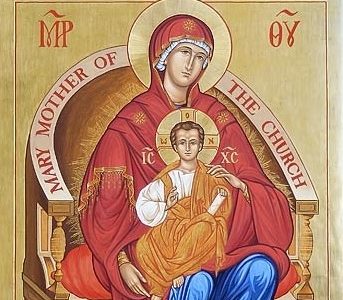
Monday after Pentecost--Memorial of the Blessed Virgin Mary, Mother of the Church

mary-mother-of-the-church-343x300.jpg

Last spring, Pope Francis decreed that “the ancient devotion to the Blessed Virgin Mary, under the title of Mother of the Church, be inserted into the Roman Calendar” on the Monday after Pentecost. Cardinal Sarah, Prefect of the Congregation for Divine Worship, said “the Pope’s decision took account of the tradition surrounding the devotion to Mary as Mother of the Church.” The Holy Father “wishes to promote this devotion in order to ‘encourage the growth of the maternal sense of the Church in the pastors, religious and faithful, as well as a growth of genuine Marian piety.’”

The Scriptures for the day include either Gn. 3:9-15, 20, which is the promise to Adam and Eve that God will save them through the New Adam, son of the New Eve, Mary, or Acts 1:12-14, which mentions Mary as the mother of Jesus after the Ascension and before the Pentecost. The Gospel is from Jn 19:25-34, where Jesus gives his mother to the beloved disciple: “‘Woman, behold, your son.’ Then he said to the disciple, ‘Behold, your mother.’”

The Tradition that Mary is the Mother of the Church goes all the way back to Jesus and has been developed more fully through the ages. In 1964, “Pope Paul VI ‘declared the Blessed Virgin Mary as “Mother of the Church, that is to say of all Christian people, the faithful as well as the pastors, who call her the most loving Mother” and established that “the Mother of God should be further honoured and invoked by the entire Christian people by this tenderest of titles”’”. As our mother, Mary intercedes on our behalf to her Son, Jesus Christ. We are blessed with such a gracious, loving mother! Mary, Mother of the Church, pray for us.

Sunday, November 4, 2018

November 16--St. Gertrude the Great, Virgin


There are few saints that are called “the Great”, four popes; Gregory I, Leo I, Nicholas I, and John Paul II; as well as a Dominican bishop, Albert. But today’s “the Great” was a woman, the only woman so designated in the Catholic Church. 

St. Gertrude the Great was a Benedictine nun who was a mystic and theologian. She was born in 1256 in Germany and went to the Cistercian monastery school at the age of five. She excelled in her education, especially “in literature, philosophy, song, and the refined art of miniature painting.” After time in the monastery school she entered religious life and became a nun. When she was 24 she had a crisis of faith and at the age of 25 she saw Jesus as an adolescent who said to her: “I have come to comfort you and bring you salvation.” It was after this that she dedicated her studies to Scripture, the Church Fathers, and theological writings. She died in 1301 and was elevated to sainthood through equivalent canonization in 1677.

She wrote many works, but her primary influence is as an early devotee of the Sacred Heart of Jesus. Her writings on the Sacred Heart are “notable within the history of Christian devotion because of their vivid descriptions of her visions, which show a considerable elaboration on the long-standing but ill-defined veneration of Christ’s heart.”

The devotion to the Sacred Heart has a long history in the Church, promoted in its earliest form by St. Gertrude and others. It is about the absolute and complete love Jesus has for each one of us, so much so that he gave his life in sacrifice for our sins and to attain for us salvation. It is love that kept Jesus on the cross, not the nails! Thank you St. Gertrude the Great, for this insight.

Tuesday, October 16, 2018

October 23--St. John of Capistrano, Priest and Religious


The Liturgy of the Hours has a brief life on all the saints we celebrate. For St. John of Capistrano it says: “Saint John was born in Capistrano in the Abruzzi (Italy) in 1386. He studied law in Perugia and for a time was governor of that city. He entered the Order of Friars Minor and, after ordination to the priesthood, he led an untiring apostolic life preaching throughout Europe both to strengthen Christian life and to refute heresy. He died at Villach in Austria in 1456.” It’s pretty cut and dried, but it doesn’t tell us…the rest of the story.

The people of Europe had just recovered from the plague, which had wiped out about one-third of the population. The Western Schism occurred, in which three men claimed to be pope! The Franciscans had a heretical group within them! The Ottoman Turks captured Constantinople in 1453 and were moving into central Europe. So, what was a body to do? Preach! He preached to great crowds who were either ambivalent or confused about the Church. He sparked great conversions in the people who heard him. He helped the Franciscans root out the heretical group in their midst. He then preached a crusade in central Europe to stop the Turks, leading an army into Belgrade, Hungary lifting the siege and stopping the Muslim advance into Europe.

Why is all this important for the life of St. John and for us? We are called to live our faith in the circumstances we encounter. If there is heresy, preach against it! If there is corruption, be a force for light and truth! If there is apathy, live with zeal! When there are forces of evil to face, do so with courage! And that’s the rest of the story! St. John of Capistrano, pray for us.

Sunday, October 7, 2018

October 17--St. Ignatius of Antioch, Bishop and Martyr


Imagine this: You are on your way to your execution, brutal at best and torturous at worst. But you write your friends to not try and stop it. Rather, you want to die as an example for others. This is what St. Ignatius of Antioch did when he was taken to the Circus Maximus in Rome. He was a second-generation Christian, having been taught by John the Apostle. As bishop of Antioch, he was a successor to Peter, who was bishop there before going to Rome. He was brought before the Emperor Trajan and refused to recant his faith, whereupon he was sentenced to death in the Circus, to be eaten by lions. In anticipation of the efforts of the Christians in Rome, he wrote: “The only thing I ask of you is to allow me to offer the libation of my blood to God. I am the wheat of the Lord; may I be ground by the teeth of the beasts to become the immaculate bread of Christ.” 

St. Ignatius wrote to various communities on his way to his martyrdom. He wrote about the importance of loyalty to the bishop. In this day we are seeing the bishops in a different light. Some have sinned grievously, while others have sinned in covering up grievous sins. Our bishops are successors to the apostles, but they are also men who need God’s grace in their own lives. We do need to be loyal to them, but we also need to help them in being accountable for the responsibilities they have. The laity has a co-responsibility, along with the clergy, to bring about the Kingdom of God. Let us never renege on our own baptismal promises to reject Satan and all his evil works! St. Ignatius, pray for us.