Saturday, November 18, 2023

December 3--St. Francis Xavier, Priest and Religious

Portrait of St. Francis Xavier by Unknown Artist licensed under public domain.

He was the most famous missionary since St. Paul! He traveled to India, Malaysia, the Maluku Islands, Japan, and China. He converted about 30,000 souls. He evangelized in native languages, adapted to native cultures, and promoted native clergy. He co-founded the Society of Jesus, the Jesuits, and was named “Patron of Catholic Missions” by Pope Pius XI. That is quite a résumé for today’s saint, St. Francis Xavier!

Pope Benedict XVI wrote: “St. Francis Xavier … saw as his own mission ‘opening new ways of access’ to the Gospel ‘in the immense Continent of Asia’. His apostolate in the Orient lasted barely 10 years, but in the four and half centuries that the Society of Jesus has existed it has proven wonderfully fruitful, for his example inspired a multitude of missionary vocations among young Jesuits and he remains a reference point for the continuation of missionary activity in the great countries of the Asian Continent.”

Jesus commissioned the Apostles and, through them, us as well: “Go, therefore, and make disciples of all nations, baptizing them in the name of the Father, and of the Son, and of the holy Spirit, teaching them to observe all that I have commanded you. And behold, I am with you always, until the end of the age” (Mt. 28:19-20). We do not have to go to India or Japan or China. We just need to go to our families or neighbors or colleagues or friends. They need to see and hear in us that we have something great to share: Jesus loves us and them. The Church welcomes us all into her midst. We just need to repent of our sins and live as the saints Jesus calls us to be. What greater missionary effort is there than to love our neighbors?


Sunday, October 29, 2023

November 7--St. Diego of Alcalá, Religious

San Diego de Alcalá by Francisco de Zurbarán licensed under PDM 1.0 DEED.

There are 21 Franciscan missions in California stretching from San Diego to Sonoma, 650 miles north. The first nine were founded by St. Junipero Serra, the first being San Diego de Alcalá, named for today’s saint. St. Diego, also known as St. Didacus, was born about 1400 in the Kingdom of Seville in Spain. He wanted to become a hermit as a child and later applied to the Observant branch of the Franciscans. He became a lay brother, that is, he was not ordained. As a friar he would do various trades as well as preach to the people in the surrounding villages. He was then sent to the Canary Islands as part of a missionary group. He became the head of the Franciscan community on one of the islands, which was unusual for a lay brother. He was filled with zeal and holiness and defended the indigenous people against the colonizers, which led to his return to Spain. He visited Rome in 1450 and served the sick during an epidemic. He returned to Alcalá, Spain, where he spent the rest of his life praying and remaining in solitude. He died on November 12, 1463 and was canonized by Pope Sixtus V in 1588, the first lay brother of the Franciscans to be so honored.

St. Diego sounds like your ordinary run-of-the-mill brother, preaching, praying, serving the poor and sick. He would probably approve of that description. But that is precisely the point of discipleship–prayer, worship, and service–the corporal and spiritual works of mercy! We are all called to be missionary disciples by our Baptism and Confirmation, sharing the love and joy of our relationship with God through Jesus Christ. We are called to holiness in our daily lives by being ambassadors of Christ. St. Diego, pray for us!  Amen!

Monday, October 2, 2023

October 9--St. John Henry Newman, Priest

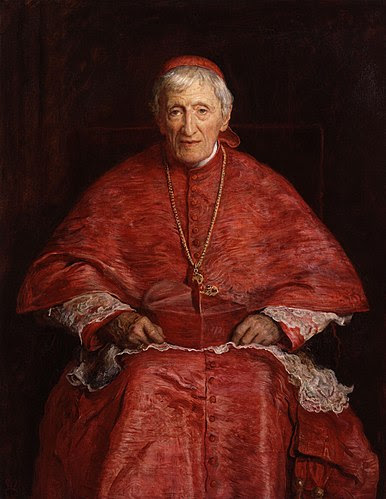
John Henry Newman, by Sir John Everett Millais, 1st Bt (died 1896), licensed under Public Domain.

“God has created me to do him some definite service; He has committed some work to me which he has not committed to another. I have my mission; I never may know it in this life, but I shall be told it in the next. I have a part in a great work; I am a link in a chain, a bond of connection between persons. He has not created me for naught. I shall do good, I shall do His work; I shall be an angel of peace, a preacher of truth in my own place, while not intending it, if I do but keep His commandments and serve Him in my calling.”

St. John Henry Newman was a late-comer to Catholicism. Born in 1801, he became an Anglican priest in 1825 and leader of the Oxford Movement, which tried to move the Church of England closer to Catholicism. Eventually, he saw that he could not be an Anglican and converted to Catholicism in 1845 and ordained a Catholic priest in 1847. He wrote extensively in theology, apologetics, education, and more. He is known today for his teachings on the development of doctrine, which were taken up in Vatican II in the Dogmatic Constitution on Divine Revelation, Dei verbum: ″[T]he understanding of the things and words handed down grows, through the contemplation and study of believers, [...] [which] tends continually towards the fullness of divine truth” (8). He was created cardinal in 1879 without becoming a bishop and died in 1890. He was beatified by Pope Benedict XVI in 2010 and canonized by Pope Francis in 2019.

St. John Henry Newman was a brilliant, humble, and holy man. Saints like him are models for us, so that we may “keep His commandments and serve Him in [our] calling.”

Sunday, September 24, 2023

October 6--Blessed Marie-Rose Durocher, Virgin and Foundress

 
A painting of Canadian nun Eulalie Durocher, also known by her religious name Marie-Rose Durocher. It replicates an earlier painting by Théophile Hamel licensed under Public Domain.

Pope St. John Paul II beatified today’s saint in 1982, stating: “Marie Rose Durocher acted with simplicity, prudence, humility, and serenity. She refused to be halted by her personal problems of health or the initial difficulties of her newborn work. Her secret lay in prayer and self-forgetfulness, which, according to her bishop, reached the point of real sanctity.” There you have it ladies and gentlemen, the secret to becoming a saint! For Blessed Marie-Rose Durocher died at the age of 38 in Quebec, Canada after living a full, if not healthy or easy, life.

At the age of 18 she tried to enter the convent, but her poor health prevented her from completing her education. Then her mother died and she took over her duties. Then she moved to her brother’s rectory as a housekeeper and secretary. It was there that she noted the lack of Catholic education for the children. In 1841 she heard that the bishop was arranging for an order of teaching sisters to come to Canada and tried to join. However, the plan fell through and instead the bishop asked her to start a teaching order. She agreed and in 1843, with two other women, founded the order of the Sisters of the Holy Names of Jesus and Mary. By 1849 demand for her girls’ schools had grown so much that she needed four convents and 30 teachers to educate 448 students! In some provinces her order was teaching boys as well. However, she faced conflict and poor health, which led to her death in 1849.

“Simplicity, prudence, humility, and serenity.” As they consecrated Bl. Marie-Rose, these virtues can help us become holy: simplicity instead of worldliness; prudence instead of rashness; humility instead of pride; and serenity instead of anxiety. Bl. Marie-Rose Durocher, pray for us!

Monday, September 18, 2023

September 26--Sts. Cosmas and Damian, Martyrs

The Martyrdom of Saints Cosmas and Damian by Fra Angelico licensed under Public Domain.


What if your doctor did not charge you for services rendered because the doctor was Christian? Would that cause you to pay a little more attention to the beliefs? Sts. Cosmas and Damian were twin brothers and physicians who did not charge for their services. By their charity many were attracted to Christianity. They were arrested and martyred during the reign of Emperor Diocletian in the third century, who had conducted the most systematic and oppressive persecution of the Roman era. Reports of their martyrdoms spread quickly and they were venerated in both the East and West. They are included in the Roman canon of the Mass: “In communion with those whose memory we venerate, especially the glorious ever-Virgin Mary, Mother of our God and Lord, Jesus Christ, † and blessed Joseph, her Spouse, your blessed Apostles and Martyrs, … Cosmas and Damian and all your Saints; we ask that through their merits and prayers, in all things we may be defended by your protecting help.”

So what can we learn from them? Do we offer our services for free? That does occur in many fields including the legal, financial, and medical professions. The term used for this is pro bono, short for pro bono publico, “for the public good.” That is one thing to gain, but Sts. Cosmas and Damian did not practice medicine for free just for the public good. They offered their services because they were disciples of Christ. We are called to be disciples of Christ in our homes, in our parishes, in our workplaces, and in our communities. Are people attracted to Christianity because of who we are and what we do as disciples? If so, we have won souls to Jesus. If not, why not, pray tell? Sts. Cosmas and Damian, pray for us.

Sunday, September 10, 2023

September 17--Saint Hildegard of Bingen, Virgin, Abbess, and Doctor of the Church

File:St. Hildegard (Berlin) Sankt Hildegard.JPG

St. Hildegard, photograph by Bobo Kubrak, licensed under CC0 1.0.

What would a “Renaissance woman” be? Perhaps a woman who was a writer, composer, philosopher, scholar, scientist, healer, consultant to popes and emperors, mystic, visionary, and saint! Perhaps, St. Hildegard of Bingen! She lived from 1098-1179 in Germany. She was placed in the convent at the age of seven after it was discovered that she experienced visions, which were known only to a few. After the abbess died she was unanimously elected the new abbess at the age of 38. “Hildegard's works include three great volumes of visionary theology; a variety of musical compositions for use in the liturgy, as well as the musical morality play Ordo Virtutum; one of the largest bodies of letters (nearly 400) to survive from the Middle Ages, addressed to correspondents ranging from popes to emperors to abbots and abbesses, and including records of many of the sermons she preached in the 1160s and 1170s; two volumes of material on natural medicine and cures; an invented language called the Lingua ignota (‘unknown language’); and various minor works, including a gospel commentary and two works of hagiography.” Finally, Pope Benedict XVI proclaimed her a saint and Doctor of the Church in 2012, one of 37. “He called Hildegard ‘perennially relevant’ and ‘an authentic teacher of theology and a profound scholar of natural science and music.’”

St. Hildegard was a “Renaissance woman” and an amazing person in all regards! God raises special people to bring his message to the world. In the Church he sends saints, like St. Hildegard. She wrote, in the voice of God: “I am the breeze that nurtures all things green. I encourage blossoms to flourish with ripening fruits. I am the rain coming from the dew that causes the grasses to laugh with the joy of life.” St. Hildegard, pray for us!


Sunday, September 3, 2023

September 15–St. Catherine of Genoa, Holy Woman

Saint Catherine of Genoa painted by artists Inna and Denys Savchenko. Church of St. Catherine, Genoa, Italy. Licensed under CC BY-SA 4.0.

What makes a saint a saint? Saints are saints because of their lives and the circumstances they face and the choices they make; and thus, the holiness derived from living their lives and giving their lives to God in love, worship, and service. St. Catherine of Genoa (1447-1510) was a noblewoman who, although attempting to enter a convent at a young age, agreed to marry a man from a rival political family to help bring about peace. However, her husband cheated on her and wasted their money to the point of bankruptcy. She suffered terribly due to this arrangement. Then, in 1473, she experienced the overwhelming love of God in her life, which revealed to her her own sinfulness. She stopped focusing on what she could not do and dedicated her life to what she could do: love, worship, and serve the poor. Her efforts had an impact on her husband Julian, who reformed his ways, and together they served the sick at the Pammatone Hospital in Genoa, the largest charity hospital in Europe. Catherine eventually became manager and treasurer of the hospital and Julian, who had become a Franciscan tertiary, became its religious director.


“After her change of heart, Catherine wrote: ‘Since I began to love, love has never forsaken me. It has ever grown to its own fullness within my innermost heart.’” Each of us has our own worries, difficulties, frustrations, and sufferings which afflict us. That is not what makes us saints! We become saints by how we respond to these trials with the love of Jesus. We each need to be converted each day to Jesus so he may transform us into saints. She also wrote: “We should not wish for anything but what comes to us from moment to moment exercising ourselves nonetheless for good.”