Monday, June 8, 2026

June 14--St. Elisha, Prophet


Prophet Elisha licensed under CC0 1.0 Universal Public Domain Dedication.

We don’t normally think of Old Testament persons as saints, but they can be. The Catechism of the Catholic Church states: “The patriarchs, prophets and certain other Old Testament figures have been and always will be honored as saints in all the Church’s liturgical traditions” (CCC 61). Today’s saint is included in that group, namely the prophet Elisha, the successor to Elijah.  He is included in the liturgical calendar of many Eastern Catholics, Orthodox Christians and the Carmelite religious order, who places its founding on Mount Carmel, where Sts. Elijah and Elisha spent much of their prophetic careers.

Elijah was considered the greatest of the Old Testament prophets and yet, Elisha received a double portion of his spirit when Elijah was taken up into heaven. What does that mean? It means that Elisha received acknowledgement as the “first-born” of Elijah, that he was the primary spiritual heir. Elisha continued the ministry of Elijah, performing twice as many miracles, including raising a man from the dead AFTER he had died! You can read about that in 2 Kings 13:20-21.

We are also spiritual heirs: “The Spirit itself bears witness with our spirit that we are children of God, and if children, then heirs, heirs of God and joint heirs with Christ, if only we suffer with him so that we may also be glorified with him” (Romans 8:16-17). Just as Elisha continued the work of Elijah, we continue the work of Jesus! And what was Jesus’ mission? To bring about the Kingdom of God. First he proclaimed it, then he achieved it through his death and resurrection. What do we do? First we proclaim Jesus and his message of salvation, then “we suffer with him so that we may also be glorified with him.” St. Elisha, pray for us!

Saturday, April 11, 2026

April 19--Leo IX, Pope


The Church has always reformed itself, meeting the needs of each age, but still remaining in continuity with Jesus and the Apostles. Today’s saint, Leo IX, was one of the great papal reformers of the Church. The son of a count and cousin of an emperor, he was a soldier and officer in his cousin’s army. Then he was chosen to be bishop of Toul, France in 1027, where he remained for twenty years. Although he was proposed as pope by Emperor Henry III in 1049, he waited until he received the approval of the clergy and the people of Rome. As bishop and soldier he was disciplined, bringing that discipline to the papacy to reform the Church. Thus, we have the start of the great reforming popes of the eleventh century.

He enforced clerical celibacy, condemned simony (the buying and selling of Church positions) and personally deposed those bishops who were guilty, encouraged liturgical reform, and prohibited clergy from being involved in violence. He also foreshadowed Pope St. John Paul’s efforts at showing the unity of the Church by traveling throughout Europe and personally encouraging and enforcing reforms through councils and synods in Italy, France, and Germany. He sent a delegate to Constantinople to support the Latin rite there, but that eventually resulted in the Great Schism in 1054 after his death. He reaffirmed the real presence of Jesus Christ in the Eucharist, foreshadowing the Church’s dogmatic declaration of that truth at the Council of Trent in 1551. Furthermore, to prevent imperial interference in the selection of the pope, he proposed the use of cardinals as electors of the pope. He also brought the future Pope St. Gregory VII with him to Rome who continued his reforms. The Church is always reforming! Pope St. Leo IX, pray for us!

Saturday, February 21, 2026

March 1--St. David of Wales, Abbot and Bishop


"Gwnewch y pethau bychain mewn bywyd." For those of you who don’t know Welsh, that means: “Do ye the little things in life,” the last words of today’s saint, St. David of Wales, who died around 589 A.D. Born in about 500 A.D., the grandson of a king in Wales, David became “renowned as a teacher and preacher, founding monastic settlements in Wales” and elsewhere. He attended a synod in Wales denouncing the Pelagian heresy, which stated that humans were not affected by Original Sin and we could earn our way to heaven, thus getting rid of our corporate sin and also the need of Jesus as Our Savior to die for us! Due to his speech he was elected primate of the monks in his region. He was later acclaimed archbishop. His last words were: “Lords, brothers and sisters, Be joyful, and keep your faith and your creed, and do the little things that you have seen me do and heard about. And as for me, I will walk the path that our fathers have trod before us." "Do ye the little things in life."


St. Thérèse of Lisieux also taught a “Little Way” whereby doing the ordinary things of everyday life with love bring us closer to God. Both St. David and St. Thérèse point out that holiness is everyone’s calling in life, no matter our state, our abilities, or our difficulties. Every moment is an opportunity for grace or, as Saint Padre Pio said, “The present moment is the only moment of grace.” We are chosen, called, and sent forth to bring God’s love to the world. We are the children of God who praise the love of Our Father, through his beloved Son, Our Lord and Savior, Jesus Christ! St. David, pray for us!

Sunday, January 4, 2026

January 11–St. Theodosius the Great, Abbot


St. Theodosius the Cenobiarch at Church of St. Thomas-Goudi, licensed under CC by-SA 4.0.

In many respects monks saved Western Christianity. St. Benedict of Nursia was the pivotal figure in the West, whereas St. Basil the Great was the pivotal figure in the East. But they were not alone in helping to spread the monastic lifestyle, Today’s saint, St. Theodosius the Great, lived from about A.D. 423-529, and developed the communal monastic way of life in the Judaean desert near Bethlehem.

There are many different kinds of monasticism, including hermits, who lived by themselves, anchorites, who lived by themselves, but physically connected to a church, and cenobites, what we think of today as being monks in community. This style was not as common in Theodosius’s day. He originally started out as a hermit, living in a cave on a mountain. But he eventually founded the Monastery of St. Theodosius near Bethlehem, which stressed the common life rather than the solitary life. It “grew rapidly, with monks of several cultures and languages, and became very well known for its work with the sick, elderly, and mentally impaired.”

What is notable about St. Theodosius was his desire to do God’s will wherever it led him. As a developer of the communal monastic movement he was able to help others find their way to God as well. We are all called by God to live according to our calling to holiness. For many it is the married life, living in the world, evangelizing and sharing faith with family, friends, and colleagues. For others it may be the priestly life, and for still others it may be the cloistered life in a monastery or the missionary life as a sister or brother of a religious order. We are all called to discern our place in God’s plan of salvation for the world. St. Theodosius, pray for us!

Sunday, October 5, 2025

October 12--St. Wilfrid, Bishop


Can bishops be political? We often want our bishops to be above politics, arguing that their work is directed toward God and not toward the world. And yet, bishops are called to be ministers to all, teaching the faith and upholding the dignity of the human person as a child of God. To that end, they are necessarily political, helping form public policy to support the God-given, natural human rights of both the unborn (CCC 2270-2275) and the immigrant (CCC 2241)!

Today’s saint was deeply political! St. Wilfrid was born in 633 and raised in northern England becoming a monk, abbot, and eventually the Bishop of York. He worked with kings to bring about Christianity in various parts of England only a generation after the reintroduction of Christianity by St. Augustine of Canterbury in 597. He established new Catholic communities and monasteries and, at the time, built the largest church north of the Alps. He helped the English Church follow the Roman method of setting the date for Easter. He was also exiled three different times by different kings of the various Anglo-Saxon kingdoms of England, each time appealing to Rome, and each time being upheld by the pope. He died in 709 at a monastery he founded in Mercia, England.

Our bishops need to be political! Jesus sent his Apostles out to the world with the instruction: “Behold, I am sending you like sheep in the midst of wolves; so be shrewd as serpents and simple as doves” (Mt. 10:16).  When dealing with the leaders of the people our bishops can follow the example of St. Wilfrid. As our bishops are in union with Rome and the pope, they will strive to fulfill God’s will for God’s people. We are all called to do the same. St. Wilfrid, pray for us.

Monday, September 29, 2025

October 6--St. Bruno, Priest and Religious


The end of the first millennium saw numerous reforms in the Church and religious life. The reforms of Pope St. Gregory VII allowed for the Church to be independent from control of the state. New religious orders, based upon the Rule of St. Benedict, were developing, especially in France. One of those orders was the Carthusian order of monks founded by today’s saint, St. Bruno. “They lived primarily as hermits and came together for the liturgy and for occasional common activities.” St. Bruno was born in Cologne, now in Germany around A.D. 1030 to a principal family of the city. He studied in Reims, France where he eventually became in charge of the school of the bishop for eighteen years. He became chancellor of the Archdiocese of Reims in 1075. He was offered the position of bishop, but instead decided to withdraw from the active ministry of diocesan work for the role of a hermit. In 1084 he and six companions went into the French Alps near Grenoble at Chartreuse and started a small community of hermits, which became the Carthusian order. St. Bruno’s student, Pope Urban II, called him to Rome to reengage in the daily activities of helping to run the universal Church as Pope Urban’s counsellor. St. Bruno died in 1101.

St. Bruno is a model for both the active and the contemplative life as symbolized by Martha and Mary, who were friends of Jesus. We need public servants of the Church to do the daily practical work of teaching, administrating, preaching, worshipping, healing, and more for the benefit of the People of God. But we also need the hidden servants who pray, meditate, sacrifice, and intercede on behalf of the People of God. St. Bruno was a master of both! St. Bruno, pray for us.

Sunday, September 14, 2025

September 25--St. Cleopas, Holy Man


There are a few people mentioned by name once or infrequently under singular circumstances in the Gospels, Simon of Cyrene, Jairus, Joanna, Mary of Clopas and today’s saint, St. Cleopas. St. Cleopas is mentioned in Luke’s Gospel as one of the two persons Jesus encountered on the road to Emmaus after the Resurrection, which may be the same occurrence stated in Mark 16:12-13 about the appearance to two disciples on their way to the country. Some think that this is the same person as Clopas, who is mentioned as the husband of Mary, one of the women present at the crucifixion of Jesus. Some traditions claim that he was the brother of St. Joseph and thus the uncle of Jesus. Others say that he was also the same person as Alphaeus, who was the father of James the Less, an Apostle of Jesus. It is difficult to know for sure, but we do know that he was a witness to the resurrected Jesus.

As a named witness to the Resurrection, St. Cleopas and his companion, perhaps his wife, were favored with a noteworthy appearance. They were on the road to Emmaus on the day of Jesus’ Resurrection when a stranger, Jesus, came up to them and walked with them. They shared their experience of the suffering, death, and resurrection of Jesus and their lack of understanding of the whole situation. Jesus explained to them the meaning of the Old Testament regarding his passion and death and then moved as to leave them. They invited him to stay and he “broke bread” with them. At that they recognized him and he disappeared. Think about it; this is the structure of the Mass–reading of Scriptures and the homily along with the sharing of the Eucharist! WOW! St. Cleopas, pray for us.


Saturday, September 6, 2025

September 16--St. Cyprian of Carthange, Bishop and Martyr


Galerius Maximus: "Are you Thascius Cyprianus?"
Cyprian: "I am."
Galerius: "The most sacred Emperors have commanded you to conform to the Roman rites."
Cyprian: "I refuse."
Galerius: "Take heed for yourself."
Cyprian: "Do as you are bid; in so clear a case I may not take heed."
Galerius: "You have long lived an irreligious life, and have drawn together a number of men bound by an unlawful association, and professed yourself an open enemy to the gods and the religion of Rome; and the pious, most sacred and august Emperors ... have endeavoured in vain to bring you back to conformity with their religious observances; whereas therefore you have been apprehended as principal and ringleader in these infamous crimes, you shall be made an example to those whom you have wickedly associated with you; the authority of law shall be ratified in your blood. It is the sentence of this court that Thascius Cyprianus be executed with the sword." 
Cyprian: "Thanks be to God."

Thus, the trial and sentencing of St. Cyprian of Carthage in A.D. 258 under Emperor Valerian. He had survived the Decian persecution eight years earlier by going into hiding. However, many had criticized him for that. He explained that he needed to be pastor for his flock, whereas in the latter persecution he explained that he needed to be an example. In between, when the persecution had been relaxed, many who had lapsed from the faith in fear of martyrdom desired to return to the fold. St. Cyprian approved, but only after an appropriate public penance. He was opposed by those who wanted no penance and those who wanted no readmission! Pope St. Cornelius, whose feast day Cyprian shares, agreed with him. Reconciliation is a necessary sacrament for us as well! St. Cyprian, pray for us.

Monday, September 1, 2025

September 7–Bl. Eugenia Picco, Virgin


“As Jesus has chosen bread, which is very common, so must my life be, common ... approachable by all and, at the same time, humble and hidden, like bread.” “These words of Eugenia Picco flow from long contemplation of Jesus, Bread of life, broken for all. Eugenia arrived at this synthesis after a long and painful journey.”

Born in 1867 in Milan, Italy; “[a]fter the mysterious disappearance of her father, she remained with her mother and grew up in an irreligious and morally corrupt environment.” “‘Dangers and occasions at home and outside’, Eugenia said when recalling those troubled years and that ‘instinctive’ strength to pray….” In 1887 she fled from her home and joined the Ursuline Sisters. Thereafter, she took on some important offices, including Superior General. She died in 1921 of tuberculosis.

Pope St. John Paul II said: “The vital synthesis between contemplation and action, assimilated in the daily participation in the Eucharist, was the foundation of the spiritual experience and the burning charity of Bl. Eugenia Picco. In her life she made every effort to listen to the word of the Lord …, never drawing back from the service which love of neighbour required. At Parma she took upon herself the poverty of the people responding to the needs of the young and of needy families and assisting the victims of the war that in this period made Europe suffer. Even in the face of suffering, with the inevitable moments of difficulty and bewilderment that it entails, Bl. Eugenia Picco knew how to transform the experience of suffering into an occasion of purification and inner growth. From Bl. Eugenia we can learn the art of listening to the voice of the Lord in order to be credible witnesses of the Gospel of charity ....” Bl. Eugenia, pray for us.

Sunday, August 24, 2025

September 6--St. Zechariah, Prophet


We don’t usually think of Old Testament prophets as saints, but they are! They proclaimed the Word of God. Zechariah is the eleventh of the twelve minor prophets. Minor does not mean lesser; their writings are shorter than the four major prophets, Isaiah, Jeremiah, Ezekiel, and Daniel. Zechariah lived and prophesied at the time of the return to Israel after the Babylonian Captivity in the late 6th century BC: “Say to them: Thus says the LORD of hosts, Return to me—oracle of the LORD* of hosts—and I will return to you, says the LORD of hosts” (Zec.1:3). He was concerned with the rebuilding of the Second Temple in Jerusalem: “Therefore, thus says the LORD: I return to Jerusalem in mercy; my house will be rebuilt there—oracle of the LORD of hosts—and a measuring line will be stretched over Jerusalem” (Zec. 1:16). He relates a series of visions, in much the same way as the Book of Daniel. In Chapter 14 he also prophesies about the “Day of the Lord,” which “focuses on the restoration of Jerusalem and the return of the people of Zion so that the rest of the world will acknowledge God’s sovereignty.” We don’t know a lot about Zechariah’s life except his parentage and time of prophecy. The name Zechariah means “God remembers.”

Each of us are commissioned as priests, prophets, and servant-kings at our baptism. To be a priest means to be one in worship of God; a servant-king serves the people he rules; and a prophet is a person who evangelizes–bringing the Good News of God’s Kingdom to the world. Zechariah was a prophet and we also share in that great ministry when we evangelize about the love of God in the Paschal Mystery of Jesus Christ. St. Zechariah, pray for us.


Sunday, August 17, 2025

August 30--St. Fiacre, Priest and Abbot


The Catholic Church recognizes patron saints from Academics–St. Thomas Aquinas and St. Albert the Great to Zoology–St. Albert the Great again! Today’s saint is the patron saint of Gardeners. St. Fiacre was born in Ireland about A.D. 600 and died in A.D. 670 in France. He grew up in a monastery, was ordained a priest, and eventually became an abbot. As people came to him because of his reputation for holiness and healing he went to France to become a hermit. He built a hermitage for himself and a hospice for travelers about 50 miles northeast of Paris. There he planted a vegetable and herb garden and an oratory in honor of the Blessed Virgin Mary. He lived a life of self-denial, prayer, fasting, vigils and healing by laying on of hands. Veneration towards him seems to be based on his healing abilities as well as his holiness. His patronage of gardeners is based on his gardening abilities.

Every good act we do can be an act of love for God and others. Gardening may bring joy through the beauty of flowers and health through the nourishment of fruits, and vegetables. Tilling the soil may allow us to focus our minds and hearts on prayer to God in praise and on behalf of others. Tending the yard may bring peace. Scripture envisioned earthly paradise as a garden: “The LORD God then took the man and settled him in the garden of Eden, to cultivate and care for it” (Gn. 2:15). Furthermore: “You make the grass grow for the cattle and plants for people’s work to bring forth food from the earth, wine to gladden their hearts, oil to make their faces shine, and bread to sustain the human heart” (Ps. 104:14-15). St. Fiacre, pray for us.

Sunday, August 10, 2025

August 17--St. Joan of the Cross, Religious and Foundress

 
“Again I say to you, it is easier for a camel to pass through the eye of a needle than for one who is rich to enter the kingdom of God” (Mt. 19:24). The U.S. has the world’s largest economy by measurement of the nominal GDP. What does that say to us? Well, let’s see what possession of wealth said to today’s saint!

St. Jeanne Delanoue, aka St. Joan of the Cross, was born in France in 1666 (died 1736) as the youngest of twelve to parents who owned a business. After her parents died she took over the business and became successful, due in part to her shrewdness, but also due in part to greed, to the point of keeping the store open on Sundays, which was against the traditions of the time. However, a poor widowed pilgrim “converted” her during the days of Pentecost. In his canonization homily, St. John Paul II stated: “Known as a prudent and self-interested merchant, she suddenly became ‘very generous in charity,’ when the Holy Spirit, extinguishing ‘the fire of her avarice,’ made her understand that her ardent faith also required ‘the fire of charity,’ showing her the extent of poverty.” And so she changed her ways, founded a religious order, and started to serve “all those who on the Day of Judgment might say to her: I was hungry, thirsty, naked, sick, homeless.”

So what does her life say to us? Again St. John Paul II guides us: “Her example will certainly challenge our modern world.” Too true! We need to root out and address the causes of poverty. “But attention to the poor, and immediate and effective aid, remain essential to remedying the harshness of our world.” We can be benefactors! St. Joan of the Cross, pray for us.

Monday, July 21, 2025

July 29--Sts. Martha, Mary, and Lazarus, Holy Family


Raising of Lazarus by Giotto Public domain


Although not common, it is not completely unusual for whole families to be saints. Before canonizations were under the direction of the papacy in the eleventh century, saints were often chosen by local churches and the people. Thus, whole families were known as saints, including Elizabeth, Zechariah, and John the Baptist; Basil the Elder, Emilia, Macrina the Elder, Macrina the Younger, Basil the Great, Gregory of Nyssa, and Peter of Sebaste; Augustine and Monica; Benedict and Scholastica; Louis, Zelie, Thérèse of Lisieux, and Leonie Martin; Clare and Agnes of Assisi; and today’s saints, Martha, Mary, and Lazarus of Bethany.

“Saints Martha, Mary, and Lazarus were added to the General Roman Calendar as a combined memorial on July 29th by Pope Francis on January 26, 2021. This replaced the previous celebration of Saint Martha alone on that date.” This is because the identity of Mary of Bethany was not definitively established until recently by scholarship.

“Martha, Mary, and Lazarus of Bethany were beloved by Jesus. We don’t know the full background, but it appears all three siblings were loved by the Lord and were close friends and disciples of his. Each had a different charism. We know that Martha had a servant’s heart and that Mary preferred to sit at the feet of her Lord and learn from him. We don’t know as much about Lazarus other than he is one for whom Jesus wept and who he rose from the grave. John’s Gospel also tells us that because Jesus rose Lazarus from the grave, the chief priests and elders also plotted to put Lazarus to death, but we don’t know if they succeeded. May we be more like Martha, Mary, and Lazarus and draw near to Christ to love and serve him.”

Sts. Martha, Mary, and Lazarus, pray for us.

Monday, July 14, 2025

July 25--St. Christopher, Martyr


Whatever happened to St. Christopher? We know that he was a martyr under the persecution of the Emperor Decius in the third century in Lycea in present-dayTurkey, but we do not know anything else about him. Because of that, the Church removed him from the liturgical calendar. However, that does not mean that the Church demoted him or denied his existence. He is still on the Roman Martyrology, the approved list of saints in the Catholic Church.

In the Middle Ages a story spread about St. Christopher. The legend states that he was a giant who wished to serve the strongest, most powerful king. He started out serving a Christian king who crossed himself whenever he heard the devil’s name. Thus St. Christopher went to serve the devil who shuddered at the sight of the cross of Christ. Thus St. Christopher went to serve Christ. He was told by a hermit he would find Christ by carrying people across a river. “After Christopher had performed this service for some time, a little child asked him to take him across the river. During the crossing, the river became swollen and the child seemed as heavy as lead, so much that Christopher could scarcely carry him and found himself in great difficulty. When he finally reached the other side, he said to the child: ‘You have put me in the greatest danger. I do not think the whole world could have been as heavy on my shoulders as you were.’ The child replied: ‘You had on your shoulders not only the whole world but Him who made it. I am Christ your king, whom you are serving by this work.’ The child then vanished.” Thus, he is the patron of travelers.

St. Christopher is still a saint! St. Christopher, pray for us.

Monday, July 7, 2025

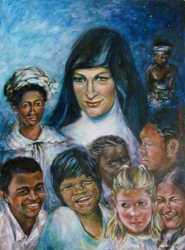
July 15--Bl. Anne-Marie Javouhey, Religious and Foundress


“If at first you don’t succeed, try, try again.” We have all heard this aphorism many times in our lives. It speaks to the virtue of perseverance, which “signifies the steadfast pursuit of a goal despite facing obstacles, delays, or difficulties” and is a strength in the virtue category of courage. This is perhaps the single most important characteristic of today’s saint, Bl. Anne-Marie Javouhey.

Born in France in 1779 just before the French Revolution, she dedicated her life to care for children of all races. In 1801 she and her three natural sisters ran a school for poor children and “during the next decade she ran two day schools and an orphanage.” For many, that would be enough, but not for her. In 1812 she founded the Sisters of St. Joseph of Cluny. From these beginnings she expanded her ministry to missionary work in the French Caribbean and African colonies, including Senegal, Gambia, Sierra Leone, and French Guiana. At the request of the French government she prepared six hundred slaves for emancipation in French Guiana. “As each family was ready to be freed, Mother Javouhey arranged for them to have money, some land, and a cottage." She also faced and overcame episcopal opposition, including prohibition of reception of the sacraments for two years.

The motto she gave her sisters illustrated her entire mission: The Holy Will of God. She said, “I am in God’s hands, ready to do God’s Will as soon as it is revealed to me.” Thus she can guide us according to Jesus’ own words for us as we pray to the Father: “Thy will be done.” To do God’s will is our bread, our life, and our calling to holiness. She died in 1851 and was beatified in 1950. Bl. Anne-Marie Javouhey, pray for us!


Monday, June 30, 2025

July 8--Sts. Priscilla and Aquila, Holy Married Couple


Pope Benedict XVI gave a General Audience on Saints Priscilla and Aquila, spouses, in February of 2007:

“Based on the information in our possession, this married couple played a very active role in the post-Paschal origins of the Church.

“When Paul wrote the First Letter to the Corinthians from Ephesus, together with his own greeting he explicitly sent those of ‘Aquila and Prisca, together with the church in their house’ (16: 19).

“Hence, we come to know the most important role that this couple played in the environment of the primitive Church: that of welcoming in their own house the group of local Christians when they gathered to listen to the Word of God and to celebrate the Eucharist.

“In the house of Aquila and Priscilla, therefore, the Church gathered, the convocation of Christ, which celebrates here the Sacred Mysteries.

“This couple in particular demonstrates how important the action of Christian spouses is. When they are supported by the faith and by a strong spirituality, their courageous commitment for the Church and in the Church becomes natural. The daily sharing of their life prolongs and in some way is sublimated in the assuming of a common responsibility in favour of the Mystical Body of Christ, even if just a little part of it. Thus it was in the first generation and thus it will often be.

“A further lesson we cannot neglect to draw from their example: every home can transform itself into a little church. Not only in the sense that in them must reign the typical Christian love made of altruism and of reciprocal care, but still more in the sense that the whole of family life, based on faith, is called to revolve around the singular lordship of Jesus Christ.”

Sts. Priscilla and Aquila, pray for us!

Monday, June 23, 2025

July 4--Bl. Pier Giorgio Frasatti, Third Order Dominican


An ordinary man is going to be canonized! He wasn’t a cleric. He did no miracles in his lifetime. He wasn’t a visionary or a mystic. He went to school to become an engineer. He helped the poor. He was a mountain climber. He protested against injustice. He opposed Italian fascism. He is Bl. Pier Giorgio Frassati. St. John Paul II said he was a “man of the Beatitudes,” “a young man filled with a joy that swept everything along with it, a joy that also overcame many difficulties in his life”. Pope Francis said: “Pier Giorgio said that he wanted to return the love of Jesus that he received in Holy Communion by visiting and helping the poor.”

Frassati (1901-1925) was the son of an agnostic newspaper publisher and an artist. He became a member of the Catholic Federation of University Students and Catholic Action in Italy as a college student and also a member of the Third Order Dominicans. “He often said: ‘Charity is not enough; we need social reform’. He helped establish a newspaper entitled Momento whose principles were based on Pope Leo XIII's Rerum novarum.” He died of polio in 1925. “His parents expected Turin's elite and political figures to come to offer their condolences and attend the funeral and expected to find many of his friends there as well. All were surprised to find the streets lined with thousands of mourners as the cortege passed out of the reverence felt for him among the people he had helped.”

Bl. Pier Giorgio Frassati was an ordinary man with an extraordinary dedication to God, love, and holiness. This is the purpose of canonization, to show that God’s love can be exemplified in our normal, everyday lives by loving others extraordinarily. Bl. Pier Giorgio Frassati, pray for us!

Sunday, June 8, 2025

June 16--St. Lutgardis, Religious


“Catholic Christians traditionally recognize June as the month of the Sacred Heart of Jesus. During this time, we call to mind Christ’s love for us, which is visible in a special way in the image of His pierced heart, and we pray that our own hearts might be conformed to His, calling us to love and respect all His people” (USCCB). St. Lutgardis is considered one of the saints who had a devotion to the Sacred Heart long before it was recognized in the Church as hers was the first recorded mystical revelation about the Sacred Heart.

St. Lutgardis was born in Tongeren, Belgium, in 1182 and died in 1246. She was sent to the convent at the age of twelve because her father lost her dowry in a bad business deal and thus could not afford to have her married according to the customs of the time. It was only later, when she had a vision of Jesus with his wounds, that she actually became a Benedictine nun. Still later, she joined the Cistercians, which followed a stricter observance of the Rule of St. Benedict. One vision was specifically about the Sacred Heart of Jesus. Jesus asked her what gift she would like to receive instead of the one she previously asked for. “‘Lord,’ said Lutgarde, ‘I would exchange it for your Heart.’ Christ then reached into Lutgarde and, removing her heart, replaced it with his own, at the same time hiding her heart within his breast.”

The Sacred Heart of Jesus is a profound reminder of God’s love for us through Jesus’ sacrifice: “For God so loved the world that he gave his only Son, so that everyone who believes in him might not perish but might have eternal life” (Jn. 3:16). St. Lutgardis, pray for us!

Sunday, June 1, 2025

June 8--St. Melania the Elder, Holy Woman


Many people ask what role women had in the early Church since they couldn’t be ordained. Luke tells us that Jesus was supported financially by women: “Afterward he journeyed from one town and village to another, preaching and proclaiming the good news of the kingdom of God. Accompanying him were the Twelve and some women who had been cured of evil spirits and infirmities, Mary, called Magdalene, from whom seven demons had gone out, Joanna, the wife of Herod’s steward Chuza, Susanna, and many others who provided for them out of their resources” (Lk. 8:1-3).

This is also true of today’s saint, St. Melania the Elder (born about 325, died about 410-417). She was from a high Roman family and became “one of the wealthiest citizens of the empire.” She was a convert and became known for her generosity and holiness. “She was one of the first Roman women to visit the Holy Land.” After her husband died she visited North Africa and presented a desert monastery with chests of silver. From there she went to Jerusalem and founded a convent and a monastery. She spent thirty-five years in the Holy Land. Her kinsman, St. Paulinus of Nola, wrote of her: “What a woman she is, if it is permissible to call such a manly Christian a woman! . . . she loftily cast herself down to a humble way of life, so that as a strong member of the weak sex she might censure indolent men.”

This may sound sexist. However, it is not a matter of sexism to insist that holiness can be attained by everyone, including women! The holiest person, after Jesus himself, is Mary, our beloved Mother. St. Melania expressed her holiness through humility and generosity, gifts God gave to her.

St. Melania the Elder, pray for us!

Monday, May 26, 2025

June 2–St. Marcellinus and Peter, Priest and Exorcist, Martyrs


“To us, also, your servants, who, though sinners, hope in your abundant mercies, graciously grant some share and fellowship with your holy apostles and martyrs: with John the Baptist, Stephen, Matthias, Barnabas, (Ignatius, Alexander, Marcellinus, Peter, Felicity, Perpetua, Agatha, Lucy, Agnes, Cecilia, Anastasia) and all your saints; admit us, we beseech you, into their company, not weighing our merits, but granting us your pardon, through Christ our Lord.”

This is part of the First Eucharistic Prayer, the oldest eucharistic prayer in the Latin Rite. It contains the names of many saints, especially of martyrs, including Marcellinus and Peter. A catacomb outside Rome is named for them.

“The catacomb of Saints Marcellinus and Peter derives its name from the two martyrs buried within it. The story behind the life of these two martyrs goes back to the time of the Emperor Diocletian. St. Marcellinus and St. Peter were slain during the persecution of 304 AD - beheaded, in Rome. Before being killed, however, they were forced to dig their tomb with their own hands. The site of the terrible martyrdom of the two saints was known as ‘Selva Nera’ (meaning ‘Black Forest’), but after their death it was renamed ‘Selva Candida’, that is ‘White Forest’, along Via Cornelia.

“It was thanks to a Roman matron, who went with the name of Lucilla, that the bodies of the two martyrs were brought to Via Casilina, at the site called ad Duas Lauros. With the translocation of the saints’ bodies, the Christian cemetery, already in use, was dedicated in their memory.” (http://www.catacombeditalia.va)

Martyrs are the heroes of the faith, the men and women who gave their lives for their love of Christ. We honor them in our prayers and we ask for their prayers. Sts. Marcellinus and Peter, pray for us.